

331
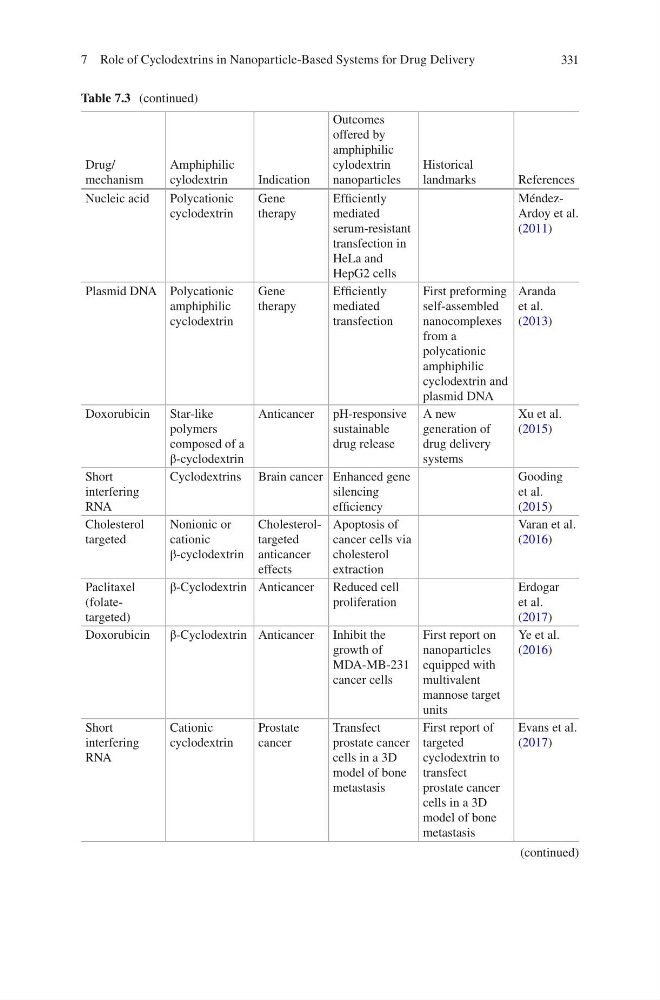
Table 7.3 (continued)
Drug/
mechanism
Amphiphilic
cylodextrin
Indication
Outcomes
offered by
amphiphilic
cylodextrin
nanoparticles
Historical
landmarks
References
Nucleic acid
Polycationic
cyclodextrin
Gene
therapy
Efficiently
mediated
serum-resistant
transfection in
HeLa and
HepG2 cells
MéndezArdoy et al.
(2011)
Plasmid DNA Polycationic
amphiphilic
cyclodextrin
Gene
therapy
Efficiently
mediated
transfection
First preforming
self-assembled
nanocomplexes
from a
polycationic
amphiphilic
cyclodextrin and
plasmid DNA
Aranda
et al.
(2013)
Doxorubicin
Star-like
polymers
composed of a
β-cyclodextrin
Anticancer pH-responsive
sustainable
drug release
A new
generation of
drug delivery
systems
Xu et al.
(2015)
Short
interfering
RNA
Cyclodextrins Brain cancer Enhanced gene
silencing
efficiency
Gooding
et al.
(2015)
Cholesterol
targeted
Nonionic or
cationic
β-cyclodextrin
Cholesteroltargeted
anticancer
effects
Apoptosis of
cancer cells via
cholesterol
extraction
Varan et al.
(2016)
Paclitaxel
(folatetargeted)
β-Cyclodextrin Anticancer Reduced cell
proliferation
Erdogar
et al.
(2017)
Doxorubicin
β-Cyclodextrin Anticancer Inhibit the
growth of
MDA-MB-231
cancer cells
First report on
nanoparticles
equipped with
multivalent
mannose target
units
Ye et al.
(2016)
Short
interfering
RNA
Cationic
cyclodextrin
Prostate
cancer
Transfect
prostate cancer
cells in a 3D
model of bone
metastasis
First report of
targeted
cyclodextrin to
transfect
prostate cancer
cells in a 3D
model of bone
metastasis
Evans et al.
(2017)
(continued)
7 Role of Cyclodextrins in Nanoparticle-Based Systems for Drug Delivery
Table 7.3 (continued)
Drug/
mechanism
Amphiphilic
cylodextrin
Indication
Outcomes
offered by
amphiphilic
cylodextrin
nanoparticles
Historical
landmarks
References
Nucleic acid
Polycationic
cyclodextrin
Gene
therapy
Efficiently
mediated
serum-resistant
transfection in
HeLa and
HepG2 cells
MéndezArdoy et al.
(2011)
Plasmid DNA Polycationic
amphiphilic
cyclodextrin
Gene
therapy
Efficiently
mediated
transfection
First preforming
self-assembled
nanocomplexes
from a
polycationic
amphiphilic
cyclodextrin and
plasmid DNA
Aranda
et al.
(2013)
Doxorubicin
Star-like
polymers
composed of a
β-cyclodextrin
Anticancer pH-responsive
sustainable
drug release
A new
generation of
drug delivery
systems
Xu et al.
(2015)
Short
interfering
RNA
Cyclodextrins Brain cancer Enhanced gene
silencing
efficiency
Gooding
et al.
(2015)
Cholesterol
targeted
Nonionic or
cationic
β-cyclodextrin
Cholesteroltargeted
anticancer
effects
Apoptosis of
cancer cells via
cholesterol
extraction
Varan et al.
(2016)
Paclitaxel
(folatetargeted)
β-Cyclodextrin Anticancer Reduced cell
proliferation
Erdogar
et al.
(2017)
Doxorubicin
β-Cyclodextrin Anticancer Inhibit the
growth of
MDA-MB-231
cancer cells
First report on
nanoparticles
equipped with
multivalent
mannose target
units
Ye et al.
(2016)
Short
interfering
RNA
Cationic
cyclodextrin
Prostate
cancer
Transfect
prostate cancer
cells in a 3D
model of bone
metastasis
First report of
targeted
cyclodextrin to
transfect
prostate cancer
cells in a 3D
model of bone
metastasis
Evans et al.
(2017)
(continued)
7 Role of Cyclodextrins in Nanoparticle-Based Systems for Drug Delivery