

317
effects on the patients. Additionally, numerous anticancer agents have poor solubility and stability in the aqueous and biological system. Several researchers have
developed some novel approaches to ensure the safe and effective delivery of such
chemotherapeutic agents. Cyclodextrins can be associated with iron oxide magnetic
nanoparticles to increase their stability and dispersion in water. Anirudhan et al.
(2015) have developed magnetic nanoparticles of anticancer drug 5-fluorouracil,
which is used to treat breast, stomach, and lung cancer and has detrimental effects
on normal cells, as it is not targeted specifically for the tumor cells. The authors
prepared 3-methacryloxypropyltrimethoxysilane-coated magnetic nanoparticles
polymerized with glycidylmethacrylate-grafted-maleated cyclodextrin in the presence of ethylene glycol dimethacrylate as cross-linker and a′-azobisisobutyronitrile
as initiator. The prepared nanoparticles exhibited significant antimicrobial activity
against gram-positive and gram-negative bacteria. The cytotoxicity studies were
also performed using MCF-7 (human breast carcinoma) cells and observed that
prepared nanoparticles are biocompatible and provide sustained and controlled
release of drugs to the targeted site. To overcome the hindrances of earlier reported
methods of targeted drug delivery, Enoch et al. (2018) synthesized β-cyclodextrinbased magnetic nanoparticles. Briefly, manganese ferrite nanoparticles were synthesized by coating with β-cyclodextrin-modified polyethylene glycol as a vehicle
for the anticancer drug camptothecin. The fabricated nanoparticles showed superparamagnetic behavior. Further research showed that coating the magnetic nanoparticles with the cyclodextrin-tethered polymer improves the drug loading capacity
and sustained drug release. Additionally, cytotoxicity is also enhanced when the
drug is incorporated in the polymer-coated magnetic nanoparticles.
Nowadays mild acid response nanodrug delivery system has been gaining attention in the research of drug delivery based on the responsive property to the abnormal physiological environment and to the normal physiological environment.
However, it lacks the site-specific action. In light of these facts, Wang et al. (2018)
fabricated a magnetic and pH-sensitive composite nanoparticulate system prepared
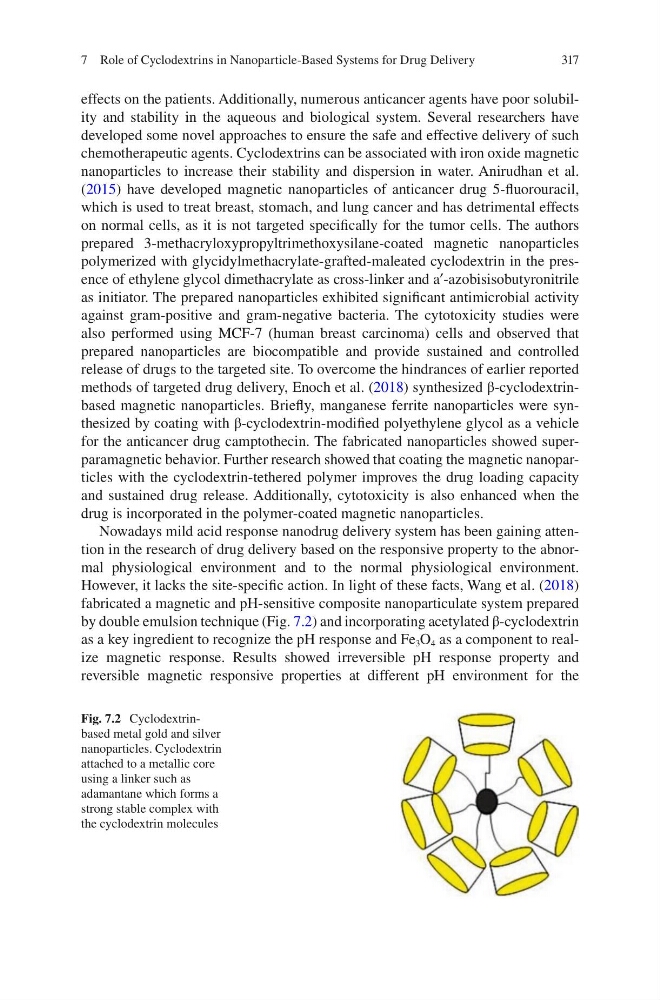
by double emulsion technique (Fig. 7.2) and incorporating acetylated β-cyclodextrin
as a key ingredient to recognize the pH response and Fe 3 O 4 as a component to realize magnetic response. Results showed irreversible pH response property and
reversible magnetic responsive properties at different pH environment for the
Fig. 7.2 Cyclodextrinbased metal gold and silver
nanoparticles. Cyclodextrin
attached to a metallic core
using a linker such as
adamantane which forms a
strong stable complex with
the cyclodextrin molecules
7 Role of Cyclodextrins in Nanoparticle-Based Systems for Drug Delivery
effects on the patients. Additionally, numerous anticancer agents have poor solubility and stability in the aqueous and biological system. Several researchers have
developed some novel approaches to ensure the safe and effective delivery of such
chemotherapeutic agents. Cyclodextrins can be associated with iron oxide magnetic
nanoparticles to increase their stability and dispersion in water. Anirudhan et al.
(2015) have developed magnetic nanoparticles of anticancer drug 5-fluorouracil,
which is used to treat breast, stomach, and lung cancer and has detrimental effects
on normal cells, as it is not targeted specifically for the tumor cells. The authors
prepared 3-methacryloxypropyltrimethoxysilane-coated magnetic nanoparticles
polymerized with glycidylmethacrylate-grafted-maleated cyclodextrin in the presence of ethylene glycol dimethacrylate as cross-linker and a′-azobisisobutyronitrile
as initiator. The prepared nanoparticles exhibited significant antimicrobial activity
against gram-positive and gram-negative bacteria. The cytotoxicity studies were
also performed using MCF-7 (human breast carcinoma) cells and observed that
prepared nanoparticles are biocompatible and provide sustained and controlled
release of drugs to the targeted site. To overcome the hindrances of earlier reported
methods of targeted drug delivery, Enoch et al. (2018) synthesized β-cyclodextrinbased magnetic nanoparticles. Briefly, manganese ferrite nanoparticles were synthesized by coating with β-cyclodextrin-modified polyethylene glycol as a vehicle
for the anticancer drug camptothecin. The fabricated nanoparticles showed superparamagnetic behavior. Further research showed that coating the magnetic nanoparticles with the cyclodextrin-tethered polymer improves the drug loading capacity
and sustained drug release. Additionally, cytotoxicity is also enhanced when the
drug is incorporated in the polymer-coated magnetic nanoparticles.
Nowadays mild acid response nanodrug delivery system has been gaining attention in the research of drug delivery based on the responsive property to the abnormal physiological environment and to the normal physiological environment.
However, it lacks the site-specific action. In light of these facts, Wang et al. (2018)
fabricated a magnetic and pH-sensitive composite nanoparticulate system prepared
by double emulsion technique (Fig. 7.2) and incorporating acetylated β-cyclodextrin
as a key ingredient to recognize the pH response and Fe 3 O 4 as a component to realize magnetic response. Results showed irreversible pH response property and
reversible magnetic responsive properties at different pH environment for the
Fig. 7.2 Cyclodextrinbased metal gold and silver
nanoparticles. Cyclodextrin
attached to a metallic core
using a linker such as
adamantane which forms a
strong stable complex with
the cyclodextrin molecules
7 Role of Cyclodextrins in Nanoparticle-Based Systems for Drug Delivery