

19
Freudenberg (Freudenberg 1934, 1939, 1943, 1955, 1957a, b; Freudenberg and
Jacobi 1935; Freudenberg and Rapp 1936; Freudenberg et al. 1936, 1938, 1939,
1947a, b, 1953; Freudenberg and Meyer-Delius 1938, 1939; Freudenberg and
Cramer 1948, 1950). From 1922, Freudenberg was attracted by Schardinger dextrins since he wanted to obtain information on the degradation products of starch to
be able to elucidate its structure (Freudenberg and Ivers 1922). For Freudenberg,
Schardinger dextrins were first laboratory curiosities and/or unwanted by-products
of starch degradation (Freudenberg 1934), and their chain molecules were intermediate between maltose and starch with non-reducing end groups. Indeed, it is only
at the end of the 1930s that Freudenberg concluded that the dextrin-α and dextrin-β
molecules were cyclic. In 1935, α-dextrin was considered as a mixture of chain
molecules containing 4–5 D-glucose units (Freudenberg and Jacobi 1935). Using
results of constructing molecular models with the monomer units in a boat rather
than a chain conformation, the dextrins were lined with a hydrocarbon interior. One
year later, studying the nature of the glycosidic bonds, Freudenberg showed that the
dextrins gave rotation-time curves closely parallel to those given by starch and the
rigid models such as Kekulé model did not allow free rotation about the individual
bonds (Freudenberg and Rapp 1936). The presence of a Konstellation, i.e., a ring
conformation, is suggested, and in 1936, Freudenberg hypothesized that Α-dextrin
and β-dextrin have a cyclic structure (Freudenberg et al. 1936). During 2 years, he
tried to prove it. On the basis of results obtained from methylation reactions and
enzymatic hydrolysis of the dextrins, Freudenberg came, in 1938, to the “same conclusion” as Schardinger, Karrer, Pringsheim, and Miekeley, concerning the cyclic
chemical structure of Α-dextrin and β-dextrin (Freudenberg and Meyer-Delius
1938; Freudenberg et al. 1938). Ten years later, Freudenberg and his doctoral student Cramer finally demonstrated his conclusion using optical activity data
(Freudenberg and Cramer 1948). Schardinger dextrins had a cyclic structure composed of maltose units bound together by α-(1→4) glycosidic linkages. At that time,
both French and Borchert also confirmed the cyclic structure of dextrins by X-ray
crystallography (French et al. 1948; Borchert 1948). However, although Freudenberg
had determined for the first time the correct chemical structure for the Schardinger
dextrins, the number of D-glucosyl residues that he gave for the α- and β-dextrin
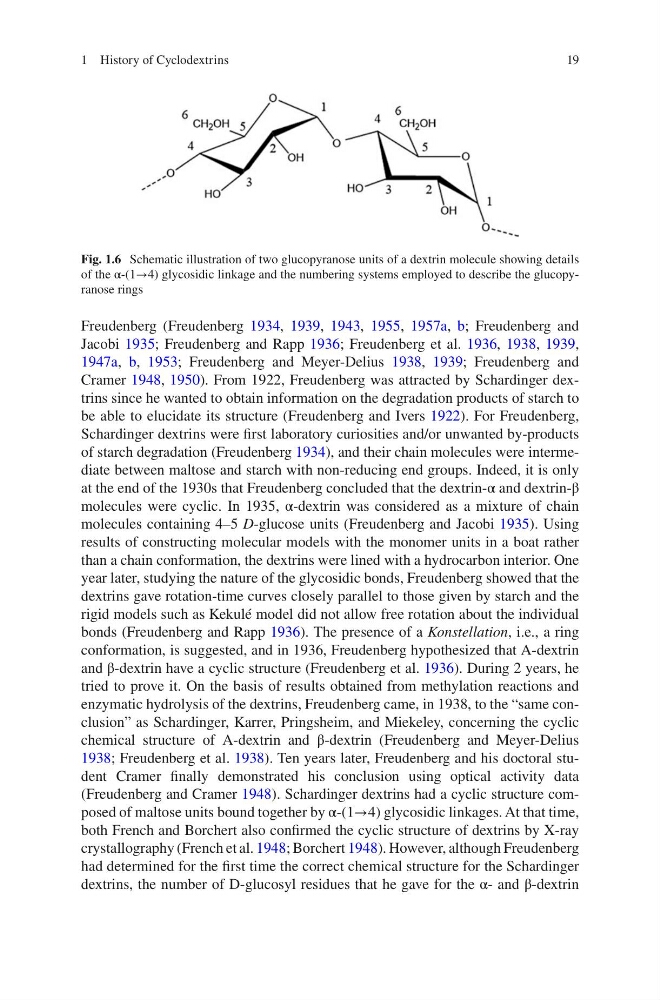
Fig. 1.6 Schematic illustration of two glucopyranose units of a dextrin molecule showing details
of the α-(1→4) glycosidic linkage and the numbering systems employed to describe the glucopyranose rings
1 History of Cyclodextrins
Freudenberg (Freudenberg 1934, 1939, 1943, 1955, 1957a, b; Freudenberg and
Jacobi 1935; Freudenberg and Rapp 1936; Freudenberg et al. 1936, 1938, 1939,
1947a, b, 1953; Freudenberg and Meyer-Delius 1938, 1939; Freudenberg and
Cramer 1948, 1950). From 1922, Freudenberg was attracted by Schardinger dextrins since he wanted to obtain information on the degradation products of starch to
be able to elucidate its structure (Freudenberg and Ivers 1922). For Freudenberg,
Schardinger dextrins were first laboratory curiosities and/or unwanted by-products
of starch degradation (Freudenberg 1934), and their chain molecules were intermediate between maltose and starch with non-reducing end groups. Indeed, it is only
at the end of the 1930s that Freudenberg concluded that the dextrin-α and dextrin-β
molecules were cyclic. In 1935, α-dextrin was considered as a mixture of chain
molecules containing 4–5 D-glucose units (Freudenberg and Jacobi 1935). Using
results of constructing molecular models with the monomer units in a boat rather
than a chain conformation, the dextrins were lined with a hydrocarbon interior. One
year later, studying the nature of the glycosidic bonds, Freudenberg showed that the
dextrins gave rotation-time curves closely parallel to those given by starch and the
rigid models such as Kekulé model did not allow free rotation about the individual
bonds (Freudenberg and Rapp 1936). The presence of a Konstellation, i.e., a ring
conformation, is suggested, and in 1936, Freudenberg hypothesized that Α-dextrin
and β-dextrin have a cyclic structure (Freudenberg et al. 1936). During 2 years, he
tried to prove it. On the basis of results obtained from methylation reactions and
enzymatic hydrolysis of the dextrins, Freudenberg came, in 1938, to the “same conclusion” as Schardinger, Karrer, Pringsheim, and Miekeley, concerning the cyclic
chemical structure of Α-dextrin and β-dextrin (Freudenberg and Meyer-Delius
1938; Freudenberg et al. 1938). Ten years later, Freudenberg and his doctoral student Cramer finally demonstrated his conclusion using optical activity data
(Freudenberg and Cramer 1948). Schardinger dextrins had a cyclic structure composed of maltose units bound together by α-(1→4) glycosidic linkages. At that time,
both French and Borchert also confirmed the cyclic structure of dextrins by X-ray
crystallography (French et al. 1948; Borchert 1948). However, although Freudenberg
had determined for the first time the correct chemical structure for the Schardinger
dextrins, the number of D-glucosyl residues that he gave for the α- and β-dextrin
Fig. 1.6 Schematic illustration of two glucopyranose units of a dextrin molecule showing details
of the α-(1→4) glycosidic linkage and the numbering systems employed to describe the glucopyranose rings
1 History of Cyclodextrins