

286
polymer synthesis. Its two reactive functional groups (epoxide group and a chlorine
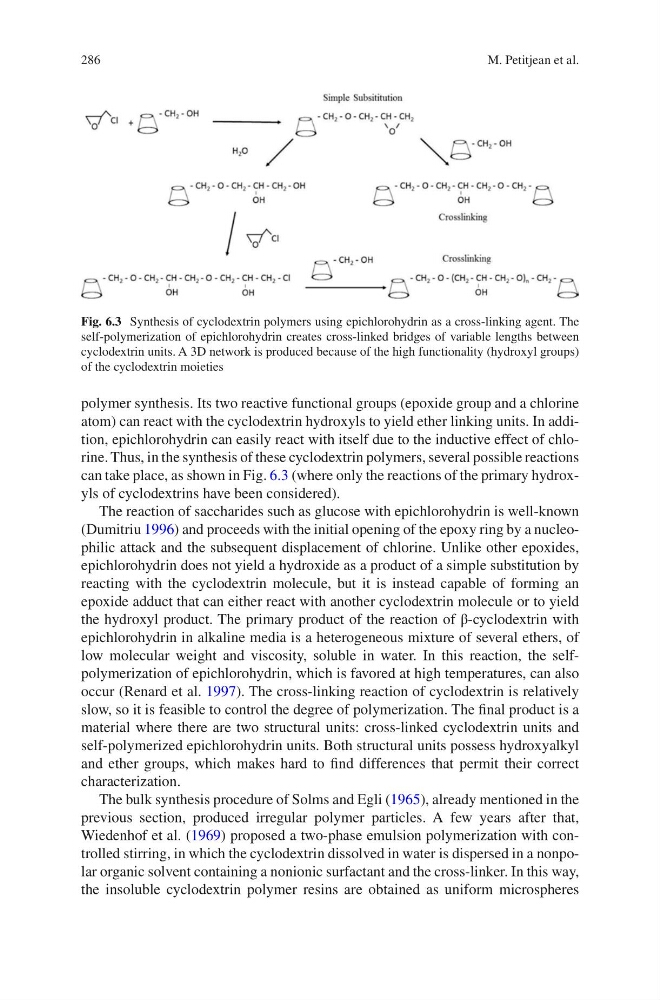
atom) can react with the cyclodextrin hydroxyls to yield ether linking units. In addition, epichlorohydrin can easily react with itself due to the inductive effect of chlorine. Thus, in the synthesis of these cyclodextrin polymers, several possible reactions
can take place, as shown in Fig. 6.3 (where only the reactions of the primary hydroxyls of cyclodextrins have been considered).
The reaction of saccharides such as glucose with epichlorohydrin is well-known
(Dumitriu 1996) and proceeds with the initial opening of the epoxy ring by a nucleophilic attack and the subsequent displacement of chlorine. Unlike other epoxides,
epichlorohydrin does not yield a hydroxide as a product of a simple substitution by
reacting with the cyclodextrin molecule, but it is instead capable of forming an
epoxide adduct that can either react with another cyclodextrin molecule or to yield
the hydroxyl product. The primary product of the reaction of β-cyclodextrin with
epichlorohydrin in alkaline media is a heterogeneous mixture of several ethers, of
low molecular weight and viscosity, soluble in water. In this reaction, the selfpolymerization of epichlorohydrin, which is favored at high temperatures, can also
occur (Renard et al. 1997). The cross-linking reaction of cyclodextrin is relatively
slow, so it is feasible to control the degree of polymerization. The final product is a
material where there are two structural units: cross-linked cyclodextrin units and
self-polymerized epichlorohydrin units. Both structural units possess hydroxyalkyl
and ether groups, which makes hard to find differences that permit their correct
characterization.
The bulk synthesis procedure of Solms and Egli (1965), already mentioned in the
previous section, produced irregular polymer particles. A few years after that,
Wiedenhof et al. (1969) proposed a two-phase emulsion polymerization with controlled stirring, in which the cyclodextrin dissolved in water is dispersed in a nonpolar organic solvent containing a nonionic surfactant and the cross-linker. In this way,
the insoluble cyclodextrin polymer resins are obtained as uniform microspheres
Fig. 6.3 Synthesis of cyclodextrin polymers using epichlorohydrin as a cross-linking agent. The
self-polymerization of epichlorohydrin creates cross-linked bridges of variable lengths between
cyclodextrin units. A 3D network is produced because of the high functionality (hydroxyl groups)
of the cyclodextrin moieties
M. Petitjean et al.
polymer synthesis. Its two reactive functional groups (epoxide group and a chlorine
atom) can react with the cyclodextrin hydroxyls to yield ether linking units. In addition, epichlorohydrin can easily react with itself due to the inductive effect of chlorine. Thus, in the synthesis of these cyclodextrin polymers, several possible reactions
can take place, as shown in Fig. 6.3 (where only the reactions of the primary hydroxyls of cyclodextrins have been considered).
The reaction of saccharides such as glucose with epichlorohydrin is well-known
(Dumitriu 1996) and proceeds with the initial opening of the epoxy ring by a nucleophilic attack and the subsequent displacement of chlorine. Unlike other epoxides,
epichlorohydrin does not yield a hydroxide as a product of a simple substitution by
reacting with the cyclodextrin molecule, but it is instead capable of forming an
epoxide adduct that can either react with another cyclodextrin molecule or to yield
the hydroxyl product. The primary product of the reaction of β-cyclodextrin with
epichlorohydrin in alkaline media is a heterogeneous mixture of several ethers, of
low molecular weight and viscosity, soluble in water. In this reaction, the selfpolymerization of epichlorohydrin, which is favored at high temperatures, can also
occur (Renard et al. 1997). The cross-linking reaction of cyclodextrin is relatively
slow, so it is feasible to control the degree of polymerization. The final product is a
material where there are two structural units: cross-linked cyclodextrin units and
self-polymerized epichlorohydrin units. Both structural units possess hydroxyalkyl
and ether groups, which makes hard to find differences that permit their correct
characterization.
The bulk synthesis procedure of Solms and Egli (1965), already mentioned in the
previous section, produced irregular polymer particles. A few years after that,
Wiedenhof et al. (1969) proposed a two-phase emulsion polymerization with controlled stirring, in which the cyclodextrin dissolved in water is dispersed in a nonpolar organic solvent containing a nonionic surfactant and the cross-linker. In this way,
the insoluble cyclodextrin polymer resins are obtained as uniform microspheres
Fig. 6.3 Synthesis of cyclodextrin polymers using epichlorohydrin as a cross-linking agent. The
self-polymerization of epichlorohydrin creates cross-linked bridges of variable lengths between
cyclodextrin units. A 3D network is produced because of the high functionality (hydroxyl groups)
of the cyclodextrin moieties
M. Petitjean et al.