

269
Shen et al. (2013) synthesized a composite material based on reduced graphene
oxide rGO/β-cyclodextrin/TiO 2 in a one-pot hydrothermal strategy. FTIR analysis
clearly showed that β-cyclodextrin molecules were still attached to the surface of
rGO. Moreover, by transmission electron microscopy, the author explained that the
sheets tend to form small aggregates due to the cross-linked rGO sheets with
β-cyclodextrin molecules. In this composite material, β-cyclodextrin acted as a
linker between rGO and TiO 2 nanoparticles. The photocatalytic and adsorption efficiencies are higher than rGO/TiO 2 or rGO/β-cyclodextrin materials which can be
explained by the interactions between the three components.
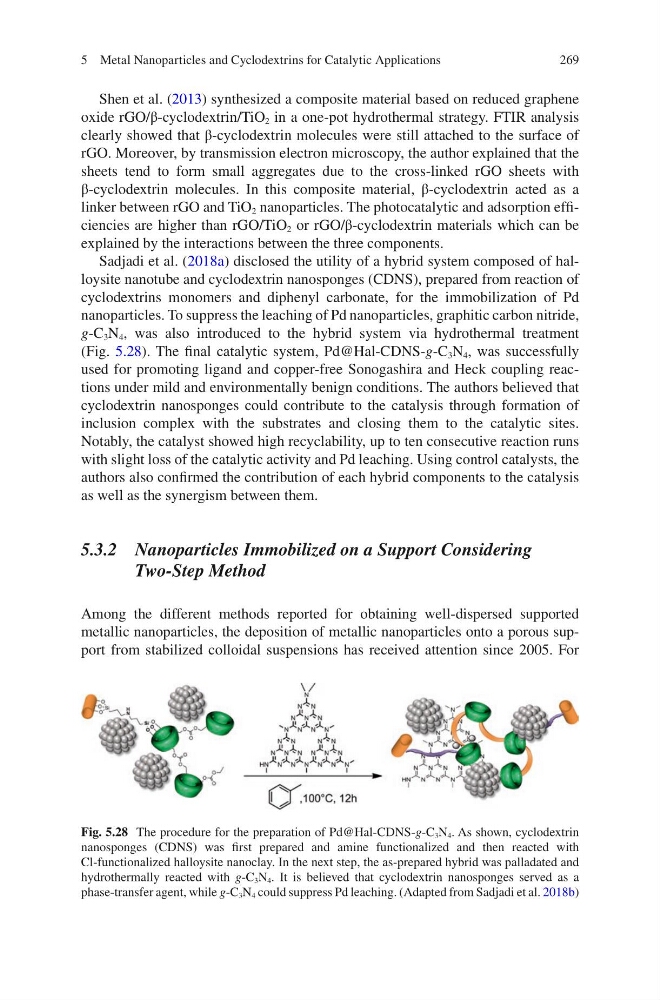
Sadjadi et al. (2018a) disclosed the utility of a hybrid system composed of halloysite nanotube and cyclodextrin nanosponges (CDNS), prepared from reaction of
cyclodextrins monomers and diphenyl carbonate, for the immobilization of Pd
nanoparticles. To suppress the leaching of Pd nanoparticles, graphitic carbon nitride,
g-C 3 N 4 , was also introduced to the hybrid system via hydrothermal treatment
(Fig. 5.28). The final catalytic system, Pd@Hal-CDNS-g-C 3 N 4 , was successfully
used for promoting ligand and copper-free Sonogashira and Heck coupling reactions under mild and environmentally benign conditions. The authors believed that
cyclodextrin nanosponges could contribute to the catalysis through formation of
inclusion complex with the substrates and closing them to the catalytic sites.
Notably, the catalyst showed high recyclability, up to ten consecutive reaction runs
with slight loss of the catalytic activity and Pd leaching. Using control catalysts, the
authors also confirmed the contribution of each hybrid components to the catalysis
as well as the synergism between them.
5.3.2 Nanoparticles Immobilized on a Support Considering
Two-Step Method
Among the different methods reported for obtaining well-dispersed supported
metallic nanoparticles, the deposition of metallic nanoparticles onto a porous support from stabilized colloidal suspensions has received attention since 2005. For
Fig. 5.28 The procedure for the preparation of Pd@Hal-CDNS-g-C 3 N 4 . As shown, cyclodextrin
nanosponges (CDNS) was first prepared and amine functionalized and then reacted with
Cl-functionalized halloysite nanoclay. In the next step, the as-prepared hybrid was palladated and
hydrothermally reacted with g-C 3 N 4 . It is believed that cyclodextrin nanosponges served as a
phase-transfer agent, while g-C 3 N 4 could suppress Pd leaching. (Adapted from Sadjadi et al. 2018b)
5 Metal Nanoparticles and Cyclodextrins for Catalytic Applications
Shen et al. (2013) synthesized a composite material based on reduced graphene
oxide rGO/β-cyclodextrin/TiO 2 in a one-pot hydrothermal strategy. FTIR analysis
clearly showed that β-cyclodextrin molecules were still attached to the surface of
rGO. Moreover, by transmission electron microscopy, the author explained that the
sheets tend to form small aggregates due to the cross-linked rGO sheets with
β-cyclodextrin molecules. In this composite material, β-cyclodextrin acted as a
linker between rGO and TiO 2 nanoparticles. The photocatalytic and adsorption efficiencies are higher than rGO/TiO 2 or rGO/β-cyclodextrin materials which can be
explained by the interactions between the three components.
Sadjadi et al. (2018a) disclosed the utility of a hybrid system composed of halloysite nanotube and cyclodextrin nanosponges (CDNS), prepared from reaction of
cyclodextrins monomers and diphenyl carbonate, for the immobilization of Pd
nanoparticles. To suppress the leaching of Pd nanoparticles, graphitic carbon nitride,
g-C 3 N 4 , was also introduced to the hybrid system via hydrothermal treatment
(Fig. 5.28). The final catalytic system, Pd@Hal-CDNS-g-C 3 N 4 , was successfully
used for promoting ligand and copper-free Sonogashira and Heck coupling reactions under mild and environmentally benign conditions. The authors believed that
cyclodextrin nanosponges could contribute to the catalysis through formation of
inclusion complex with the substrates and closing them to the catalytic sites.
Notably, the catalyst showed high recyclability, up to ten consecutive reaction runs
with slight loss of the catalytic activity and Pd leaching. Using control catalysts, the
authors also confirmed the contribution of each hybrid components to the catalysis
as well as the synergism between them.
5.3.2 Nanoparticles Immobilized on a Support Considering
Two-Step Method
Among the different methods reported for obtaining well-dispersed supported
metallic nanoparticles, the deposition of metallic nanoparticles onto a porous support from stabilized colloidal suspensions has received attention since 2005. For
Fig. 5.28 The procedure for the preparation of Pd@Hal-CDNS-g-C 3 N 4 . As shown, cyclodextrin
nanosponges (CDNS) was first prepared and amine functionalized and then reacted with
Cl-functionalized halloysite nanoclay. In the next step, the as-prepared hybrid was palladated and
hydrothermally reacted with g-C 3 N 4 . It is believed that cyclodextrin nanosponges served as a
phase-transfer agent, while g-C 3 N 4 could suppress Pd leaching. (Adapted from Sadjadi et al. 2018b)
5 Metal Nanoparticles and Cyclodextrins for Catalytic Applications