

266
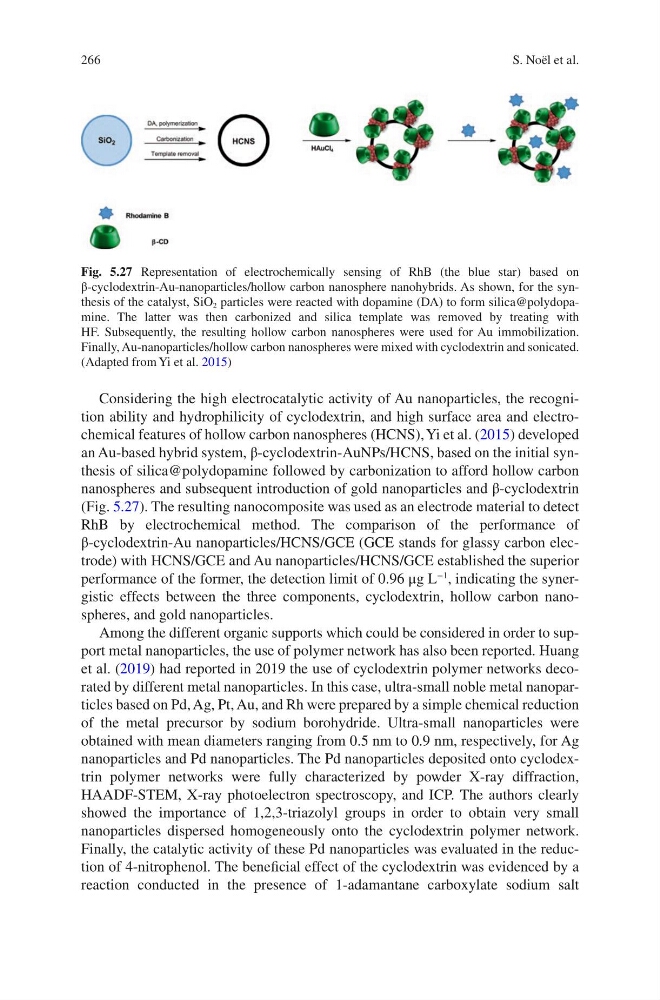
Considering the high electrocatalytic activity of Au nanoparticles, the recognition ability and hydrophilicity of cyclodextrin, and high surface area and electrochemical features of hollow carbon nanospheres (HCNS), Yi et al. (2015) developed
an Au-based hybrid system, β-cyclodextrin-AuNPs/HCNS, based on the initial synthesis of silica@polydopamine followed by carbonization to afford hollow carbon
nanospheres and subsequent introduction of gold nanoparticles and β-cyclodextrin
(Fig. 5.27). The resulting nanocomposite was used as an electrode material to detect
RhB by electrochemical method. The comparison of the performance of
β-cyclodextrin-Au nanoparticles/HCNS/GCE (GCE stands for glassy carbon electrode) with HCNS/GCE and Au nanoparticles/HCNS/GCE established the superior
performance of the former, the detection limit of 0.96 μg L
−1
, indicating the synergistic effects between the three components, cyclodextrin, hollow carbon nanospheres, and gold nanoparticles.
Among the different organic supports which could be considered in order to support metal nanoparticles, the use of polymer network has also been reported. Huang
et al. (2019) had reported in 2019 the use of cyclodextrin polymer networks decorated by different metal nanoparticles. In this case, ultra-small noble metal nanoparticles based on Pd, Ag, Pt, Au, and Rh were prepared by a simple chemical reduction
of the metal precursor by sodium borohydride. Ultra-small nanoparticles were
obtained with mean diameters ranging from 0.5 nm to 0.9 nm, respectively, for Ag
nanoparticles and Pd nanoparticles. The Pd nanoparticles deposited onto cyclodextrin polymer networks were fully characterized by powder X-ray diffraction,
HAADF-STEM, X-ray photoelectron spectroscopy, and ICP. The authors clearly
showed the importance of 1,2,3-triazolyl groups in order to obtain very small
nanoparticles dispersed homogeneously onto the cyclodextrin polymer network.
Finally, the catalytic activity of these Pd nanoparticles was evaluated in the reduction of 4-nitrophenol. The beneficial effect of the cyclodextrin was evidenced by a
reaction conducted in the presence of 1-adamantane carboxylate sodium salt
Fig. 5.27 Representation of electrochemically sensing of RhB (the blue star) based on
β-cyclodextrin-Au-nanoparticles/hollow carbon nanosphere nanohybrids. As shown, for the synthesis of the catalyst, SiO 2 particles were reacted with dopamine (DA) to form silica@polydopamine. The latter was then carbonized and silica template was removed by treating with
HF. Subsequently, the resulting hollow carbon nanospheres were used for Au immobilization.
Finally, Au-nanoparticles/hollow carbon nanospheres were mixed with cyclodextrin and sonicated.
(Adapted from Yi et al. 2015)
S. Noël et al.
Considering the high electrocatalytic activity of Au nanoparticles, the recognition ability and hydrophilicity of cyclodextrin, and high surface area and electrochemical features of hollow carbon nanospheres (HCNS), Yi et al. (2015) developed
an Au-based hybrid system, β-cyclodextrin-AuNPs/HCNS, based on the initial synthesis of silica@polydopamine followed by carbonization to afford hollow carbon
nanospheres and subsequent introduction of gold nanoparticles and β-cyclodextrin
(Fig. 5.27). The resulting nanocomposite was used as an electrode material to detect
RhB by electrochemical method. The comparison of the performance of
β-cyclodextrin-Au nanoparticles/HCNS/GCE (GCE stands for glassy carbon electrode) with HCNS/GCE and Au nanoparticles/HCNS/GCE established the superior
performance of the former, the detection limit of 0.96 μg L
−1
, indicating the synergistic effects between the three components, cyclodextrin, hollow carbon nanospheres, and gold nanoparticles.
Among the different organic supports which could be considered in order to support metal nanoparticles, the use of polymer network has also been reported. Huang
et al. (2019) had reported in 2019 the use of cyclodextrin polymer networks decorated by different metal nanoparticles. In this case, ultra-small noble metal nanoparticles based on Pd, Ag, Pt, Au, and Rh were prepared by a simple chemical reduction
of the metal precursor by sodium borohydride. Ultra-small nanoparticles were
obtained with mean diameters ranging from 0.5 nm to 0.9 nm, respectively, for Ag
nanoparticles and Pd nanoparticles. The Pd nanoparticles deposited onto cyclodextrin polymer networks were fully characterized by powder X-ray diffraction,
HAADF-STEM, X-ray photoelectron spectroscopy, and ICP. The authors clearly
showed the importance of 1,2,3-triazolyl groups in order to obtain very small
nanoparticles dispersed homogeneously onto the cyclodextrin polymer network.
Finally, the catalytic activity of these Pd nanoparticles was evaluated in the reduction of 4-nitrophenol. The beneficial effect of the cyclodextrin was evidenced by a
reaction conducted in the presence of 1-adamantane carboxylate sodium salt
Fig. 5.27 Representation of electrochemically sensing of RhB (the blue star) based on
β-cyclodextrin-Au-nanoparticles/hollow carbon nanosphere nanohybrids. As shown, for the synthesis of the catalyst, SiO 2 particles were reacted with dopamine (DA) to form silica@polydopamine. The latter was then carbonized and silica template was removed by treating with
HF. Subsequently, the resulting hollow carbon nanospheres were used for Au immobilization.
Finally, Au-nanoparticles/hollow carbon nanospheres were mixed with cyclodextrin and sonicated.
(Adapted from Yi et al. 2015)
S. Noël et al.