

258
means inorganic supports or organic supports. It could be done regarding two different ways of preparation: (1) the one-pot method where the synthesis of nanoparticles is realized in the presence of the support and (2) the two-step method where the
synthesis of nanoparticles is realized before the addition of the support. Whatever
the strategy which will be considered, the multiple roles of the cyclodextrin
described in the first part of this chapter related to the synthesis of the nanocatalysts
and also to the catalytic processes will be further discussed in this part. All of the
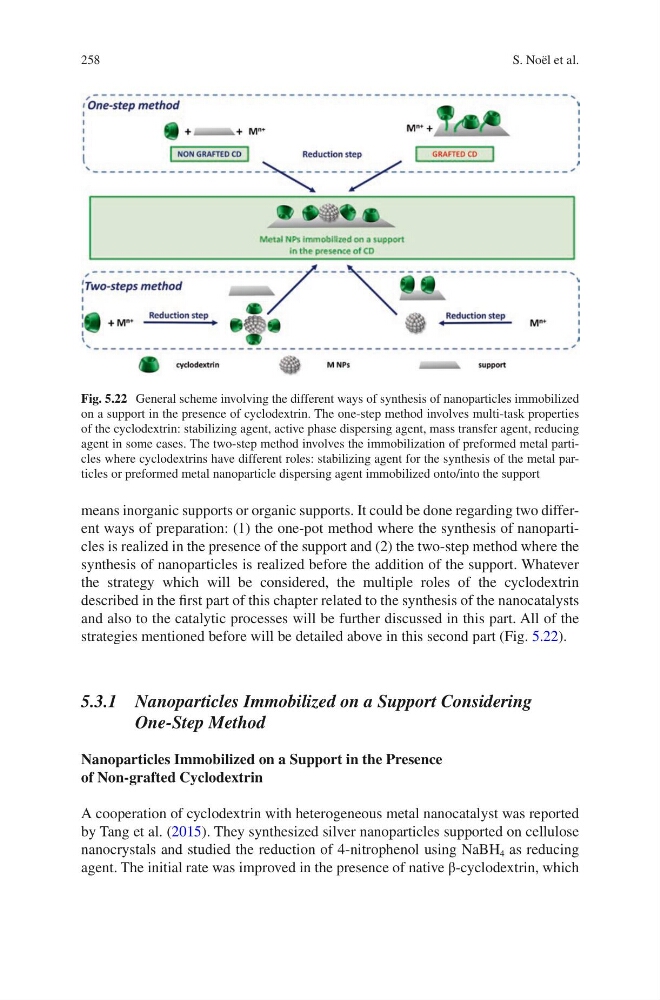
strategies mentioned before will be detailed above in this second part (Fig. 5.22).
5.3.1 Nanoparticles Immobilized on a Support Considering
One-Step Method
Nanoparticles Immobilized on a Support in the Presence
of Non-grafted Cyclodextrin
A cooperation of cyclodextrin with heterogeneous metal nanocatalyst was reported
by Tang et al. (2015). They synthesized silver nanoparticles supported on cellulose
nanocrystals and studied the reduction of 4-nitrophenol using NaBH 4 as reducing
agent. The initial rate was improved in the presence of native β-cyclodextrin, which
Fig. 5.22 General scheme involving the different ways of synthesis of nanoparticles immobilized
on a support in the presence of cyclodextrin. The one-step method involves multi-task properties
of the cyclodextrin: stabilizing agent, active phase dispersing agent, mass transfer agent, reducing
agent in some cases. The two-step method involves the immobilization of preformed metal particles where cyclodextrins have different roles: stabilizing agent for the synthesis of the metal particles or preformed metal nanoparticle dispersing agent immobilized onto/into the support
S. Noël et al.
means inorganic supports or organic supports. It could be done regarding two different ways of preparation: (1) the one-pot method where the synthesis of nanoparticles is realized in the presence of the support and (2) the two-step method where the
synthesis of nanoparticles is realized before the addition of the support. Whatever
the strategy which will be considered, the multiple roles of the cyclodextrin
described in the first part of this chapter related to the synthesis of the nanocatalysts
and also to the catalytic processes will be further discussed in this part. All of the
strategies mentioned before will be detailed above in this second part (Fig. 5.22).
5.3.1 Nanoparticles Immobilized on a Support Considering
One-Step Method
Nanoparticles Immobilized on a Support in the Presence
of Non-grafted Cyclodextrin
A cooperation of cyclodextrin with heterogeneous metal nanocatalyst was reported
by Tang et al. (2015). They synthesized silver nanoparticles supported on cellulose
nanocrystals and studied the reduction of 4-nitrophenol using NaBH 4 as reducing
agent. The initial rate was improved in the presence of native β-cyclodextrin, which
Fig. 5.22 General scheme involving the different ways of synthesis of nanoparticles immobilized
on a support in the presence of cyclodextrin. The one-step method involves multi-task properties
of the cyclodextrin: stabilizing agent, active phase dispersing agent, mass transfer agent, reducing
agent in some cases. The two-step method involves the immobilization of preformed metal particles where cyclodextrins have different roles: stabilizing agent for the synthesis of the metal particles or preformed metal nanoparticle dispersing agent immobilized onto/into the support
S. Noël et al.