

252
formation of the cis isomer (51% vs. 100% for dppbs and dppbs/5.0 cyclodextrin,
respectively).
Nanoparticles Stabilized by Dendrimers
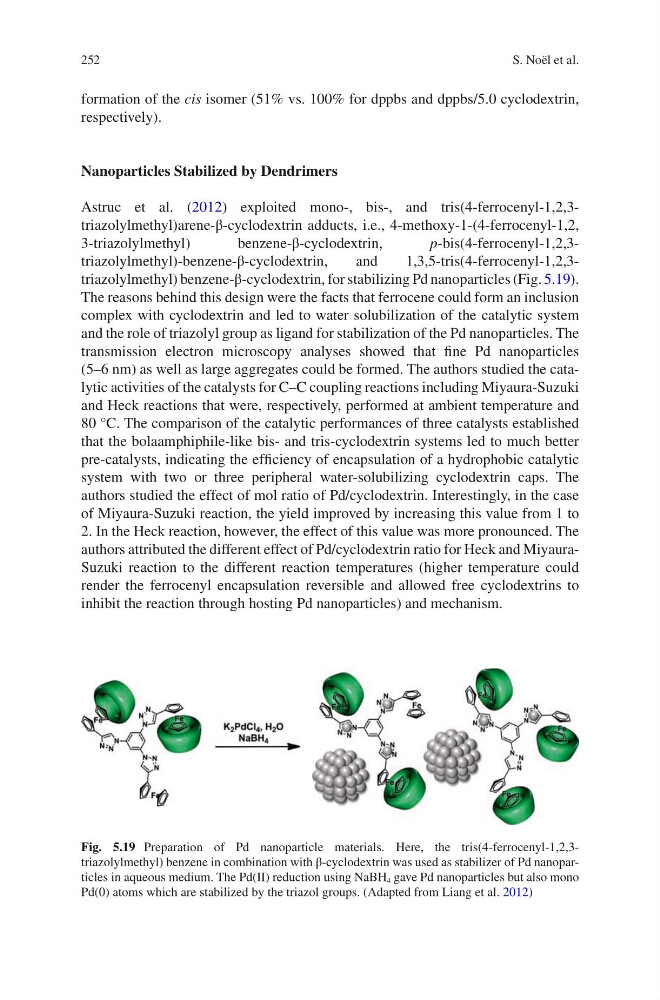
Astruc et al. (2012) exploited mono-, bis-, and tris(4-ferrocenyl-1,2,3triazolylmethyl)arene-β-cyclodextrin adducts, i.e., 4-methoxy-1-(4- ferrocenyl-1,2,
3- triazolylmethyl)
benzene-β-cyclodextrin,
p-bis(4-ferrocenyl-1,2,3triazolylmethyl)-benzene-β-cyclodextrin,
and
1,3,5-tris(4- ferrocenyl- 1,2,3triazolylmethyl) benzene-β-cyclodextrin, for stabilizing Pd nanoparticles (Fig. 5.19).
The reasons behind this design were the facts that ferrocene could form an inclusion
complex with cyclodextrin and led to water solubilization of the catalytic system
and the role of triazolyl group as ligand for stabilization of the Pd nanoparticles. The
transmission electron microscopy analyses showed that fine Pd nanoparticles
(5–6 nm) as well as large aggregates could be formed. The authors studied the catalytic activities of the catalysts for C–C coupling reactions including Miyaura-Suzuki
and Heck reactions that were, respectively, performed at ambient temperature and
80 °C. The comparison of the catalytic performances of three catalysts established
that the bolaamphiphile-like bis- and tris-cyclodextrin systems led to much better
pre-catalysts, indicating the efficiency of encapsulation of a hydrophobic catalytic
system with two or three peripheral water-solubilizing cyclodextrin caps. The
authors studied the effect of mol ratio of Pd/cyclodextrin. Interestingly, in the case
of Miyaura-Suzuki reaction, the yield improved by increasing this value from 1 to
2. In the Heck reaction, however, the effect of this value was more pronounced. The
authors attributed the different effect of Pd/cyclodextrin ratio for Heck and MiyauraSuzuki reaction to the different reaction temperatures (higher temperature could
render the ferrocenyl encapsulation reversible and allowed free cyclodextrins to
inhibit the reaction through hosting Pd nanoparticles) and mechanism.
Fig. 5.19 Preparation of Pd nanoparticle materials. Here, the tris(4-ferrocenyl-1,2,3triazolylmethyl) benzene in combination with β-cyclodextrin was used as stabilizer of Pd nanoparticles in aqueous medium. The Pd(II) reduction using NaBH 4 gave Pd nanoparticles but also mono
Pd(0) atoms which are stabilized by the triazol groups. (Adapted from Liang et al. 2012)
S. Noël et al.
formation of the cis isomer (51% vs. 100% for dppbs and dppbs/5.0 cyclodextrin,
respectively).
Nanoparticles Stabilized by Dendrimers
Astruc et al. (2012) exploited mono-, bis-, and tris(4-ferrocenyl-1,2,3triazolylmethyl)arene-β-cyclodextrin adducts, i.e., 4-methoxy-1-(4- ferrocenyl-1,2,
3- triazolylmethyl)
benzene-β-cyclodextrin,
p-bis(4-ferrocenyl-1,2,3triazolylmethyl)-benzene-β-cyclodextrin,
and
1,3,5-tris(4- ferrocenyl- 1,2,3triazolylmethyl) benzene-β-cyclodextrin, for stabilizing Pd nanoparticles (Fig. 5.19).
The reasons behind this design were the facts that ferrocene could form an inclusion
complex with cyclodextrin and led to water solubilization of the catalytic system
and the role of triazolyl group as ligand for stabilization of the Pd nanoparticles. The
transmission electron microscopy analyses showed that fine Pd nanoparticles
(5–6 nm) as well as large aggregates could be formed. The authors studied the catalytic activities of the catalysts for C–C coupling reactions including Miyaura-Suzuki
and Heck reactions that were, respectively, performed at ambient temperature and
80 °C. The comparison of the catalytic performances of three catalysts established
that the bolaamphiphile-like bis- and tris-cyclodextrin systems led to much better
pre-catalysts, indicating the efficiency of encapsulation of a hydrophobic catalytic
system with two or three peripheral water-solubilizing cyclodextrin caps. The
authors studied the effect of mol ratio of Pd/cyclodextrin. Interestingly, in the case
of Miyaura-Suzuki reaction, the yield improved by increasing this value from 1 to
2. In the Heck reaction, however, the effect of this value was more pronounced. The
authors attributed the different effect of Pd/cyclodextrin ratio for Heck and MiyauraSuzuki reaction to the different reaction temperatures (higher temperature could
render the ferrocenyl encapsulation reversible and allowed free cyclodextrins to
inhibit the reaction through hosting Pd nanoparticles) and mechanism.
Fig. 5.19 Preparation of Pd nanoparticle materials. Here, the tris(4-ferrocenyl-1,2,3triazolylmethyl) benzene in combination with β-cyclodextrin was used as stabilizer of Pd nanoparticles in aqueous medium. The Pd(II) reduction using NaBH 4 gave Pd nanoparticles but also mono
Pd(0) atoms which are stabilized by the triazol groups. (Adapted from Liang et al. 2012)
S. Noël et al.