

224
functions. In addition to the conventional host-guest interaction-based properties,
the gold nanoparticles stabilized by these cyclodextrins showed interesting catalytic
activities and exhibited mimicking properties of both glucose oxidase and horseradish peroxidase. Especially, the cascade reaction (oxidation of glucose with generation of gluconic acid and H 2 O 2 followed by the oxidation of TMB
(3,3′,5,5′-tetramethylbenzidine)) was well-achieved using the Au nanoparticles as
the sole catalyst.
Several cucurbit[n]urils and native cyclodextrins were used as stabilizers of
metastable gold nanoparticles, i.e., gold nanoparticles synthesized by chemical
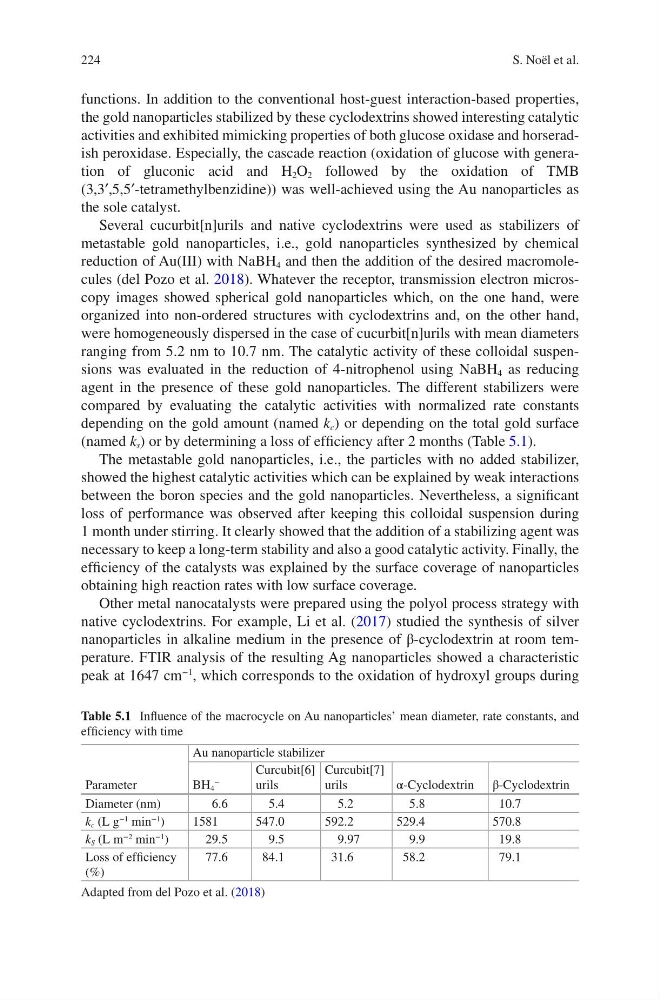
reduction of Au(III) with NaBH 4 and then the addition of the desired macromolecules (del Pozo et al. 2018). Whatever the receptor, transmission electron microscopy images showed spherical gold nanoparticles which, on the one hand, were
organized into non-ordered structures with cyclodextrins and, on the other hand,
were homogeneously dispersed in the case of cucurbit[n]urils with mean diameters
ranging from 5.2 nm to 10.7 nm. The catalytic activity of these colloidal suspensions was evaluated in the reduction of 4-nitrophenol using NaBH 4 as reducing
agent in the presence of these gold nanoparticles. The different stabilizers were
compared by evaluating the catalytic activities with normalized rate constants
depending on the gold amount (named k c ) or depending on the total gold surface
(named k s ) or by determining a loss of efficiency after 2 months (Table 5.1).
The metastable gold nanoparticles, i.e., the particles with no added stabilizer,
showed the highest catalytic activities which can be explained by weak interactions
between the boron species and the gold nanoparticles. Nevertheless, a significant
loss of performance was observed after keeping this colloidal suspension during
1 month under stirring. It clearly showed that the addition of a stabilizing agent was
necessary to keep a long-term stability and also a good catalytic activity. Finally, the
efficiency of the catalysts was explained by the surface coverage of nanoparticles
obtaining high reaction rates with low surface coverage.
Other metal nanocatalysts were prepared using the polyol process strategy with
native cyclodextrins. For example, Li et al. (2017) studied the synthesis of silver
nanoparticles in alkaline medium in the presence of β-cyclodextrin at room temperature. FTIR analysis of the resulting Ag nanoparticles showed a characteristic
peak at 1647 cm
−1
, which corresponds to the oxidation of hydroxyl groups during
Table 5.1 Influence of the macrocycle on Au nanoparticles’ mean diameter, rate constants, and
efficiency with time
Parameter
Au nanoparticle stabilizer
BH 4
−
Curcubit[6]
urils
Curcubit[7]
urils
α-Cyclodextrin β-Cyclodextrin
Diameter (nm)
6.6
5.4
5.2
5.8
10.7
k c (L g
−1
min
−1 )
1581
547.0
592.2
529.4
570.8
k S (L m
−2
min
−1
)
29.5
9.5
9.97
9.9
19.8
Loss of efficiency
(%)
77.6
84.1
31.6
58.2
79.1
Adapted from del Pozo et al. (2018)
S. Noël et al.
functions. In addition to the conventional host-guest interaction-based properties,
the gold nanoparticles stabilized by these cyclodextrins showed interesting catalytic
activities and exhibited mimicking properties of both glucose oxidase and horseradish peroxidase. Especially, the cascade reaction (oxidation of glucose with generation of gluconic acid and H 2 O 2 followed by the oxidation of TMB
(3,3′,5,5′-tetramethylbenzidine)) was well-achieved using the Au nanoparticles as
the sole catalyst.
Several cucurbit[n]urils and native cyclodextrins were used as stabilizers of
metastable gold nanoparticles, i.e., gold nanoparticles synthesized by chemical
reduction of Au(III) with NaBH 4 and then the addition of the desired macromolecules (del Pozo et al. 2018). Whatever the receptor, transmission electron microscopy images showed spherical gold nanoparticles which, on the one hand, were
organized into non-ordered structures with cyclodextrins and, on the other hand,
were homogeneously dispersed in the case of cucurbit[n]urils with mean diameters
ranging from 5.2 nm to 10.7 nm. The catalytic activity of these colloidal suspensions was evaluated in the reduction of 4-nitrophenol using NaBH 4 as reducing
agent in the presence of these gold nanoparticles. The different stabilizers were
compared by evaluating the catalytic activities with normalized rate constants
depending on the gold amount (named k c ) or depending on the total gold surface
(named k s ) or by determining a loss of efficiency after 2 months (Table 5.1).
The metastable gold nanoparticles, i.e., the particles with no added stabilizer,
showed the highest catalytic activities which can be explained by weak interactions
between the boron species and the gold nanoparticles. Nevertheless, a significant
loss of performance was observed after keeping this colloidal suspension during
1 month under stirring. It clearly showed that the addition of a stabilizing agent was
necessary to keep a long-term stability and also a good catalytic activity. Finally, the
efficiency of the catalysts was explained by the surface coverage of nanoparticles
obtaining high reaction rates with low surface coverage.
Other metal nanocatalysts were prepared using the polyol process strategy with
native cyclodextrins. For example, Li et al. (2017) studied the synthesis of silver
nanoparticles in alkaline medium in the presence of β-cyclodextrin at room temperature. FTIR analysis of the resulting Ag nanoparticles showed a characteristic
peak at 1647 cm
−1
, which corresponds to the oxidation of hydroxyl groups during
Table 5.1 Influence of the macrocycle on Au nanoparticles’ mean diameter, rate constants, and
efficiency with time
Parameter
Au nanoparticle stabilizer
BH 4
−
Curcubit[6]
urils
Curcubit[7]
urils
α-Cyclodextrin β-Cyclodextrin
Diameter (nm)
6.6
5.4
5.2
5.8
10.7
k c (L g
−1
min
−1 )
1581
547.0
592.2
529.4
570.8
k S (L m
−2
min
−1
)
29.5
9.5
9.97
9.9
19.8
Loss of efficiency
(%)
77.6
84.1
31.6
58.2
79.1
Adapted from del Pozo et al. (2018)
S. Noël et al.