

222
5.2 Nanoparticles Stabilized by Cyclodextrins in Solution
5.2.1 Nanoparticles Stabilized by Native Cyclodextrins
The first example of the synthesis of metal nanoparticles stabilized by native cyclodextrins (α-cyclodextrin, β-cyclodextrin, and γ-cyclodextrin) was reported by
Komiyama and Hirai (1983). An aqueous Rh(III) salt solution in the presence of
native cyclodextrin and ethanol was refluxed in order to give Rh nanoparticles. The
stability of the resulting particles was associated to the ability of the cyclodextrin to
prevent aggregation via strong hydrophobic interactions between the cyclodextrin
cavity and the metal surface. β-cyclodextrin gave the best colloidal dispersion with
a Rh average diameter of 2.8 nm. When γ-cyclodextrin was used, no colloidal suspension was observed, and sedimentation took place. The resulting Rh particles
stabilized by β-cyclodextrin were then evaluated in the catalytic hydrogenation of
water-soluble α,β-conjugated carbonyls under mild experimental conditions (30 °C,
1 bar of hydrogen) with the catalytic activities ranging from 0.06 to 0.24 molH 2
g(Rh)
−1
s
−1
. The role of β-cyclodextrin was highlighted by observing no activity for
the hydrogenation of 3-buten-2-one in the presence of cyclohexanol that was a competing guest forming an inclusion complex with β-cyclodextrin.
The ability of β-cyclodextrin to stabilize solvent-dispersed metal colloids was
also observed by Willner in 1987 by synthesizing TiO 2 and CdS nanoparticles with,
respectively, an average diameter of 8 nm and 10 nm (Mandler and Willner 1987).
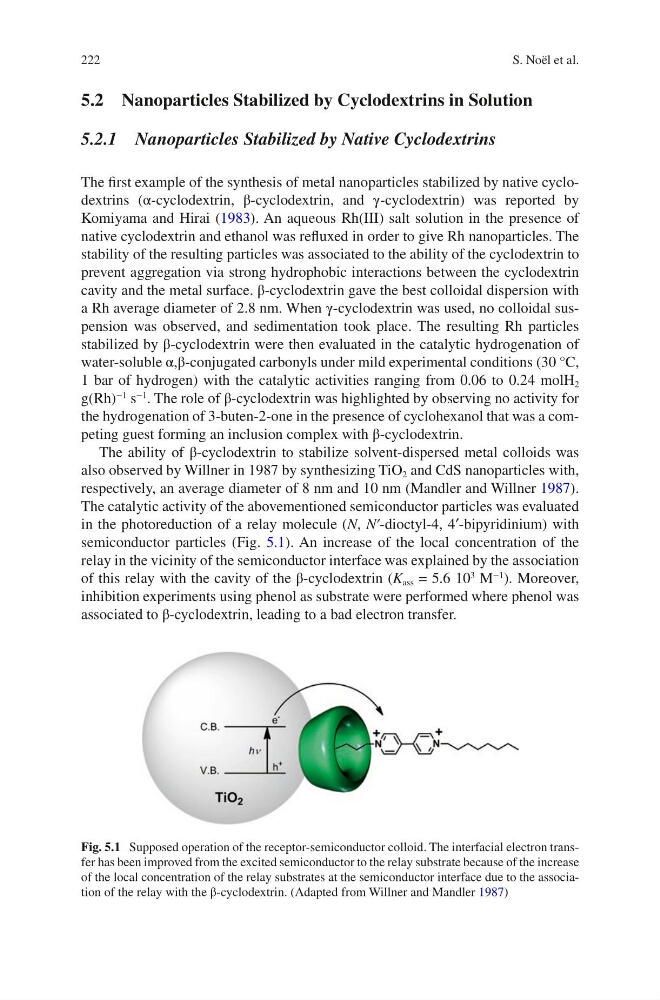
The catalytic activity of the abovementioned semiconductor particles was evaluated
in the photoreduction of a relay molecule (N, N′-dioctyl-4, 4′-bipyridinium) with
semiconductor particles (Fig. 5.1). An increase of the local concentration of the
relay in the vicinity of the semiconductor interface was explained by the association
of this relay with the cavity of the β-cyclodextrin (K ass = 5.6 10
3
M
−1
). Moreover,
inhibition experiments using phenol as substrate were performed where phenol was
associated to β-cyclodextrin, leading to a bad electron transfer.
Fig. 5.1 Supposed operation of the receptor-semiconductor colloid. The interfacial electron transfer has been improved from the excited semiconductor to the relay substrate because of the increase
of the local concentration of the relay substrates at the semiconductor interface due to the association of the relay with the β-cyclodextrin. (Adapted from Willner and Mandler 1987)
S. Noël et al.
5.2 Nanoparticles Stabilized by Cyclodextrins in Solution
5.2.1 Nanoparticles Stabilized by Native Cyclodextrins
The first example of the synthesis of metal nanoparticles stabilized by native cyclodextrins (α-cyclodextrin, β-cyclodextrin, and γ-cyclodextrin) was reported by
Komiyama and Hirai (1983). An aqueous Rh(III) salt solution in the presence of
native cyclodextrin and ethanol was refluxed in order to give Rh nanoparticles. The
stability of the resulting particles was associated to the ability of the cyclodextrin to
prevent aggregation via strong hydrophobic interactions between the cyclodextrin
cavity and the metal surface. β-cyclodextrin gave the best colloidal dispersion with
a Rh average diameter of 2.8 nm. When γ-cyclodextrin was used, no colloidal suspension was observed, and sedimentation took place. The resulting Rh particles
stabilized by β-cyclodextrin were then evaluated in the catalytic hydrogenation of
water-soluble α,β-conjugated carbonyls under mild experimental conditions (30 °C,
1 bar of hydrogen) with the catalytic activities ranging from 0.06 to 0.24 molH 2
g(Rh)
−1
s
−1
. The role of β-cyclodextrin was highlighted by observing no activity for
the hydrogenation of 3-buten-2-one in the presence of cyclohexanol that was a competing guest forming an inclusion complex with β-cyclodextrin.
The ability of β-cyclodextrin to stabilize solvent-dispersed metal colloids was
also observed by Willner in 1987 by synthesizing TiO 2 and CdS nanoparticles with,
respectively, an average diameter of 8 nm and 10 nm (Mandler and Willner 1987).
The catalytic activity of the abovementioned semiconductor particles was evaluated
in the photoreduction of a relay molecule (N, N′-dioctyl-4, 4′-bipyridinium) with
semiconductor particles (Fig. 5.1). An increase of the local concentration of the
relay in the vicinity of the semiconductor interface was explained by the association
of this relay with the cavity of the β-cyclodextrin (K ass = 5.6 10
3
M
−1
). Moreover,
inhibition experiments using phenol as substrate were performed where phenol was
associated to β-cyclodextrin, leading to a bad electron transfer.
Fig. 5.1 Supposed operation of the receptor-semiconductor colloid. The interfacial electron transfer has been improved from the excited semiconductor to the relay substrate because of the increase
of the local concentration of the relay substrates at the semiconductor interface due to the association of the relay with the β-cyclodextrin. (Adapted from Willner and Mandler 1987)
S. Noël et al.