

208
under atmospheric pressure. Once the reaction was completed, the base was removed
by neutralization with sulfuric acid and by cation exchange resin. The solution was
concentrated by evaporation, then diluted by 2–4-carbon-atom glycols, then evaporated again, and finally diluted with alcohol and acetone to remove polypropylene
glycol by-products. The precipitated salt was removed by filtration, and the final
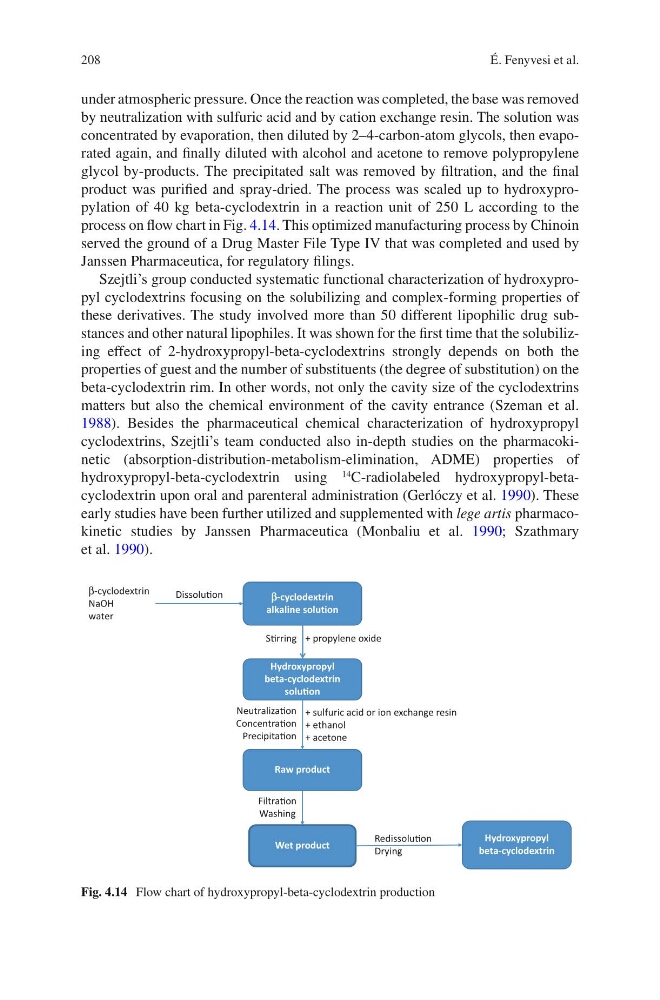
product was purified and spray-dried. The process was scaled up to hydroxypropylation of 40 kg beta-cyclodextrin in a reaction unit of 250 L according to the
process on flow chart in Fig. 4.14. This optimized manufacturing process by Chinoin
served the ground of a Drug Master File Type IV that was completed and used by
Janssen Pharmaceutica, for regulatory filings.
Szejtli’s group conducted systematic functional characterization of hydroxypropyl cyclodextrins focusing on the solubilizing and complex-forming properties of
these derivatives. The study involved more than 50 different lipophilic drug substances and other natural lipophiles. It was shown for the first time that the solubilizing effect of 2-hydroxypropyl-beta-cyclodextrins strongly depends on both the
properties of guest and the number of substituents (the degree of substitution) on the
beta-cyclodextrin rim. In other words, not only the cavity size of the cyclodextrins
matters but also the chemical environment of the cavity entrance (Szeman et al.
1988). Besides the pharmaceutical chemical characterization of hydroxypropyl
cyclodextrins, Szejtli’s team conducted also in-depth studies on the pharmacokinetic (absorption-distribution-metabolism-elimination, ADME) properties of
hydroxypropyl-beta-cyclodextrin using
14
C-radiolabeled hydroxypropyl-betacyclodextrin upon oral and parenteral administration (Gerlóczy et al. 1990). These
early studies have been further utilized and supplemented with lege artis pharmacokinetic studies by Janssen Pharmaceutica (Monbaliu et al. 1990; Szathmary
et al. 1990).
Raw product
Wet product
β-cyclodextrin
NaOH
water
b-cyclodextrin
alkaline solution
Hydroxypropyl
beta-cyclodextrin
DissoluƟon
Hydroxypropyl
beta-cyclodextrin
soluƟon
+ propylene oxide
SƟrring
+ sulfuric acid or ion exchange resin
+ ethanol
+ acetone
NeutralizaƟon
ConcentraƟon
PrecipitaƟon
FiltraƟon
Washing
RedissoluƟon
Drying
Fig. 4.14 Flow chart of hydroxypropyl-beta-cyclodextrin production
É. Fenyvesi et al.
under atmospheric pressure. Once the reaction was completed, the base was removed
by neutralization with sulfuric acid and by cation exchange resin. The solution was
concentrated by evaporation, then diluted by 2–4-carbon-atom glycols, then evaporated again, and finally diluted with alcohol and acetone to remove polypropylene
glycol by-products. The precipitated salt was removed by filtration, and the final
product was purified and spray-dried. The process was scaled up to hydroxypropylation of 40 kg beta-cyclodextrin in a reaction unit of 250 L according to the
process on flow chart in Fig. 4.14. This optimized manufacturing process by Chinoin
served the ground of a Drug Master File Type IV that was completed and used by
Janssen Pharmaceutica, for regulatory filings.
Szejtli’s group conducted systematic functional characterization of hydroxypropyl cyclodextrins focusing on the solubilizing and complex-forming properties of
these derivatives. The study involved more than 50 different lipophilic drug substances and other natural lipophiles. It was shown for the first time that the solubilizing effect of 2-hydroxypropyl-beta-cyclodextrins strongly depends on both the
properties of guest and the number of substituents (the degree of substitution) on the
beta-cyclodextrin rim. In other words, not only the cavity size of the cyclodextrins
matters but also the chemical environment of the cavity entrance (Szeman et al.
1988). Besides the pharmaceutical chemical characterization of hydroxypropyl
cyclodextrins, Szejtli’s team conducted also in-depth studies on the pharmacokinetic (absorption-distribution-metabolism-elimination, ADME) properties of
hydroxypropyl-beta-cyclodextrin using
14
C-radiolabeled hydroxypropyl-betacyclodextrin upon oral and parenteral administration (Gerlóczy et al. 1990). These
early studies have been further utilized and supplemented with lege artis pharmacokinetic studies by Janssen Pharmaceutica (Monbaliu et al. 1990; Szathmary
et al. 1990).
Raw product
Wet product
β-cyclodextrin
NaOH
water
b-cyclodextrin
alkaline solution
Hydroxypropyl
beta-cyclodextrin
DissoluƟon
Hydroxypropyl
beta-cyclodextrin
soluƟon
+ propylene oxide
SƟrring
+ sulfuric acid or ion exchange resin
+ ethanol
+ acetone
NeutralizaƟon
ConcentraƟon
PrecipitaƟon
FiltraƟon
Washing
RedissoluƟon
Drying
Fig. 4.14 Flow chart of hydroxypropyl-beta-cyclodextrin production
É. Fenyvesi et al.