

200
method was elimination of the total quantity of organic precipitant; therefore no
toxicity issues arose. On the other hand, the low capacity and high energy consumption required for the concentration of diluted solutions of cyclodextrins are drawbacks hindering the industrialization of this technology.
In consequence of the expensive multistep precipitation processes and chromatography, moreover the lack of industrial processing, both alpha- and gammacyclodextrins were available only as fine chemicals in the 1970s–1980s. In the
conversion step, various polycyclic compounds were applied as precipitating agent.
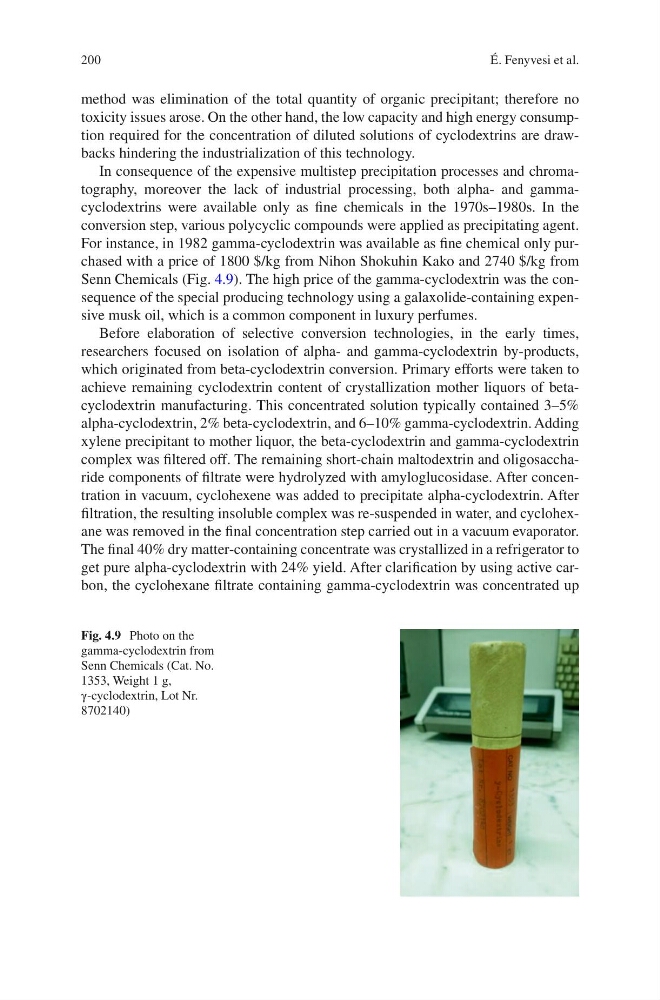
For instance, in 1982 gamma-cyclodextrin was available as fine chemical only purchased with a price of 1800 $/kg from Nihon Shokuhin Kako and 2740 $/kg from
Senn Chemicals (Fig. 4.9). The high price of the gamma-cyclodextrin was the consequence of the special producing technology using a galaxolide-containing expensive musk oil, which is a common component in luxury perfumes.
Before elaboration of selective conversion technologies, in the early times,
researchers focused on isolation of alpha- and gamma-cyclodextrin by-products,
which originated from beta-cyclodextrin conversion. Primary efforts were taken to
achieve remaining cyclodextrin content of crystallization mother liquors of betacyclodextrin manufacturing. This concentrated solution typically contained 3–5%
alpha-cyclodextrin, 2% beta-cyclodextrin, and 6–10% gamma-cyclodextrin. Adding
xylene precipitant to mother liquor, the beta-cyclodextrin and gamma-cyclodextrin
complex was filtered off. The remaining short-chain maltodextrin and oligosaccharide components of filtrate were hydrolyzed with amyloglucosidase. After concentration in vacuum, cyclohexene was added to precipitate alpha-cyclodextrin. After
filtration, the resulting insoluble complex was re-suspended in water, and cyclohexane was removed in the final concentration step carried out in a vacuum evaporator.
The final 40% dry matter-containing concentrate was crystallized in a refrigerator to
get pure alpha-cyclodextrin with 24% yield. After clarification by using active carbon, the cyclohexane filtrate containing gamma-cyclodextrin was concentrated up
Fig. 4.9 Photo on the
gamma-cyclodextrin from
Senn Chemicals (Cat. No.
1353, Weight 1 g,
γ-cyclodextrin, Lot Nr.
8702140)
É. Fenyvesi et al.
method was elimination of the total quantity of organic precipitant; therefore no
toxicity issues arose. On the other hand, the low capacity and high energy consumption required for the concentration of diluted solutions of cyclodextrins are drawbacks hindering the industrialization of this technology.
In consequence of the expensive multistep precipitation processes and chromatography, moreover the lack of industrial processing, both alpha- and gammacyclodextrins were available only as fine chemicals in the 1970s–1980s. In the
conversion step, various polycyclic compounds were applied as precipitating agent.
For instance, in 1982 gamma-cyclodextrin was available as fine chemical only purchased with a price of 1800 $/kg from Nihon Shokuhin Kako and 2740 $/kg from
Senn Chemicals (Fig. 4.9). The high price of the gamma-cyclodextrin was the consequence of the special producing technology using a galaxolide-containing expensive musk oil, which is a common component in luxury perfumes.
Before elaboration of selective conversion technologies, in the early times,
researchers focused on isolation of alpha- and gamma-cyclodextrin by-products,
which originated from beta-cyclodextrin conversion. Primary efforts were taken to
achieve remaining cyclodextrin content of crystallization mother liquors of betacyclodextrin manufacturing. This concentrated solution typically contained 3–5%
alpha-cyclodextrin, 2% beta-cyclodextrin, and 6–10% gamma-cyclodextrin. Adding
xylene precipitant to mother liquor, the beta-cyclodextrin and gamma-cyclodextrin
complex was filtered off. The remaining short-chain maltodextrin and oligosaccharide components of filtrate were hydrolyzed with amyloglucosidase. After concentration in vacuum, cyclohexene was added to precipitate alpha-cyclodextrin. After
filtration, the resulting insoluble complex was re-suspended in water, and cyclohexane was removed in the final concentration step carried out in a vacuum evaporator.
The final 40% dry matter-containing concentrate was crystallized in a refrigerator to
get pure alpha-cyclodextrin with 24% yield. After clarification by using active carbon, the cyclohexane filtrate containing gamma-cyclodextrin was concentrated up
Fig. 4.9 Photo on the
gamma-cyclodextrin from
Senn Chemicals (Cat. No.
1353, Weight 1 g,
γ-cyclodextrin, Lot Nr.
8702140)
É. Fenyvesi et al.