

197
substantial removal of toluene and also get rid of time-consuming intermittent drying technology, conventional drying ovens were substituted by a continuous fluid
dryer. Based on these developments, the industrial beta-cyclodextrin manufacturing
started in plant Chinoin-II, in 1985. Pure industrial beta-cyclodextrin was produced
in a robust process with high throughput and appreciable yield (38% in average).
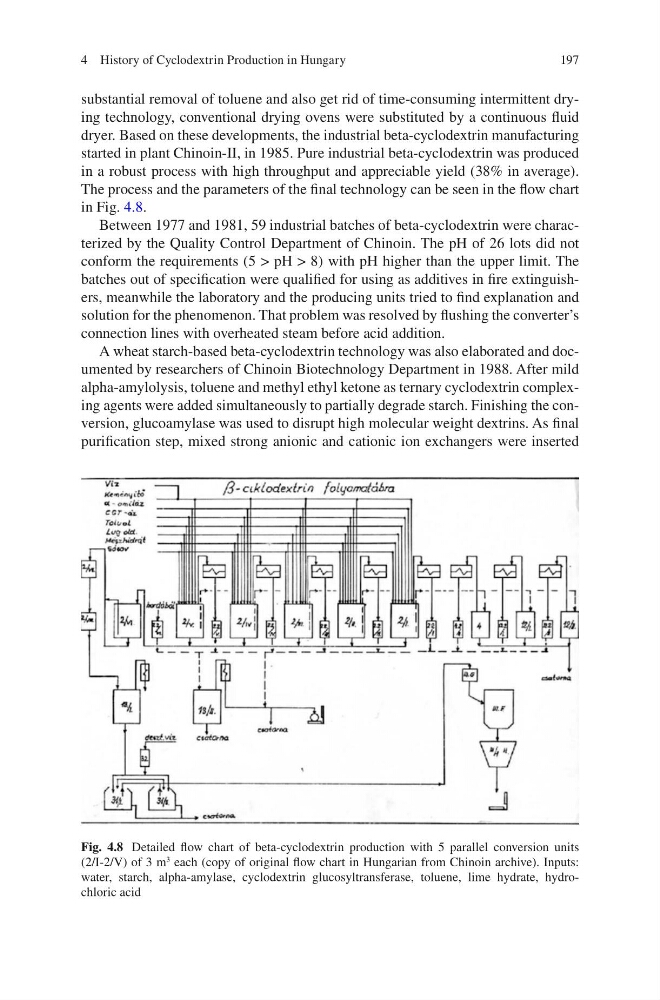
The process and the parameters of the final technology can be seen in the flow chart
in Fig. 4.8.
Between 1977 and 1981, 59 industrial batches of beta-cyclodextrin were characterized by the Quality Control Department of Chinoin. The pH of 26 lots did not
conform the requirements (5 > pH > 8) with pH higher than the upper limit. The
batches out of specification were qualified for using as additives in fire extinguishers, meanwhile the laboratory and the producing units tried to find explanation and
solution for the phenomenon. That problem was resolved by flushing the converter’s
connection lines with overheated steam before acid addition.
A wheat starch-based beta-cyclodextrin technology was also elaborated and documented by researchers of Chinoin Biotechnology Department in 1988. After mild
alpha-amylolysis, toluene and methyl ethyl ketone as ternary cyclodextrin complexing agents were added simultaneously to partially degrade starch. Finishing the conversion, glucoamylase was used to disrupt high molecular weight dextrins. As final
purification step, mixed strong anionic and cationic ion exchangers were inserted
Fig. 4.8 Detailed flow chart of beta-cyclodextrin production with 5 parallel conversion units
(2/I-2/V) of 3 m
3 each (copy of original flow chart in Hungarian from Chinoin archive). Inputs:
water, starch, alpha-amylase, cyclodextrin glucosyltransferase, toluene, lime hydrate, hydrochloric acid
4 History of Cyclodextrin Production in Hungary
substantial removal of toluene and also get rid of time-consuming intermittent drying technology, conventional drying ovens were substituted by a continuous fluid
dryer. Based on these developments, the industrial beta-cyclodextrin manufacturing
started in plant Chinoin-II, in 1985. Pure industrial beta-cyclodextrin was produced
in a robust process with high throughput and appreciable yield (38% in average).
The process and the parameters of the final technology can be seen in the flow chart
in Fig. 4.8.
Between 1977 and 1981, 59 industrial batches of beta-cyclodextrin were characterized by the Quality Control Department of Chinoin. The pH of 26 lots did not
conform the requirements (5 > pH > 8) with pH higher than the upper limit. The
batches out of specification were qualified for using as additives in fire extinguishers, meanwhile the laboratory and the producing units tried to find explanation and
solution for the phenomenon. That problem was resolved by flushing the converter’s
connection lines with overheated steam before acid addition.
A wheat starch-based beta-cyclodextrin technology was also elaborated and documented by researchers of Chinoin Biotechnology Department in 1988. After mild
alpha-amylolysis, toluene and methyl ethyl ketone as ternary cyclodextrin complexing agents were added simultaneously to partially degrade starch. Finishing the conversion, glucoamylase was used to disrupt high molecular weight dextrins. As final
purification step, mixed strong anionic and cationic ion exchangers were inserted
Fig. 4.8 Detailed flow chart of beta-cyclodextrin production with 5 parallel conversion units
(2/I-2/V) of 3 m
3 each (copy of original flow chart in Hungarian from Chinoin archive). Inputs:
water, starch, alpha-amylase, cyclodextrin glucosyltransferase, toluene, lime hydrate, hydrochloric acid
4 History of Cyclodextrin Production in Hungary