

189
accurate glucosyl transfer methods were not introduced into Chinoin practice, and
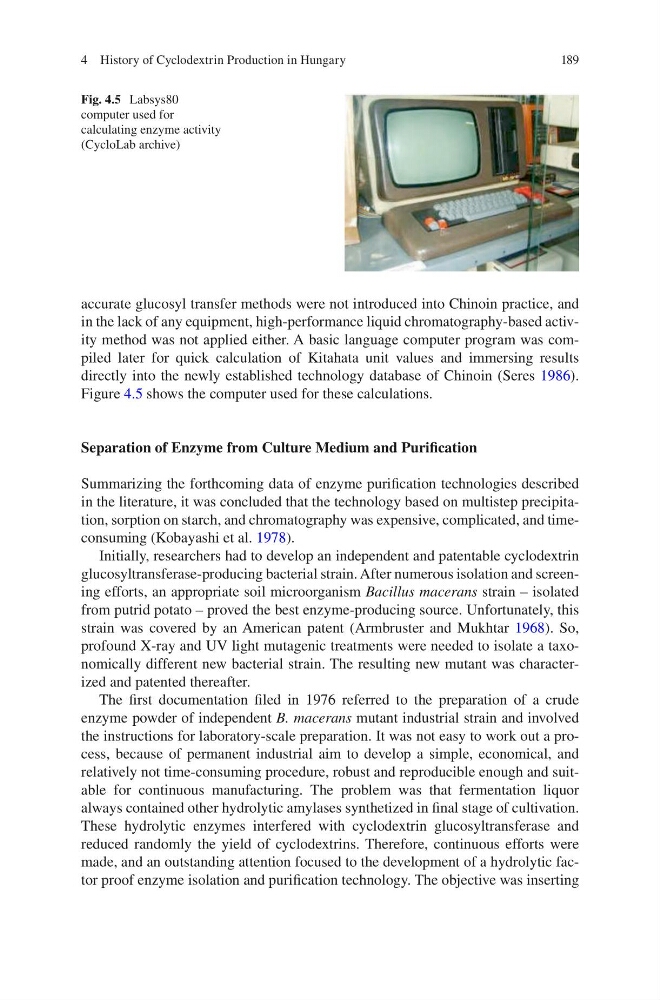
in the lack of any equipment, high-performance liquid chromatography-based activity method was not applied either. A basic language computer program was compiled later for quick calculation of Kitahata unit values and immersing results
directly into the newly established technology database of Chinoin (Seres 1986).
Figure 4.5 shows the computer used for these calculations.
Separation of Enzyme from Culture Medium and Purification
Summarizing the forthcoming data of enzyme purification technologies described
in the literature, it was concluded that the technology based on multistep precipitation, sorption on starch, and chromatography was expensive, complicated, and timeconsuming (Kobayashi et al. 1978).
Initially, researchers had to develop an independent and patentable cyclodextrin
glucosyltransferase-producing bacterial strain. After numerous isolation and screening efforts, an appropriate soil microorganism Bacillus macerans strain – isolated
from putrid potato – proved the best enzyme-producing source. Unfortunately, this
strain was covered by an American patent (Armbruster and Mukhtar 1968). So,
profound X-ray and UV light mutagenic treatments were needed to isolate a taxonomically different new bacterial strain. The resulting new mutant was characterized and patented thereafter.
The first documentation filed in 1976 referred to the preparation of a crude
enzyme powder of independent B. macerans mutant industrial strain and involved
the instructions for laboratory-scale preparation. It was not easy to work out a process, because of permanent industrial aim to develop a simple, economical, and
relatively not time-consuming procedure, robust and reproducible enough and suitable for continuous manufacturing. The problem was that fermentation liquor
always contained other hydrolytic amylases synthetized in final stage of cultivation.
These hydrolytic enzymes interfered with cyclodextrin glucosyltransferase and
reduced randomly the yield of cyclodextrins. Therefore, continuous efforts were
made, and an outstanding attention focused to the development of a hydrolytic factor proof enzyme isolation and purification technology. The objective was inserting
Fig. 4.5 Labsys80
computer used for
calculating enzyme activity
(CycloLab archive)
4 History of Cyclodextrin Production in Hungary
accurate glucosyl transfer methods were not introduced into Chinoin practice, and
in the lack of any equipment, high-performance liquid chromatography-based activity method was not applied either. A basic language computer program was compiled later for quick calculation of Kitahata unit values and immersing results
directly into the newly established technology database of Chinoin (Seres 1986).
Figure 4.5 shows the computer used for these calculations.
Separation of Enzyme from Culture Medium and Purification
Summarizing the forthcoming data of enzyme purification technologies described
in the literature, it was concluded that the technology based on multistep precipitation, sorption on starch, and chromatography was expensive, complicated, and timeconsuming (Kobayashi et al. 1978).
Initially, researchers had to develop an independent and patentable cyclodextrin
glucosyltransferase-producing bacterial strain. After numerous isolation and screening efforts, an appropriate soil microorganism Bacillus macerans strain – isolated
from putrid potato – proved the best enzyme-producing source. Unfortunately, this
strain was covered by an American patent (Armbruster and Mukhtar 1968). So,
profound X-ray and UV light mutagenic treatments were needed to isolate a taxonomically different new bacterial strain. The resulting new mutant was characterized and patented thereafter.
The first documentation filed in 1976 referred to the preparation of a crude
enzyme powder of independent B. macerans mutant industrial strain and involved
the instructions for laboratory-scale preparation. It was not easy to work out a process, because of permanent industrial aim to develop a simple, economical, and
relatively not time-consuming procedure, robust and reproducible enough and suitable for continuous manufacturing. The problem was that fermentation liquor
always contained other hydrolytic amylases synthetized in final stage of cultivation.
These hydrolytic enzymes interfered with cyclodextrin glucosyltransferase and
reduced randomly the yield of cyclodextrins. Therefore, continuous efforts were
made, and an outstanding attention focused to the development of a hydrolytic factor proof enzyme isolation and purification technology. The objective was inserting
Fig. 4.5 Labsys80
computer used for
calculating enzyme activity
(CycloLab archive)
4 History of Cyclodextrin Production in Hungary