

163
3.2.5 Awards and Distinctions
Professor Casu received many distinctions and prizes, most notably the degree of
Doctor in Medicine Honoris causa at the University of Uppsala, Sweden (1998), the
gold medals of the Italian Chemical Society (1998) and of the Italian Carbohydrate
Group (2003), and recognition plaques from the Italian Cyclodextrin Group (2009)
and the International Union of Angiology (1990 and 2012).
3.3 Casu’s Scientific Achievements
3.3.1 Professor Casu and Polysaccharides
In the early 1950s, Dr. Casu began working on carbohydrate structure and conformation using the most innovative spectrometric techniques of the time (Reggiani
and Casu 1957; Crini and Torri 2017). He was the first to demonstrate that infrared
spectroscopy (IR) and proton nuclear magnetic resonance (
1
H-NMR) were powerful methods to study the structure and conformations of disaccharides, oligosaccharides, and polysaccharides, including starch and its linear and cyclic derivatives
(Crini 2014; Crini and Torri 2017). All his results were summarized in the 1980s in
two comprehensive reviews (Casu 1982, 1985a).
In 1964, Professor Casu studied infrared spectra of starch derivatives. This work
was supported by a grant from the US Department of Agriculture. Professor Casu
reported infrared spectra of amylose, cycloamyloses, and amylodextrin and assigned
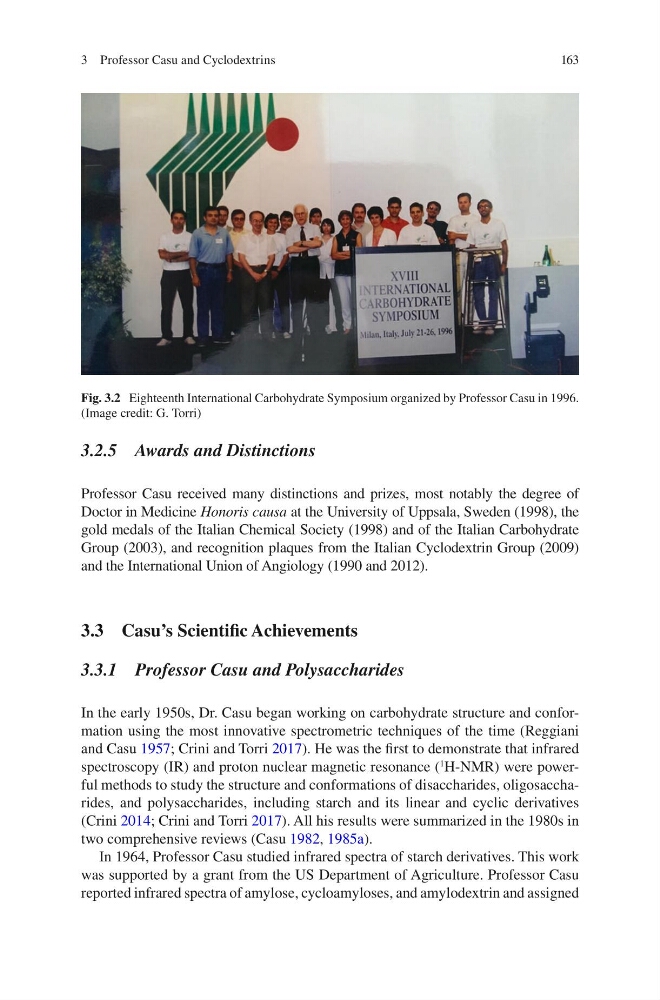
Fig. 3.2 Eighteenth International Carbohydrate Symposium organized by Professor Casu in 1996.
(Image credit: G. Torri)
3 Professor Casu and Cyclodextrins
3.2.5 Awards and Distinctions
Professor Casu received many distinctions and prizes, most notably the degree of
Doctor in Medicine Honoris causa at the University of Uppsala, Sweden (1998), the
gold medals of the Italian Chemical Society (1998) and of the Italian Carbohydrate
Group (2003), and recognition plaques from the Italian Cyclodextrin Group (2009)
and the International Union of Angiology (1990 and 2012).
3.3 Casu’s Scientific Achievements
3.3.1 Professor Casu and Polysaccharides
In the early 1950s, Dr. Casu began working on carbohydrate structure and conformation using the most innovative spectrometric techniques of the time (Reggiani
and Casu 1957; Crini and Torri 2017). He was the first to demonstrate that infrared
spectroscopy (IR) and proton nuclear magnetic resonance (
1
H-NMR) were powerful methods to study the structure and conformations of disaccharides, oligosaccharides, and polysaccharides, including starch and its linear and cyclic derivatives
(Crini 2014; Crini and Torri 2017). All his results were summarized in the 1980s in
two comprehensive reviews (Casu 1982, 1985a).
In 1964, Professor Casu studied infrared spectra of starch derivatives. This work
was supported by a grant from the US Department of Agriculture. Professor Casu
reported infrared spectra of amylose, cycloamyloses, and amylodextrin and assigned
Fig. 3.2 Eighteenth International Carbohydrate Symposium organized by Professor Casu in 1996.
(Image credit: G. Torri)
3 Professor Casu and Cyclodextrins