

159
communicator, an enthusiastic teacher of many doctoral students and postdoctoral
fellows, a genial host to visitors, and a truly caring person.
Casu’s scientific career was based on two main research axes: the first focused on
oligosaccharides and polysaccharides developed essentially during the years
between 1951 and 1980 and the second on biological substances during 1969–2014.
Professor Casu had many varied scientific interests: chemistry and biochemistry
of starch, linear and cyclic dextrins, glycosaminoglycans, mechanism of action of
biologically active substances, structural analysis of carbohydrates, and their interactions with proteins, enzymology, analytical chemistry, surfactant chemistry, etc.
Professor Casu has also made a significant contribution to the development of structural modelling and NMR, infrared, and Raman techniques applied to carbohydrates
(Crini 2014; Crini and Torri 2017; Torri and Cassinelli 2018). All this research was
carried out, thanks to multidisciplinary and transversal collaborations developed
and thanks to his willingness to involve both academic and industrial colleagues,
both national and especially international. Its activities have also focused on scientific fields with direct social implications, in accordance with the principles dictated
by the founder of the Ronzoni Institute.
At the end of the 1940s, the young student Casu first concentrated on the field of
carbohydrate chemistry, e.g., investigating the structure of glucose and its chemical
modification, at the University of Pavia, Italy, where he presented his PhD in 1950
(Crini 2014). In the early 1950s, Dr. Casu began his scientific career at the
G. Ronzoni Institute, as research fellow in 1951, and research assistant in 1954,
studying the structure of disaccharides such as maltose, oligosaccharides, e.g.,
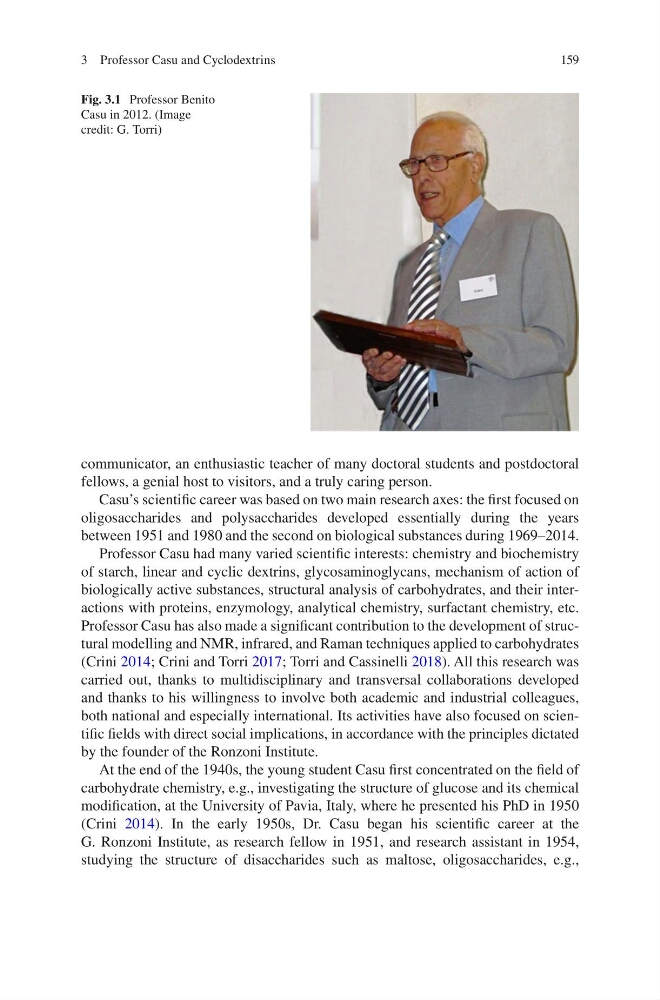
Fig. 3.1 Professor Benito
Casu in 2012. (Image
credit: G. Torri)
3 Professor Casu and Cyclodextrins
communicator, an enthusiastic teacher of many doctoral students and postdoctoral
fellows, a genial host to visitors, and a truly caring person.
Casu’s scientific career was based on two main research axes: the first focused on
oligosaccharides and polysaccharides developed essentially during the years
between 1951 and 1980 and the second on biological substances during 1969–2014.
Professor Casu had many varied scientific interests: chemistry and biochemistry
of starch, linear and cyclic dextrins, glycosaminoglycans, mechanism of action of
biologically active substances, structural analysis of carbohydrates, and their interactions with proteins, enzymology, analytical chemistry, surfactant chemistry, etc.
Professor Casu has also made a significant contribution to the development of structural modelling and NMR, infrared, and Raman techniques applied to carbohydrates
(Crini 2014; Crini and Torri 2017; Torri and Cassinelli 2018). All this research was
carried out, thanks to multidisciplinary and transversal collaborations developed
and thanks to his willingness to involve both academic and industrial colleagues,
both national and especially international. Its activities have also focused on scientific fields with direct social implications, in accordance with the principles dictated
by the founder of the Ronzoni Institute.
At the end of the 1940s, the young student Casu first concentrated on the field of
carbohydrate chemistry, e.g., investigating the structure of glucose and its chemical
modification, at the University of Pavia, Italy, where he presented his PhD in 1950
(Crini 2014). In the early 1950s, Dr. Casu began his scientific career at the
G. Ronzoni Institute, as research fellow in 1951, and research assistant in 1954,
studying the structure of disaccharides such as maltose, oligosaccharides, e.g.,
Fig. 3.1 Professor Benito
Casu in 2012. (Image
credit: G. Torri)
3 Professor Casu and Cyclodextrins