

100
toxicological studies had established that cyclodextrin administrated orally was a
harmless substance.
In 1974, an important research project on cyclodextrins was launched at
CHINOIN with the support of Research Director Professor Zoltán Mészáros. In
1982, Professor Szejtli wrote: “Professor Mészáros supported this project by every
means, running substantial financial risks” (Szejtli 1982a). The two main objectives
of this innovative project were to produce cyclodextrins at a reasonable price and,
especially, to investigate every possible field of application for cyclodextrins and
their inclusion complexes. In a few years, several patents are registered (Szejtli et al.
1976, 1977a, b, c, 1978c, d, 1980c, d, e, 1981b, 1982b, 1983d, 1985a, b). At the end
of the 1970s, Professor Szejtli also published his first general reviews on the potential applications of cyclodextrins (Szejtli 1977a, 1978; Szejtli et al. 1978a, b).
Realizing the exponentially increasing number of articles, chapters, and patents,
Professor Szejtli organized the first International Cyclodextrin Symposium in
Budapest in 1981 with participants from 17 countries. The eighth symposium was
again in Budapest in 1996, organized by him. In the mid-1980s, with his English
colleague Professor Pagington, Professor Szejtli founded the scientific monthly
newsletter, “Cyclodextrin News” (first issue: November 1986), in order to create a
source of information for everyone active in the field, from students and colleagues
to industrial engineers (Szente 1994).
During 1975–2004, Professor Szejtli published plentiful experimental data on
almost every field of cyclodextrin with major theoretical and practical impacts in
chemistry, biology, health science, and agriculture. He knew virtually everything
about them. In spring 2004, Professor Szejtli retired from his position in CycloLab
but remained active in science (Fig. 2.3). He has devoted his life to cyclodextrins.
József Szejtli tragically passed away on November 26, 2004.
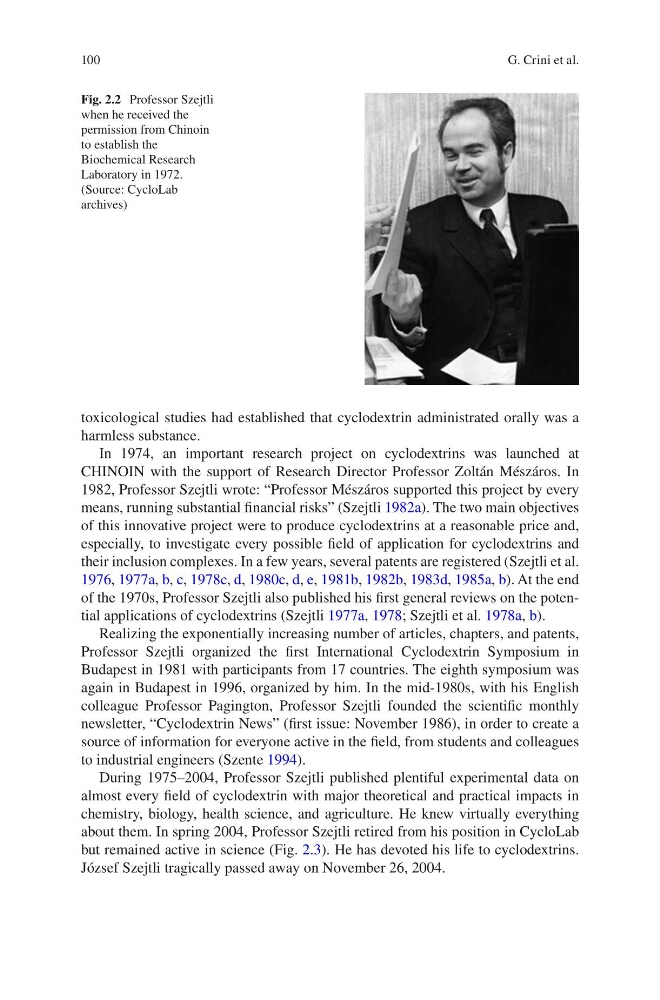
Fig. 2.2 Professor Szejtli
when he received the
permission from Chinoin
to establish the
Biochemical Research
Laboratory in 1972.
(Source: CycloLab
archives)
G. Crini et al.
toxicological studies had established that cyclodextrin administrated orally was a
harmless substance.
In 1974, an important research project on cyclodextrins was launched at
CHINOIN with the support of Research Director Professor Zoltán Mészáros. In
1982, Professor Szejtli wrote: “Professor Mészáros supported this project by every
means, running substantial financial risks” (Szejtli 1982a). The two main objectives
of this innovative project were to produce cyclodextrins at a reasonable price and,
especially, to investigate every possible field of application for cyclodextrins and
their inclusion complexes. In a few years, several patents are registered (Szejtli et al.
1976, 1977a, b, c, 1978c, d, 1980c, d, e, 1981b, 1982b, 1983d, 1985a, b). At the end
of the 1970s, Professor Szejtli also published his first general reviews on the potential applications of cyclodextrins (Szejtli 1977a, 1978; Szejtli et al. 1978a, b).
Realizing the exponentially increasing number of articles, chapters, and patents,
Professor Szejtli organized the first International Cyclodextrin Symposium in
Budapest in 1981 with participants from 17 countries. The eighth symposium was
again in Budapest in 1996, organized by him. In the mid-1980s, with his English
colleague Professor Pagington, Professor Szejtli founded the scientific monthly
newsletter, “Cyclodextrin News” (first issue: November 1986), in order to create a
source of information for everyone active in the field, from students and colleagues
to industrial engineers (Szente 1994).
During 1975–2004, Professor Szejtli published plentiful experimental data on
almost every field of cyclodextrin with major theoretical and practical impacts in
chemistry, biology, health science, and agriculture. He knew virtually everything
about them. In spring 2004, Professor Szejtli retired from his position in CycloLab
but remained active in science (Fig. 2.3). He has devoted his life to cyclodextrins.
József Szejtli tragically passed away on November 26, 2004.
Fig. 2.2 Professor Szejtli
when he received the
permission from Chinoin
to establish the
Biochemical Research
Laboratory in 1972.
(Source: CycloLab
archives)
G. Crini et al.