

97
first applications in the chromatography, pharmaceutical, and food industries (Saenger
1980; Smolková-Keulemansová 1982; Szejtli 1982a; Uekama and Otagiri 1987;
Armstrong and Jin 1989; Li and Purdy 1992; Hedges 1998; Crini 2014). With a more
accurate picture of their toxicity and better understanding of molecular encapsulation,
several inclusion complexes also appeared on the market in the 1980s. The introduction
of cyclodextrins into pharmaceutical chemistry led to spectacular progress (Szejtli
1988a, 1998; Duchêne 1991; Uekama et al. 1994; Duchêne and Wouessidjewe 1996;
Loftsson and Brewster 1996; Stella and Rajewski 1997; Irie and Uekama 1997).
Several great scientists have left their mark on the history, characterization, properties, and potential applications of these molecules (Crini 2014), e.g., Antoine
Villiers from France, Franz Schardinger from Austria, Hans Pringsheim, Karl
Freudenberg, Friedrich Cramer, and Wolfram Saenger from Germany, Paul Karrer
from Switzerland, Dexter French, Myron L. Bender, Ronald Breslow, and Joseph
Pitha from the USA, Benito Casu from Italy, and Tsuneji Nagai from Japan. The list
of prestigious researchers who have contributed to the development of cyclodextrins
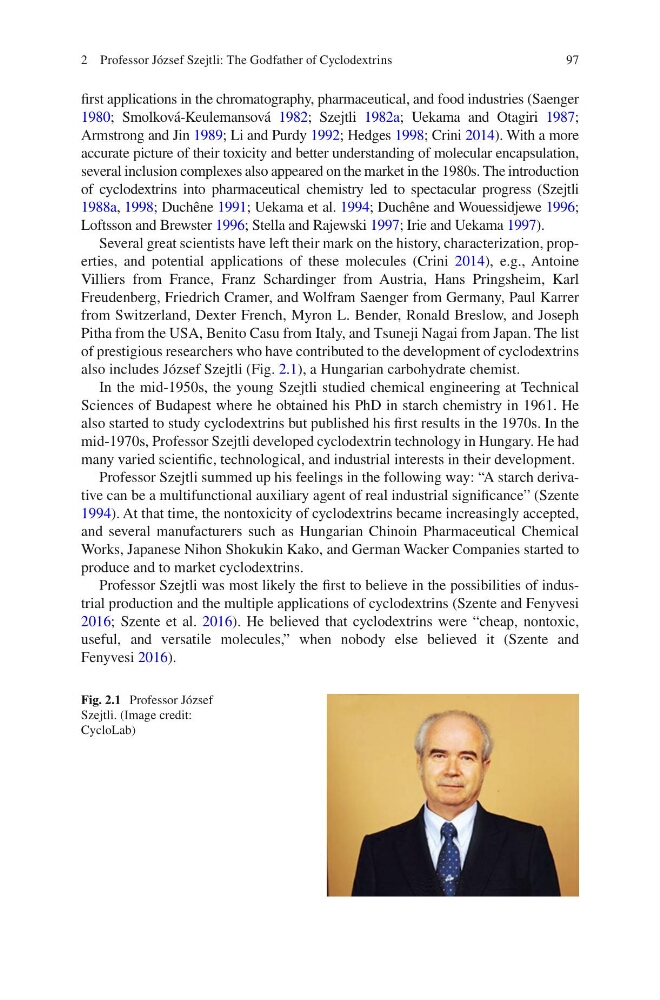
also includes József Szejtli (Fig. 2.1), a Hungarian carbohydrate chemist.
In the mid-1950s, the young Szejtli studied chemical engineering at Technical
Sciences of Budapest where he obtained his PhD in starch chemistry in 1961. He
also started to study cyclodextrins but published his first results in the 1970s. In the
mid-1970s, Professor Szejtli developed cyclodextrin technology in Hungary. He had
many varied scientific, technological, and industrial interests in their development.
Professor Szejtli summed up his feelings in the following way: “A starch derivative can be a multifunctional auxiliary agent of real industrial significance” (Szente
1994). At that time, the nontoxicity of cyclodextrins became increasingly accepted,
and several manufacturers such as Hungarian Chinoin Pharmaceutical Chemical
Works, Japanese Nihon Shokukin Kako, and German Wacker Companies started to
produce and to market cyclodextrins.
Professor Szejtli was most likely the first to believe in the possibilities of industrial production and the multiple applications of cyclodextrins (Szente and Fenyvesi
2016; Szente et al. 2016). He believed that cyclodextrins were “cheap, nontoxic,
useful, and versatile molecules,” when nobody else believed it (Szente and
Fenyvesi 2016).
Fig. 2.1 Professor József
Szejtli. (Image credit:
CycloLab)
2 Professor József Szejtli: The Godfather of Cyclodextrins
first applications in the chromatography, pharmaceutical, and food industries (Saenger
1980; Smolková-Keulemansová 1982; Szejtli 1982a; Uekama and Otagiri 1987;
Armstrong and Jin 1989; Li and Purdy 1992; Hedges 1998; Crini 2014). With a more
accurate picture of their toxicity and better understanding of molecular encapsulation,
several inclusion complexes also appeared on the market in the 1980s. The introduction
of cyclodextrins into pharmaceutical chemistry led to spectacular progress (Szejtli
1988a, 1998; Duchêne 1991; Uekama et al. 1994; Duchêne and Wouessidjewe 1996;
Loftsson and Brewster 1996; Stella and Rajewski 1997; Irie and Uekama 1997).
Several great scientists have left their mark on the history, characterization, properties, and potential applications of these molecules (Crini 2014), e.g., Antoine
Villiers from France, Franz Schardinger from Austria, Hans Pringsheim, Karl
Freudenberg, Friedrich Cramer, and Wolfram Saenger from Germany, Paul Karrer
from Switzerland, Dexter French, Myron L. Bender, Ronald Breslow, and Joseph
Pitha from the USA, Benito Casu from Italy, and Tsuneji Nagai from Japan. The list
of prestigious researchers who have contributed to the development of cyclodextrins
also includes József Szejtli (Fig. 2.1), a Hungarian carbohydrate chemist.
In the mid-1950s, the young Szejtli studied chemical engineering at Technical
Sciences of Budapest where he obtained his PhD in starch chemistry in 1961. He
also started to study cyclodextrins but published his first results in the 1970s. In the
mid-1970s, Professor Szejtli developed cyclodextrin technology in Hungary. He had
many varied scientific, technological, and industrial interests in their development.
Professor Szejtli summed up his feelings in the following way: “A starch derivative can be a multifunctional auxiliary agent of real industrial significance” (Szente
1994). At that time, the nontoxicity of cyclodextrins became increasingly accepted,
and several manufacturers such as Hungarian Chinoin Pharmaceutical Chemical
Works, Japanese Nihon Shokukin Kako, and German Wacker Companies started to
produce and to market cyclodextrins.
Professor Szejtli was most likely the first to believe in the possibilities of industrial production and the multiple applications of cyclodextrins (Szente and Fenyvesi
2016; Szente et al. 2016). He believed that cyclodextrins were “cheap, nontoxic,
useful, and versatile molecules,” when nobody else believed it (Szente and
Fenyvesi 2016).
Fig. 2.1 Professor József
Szejtli. (Image credit:
CycloLab)
2 Professor József Szejtli: The Godfather of Cyclodextrins