

42
Sensemaking in Safety Critical and Complex Situations
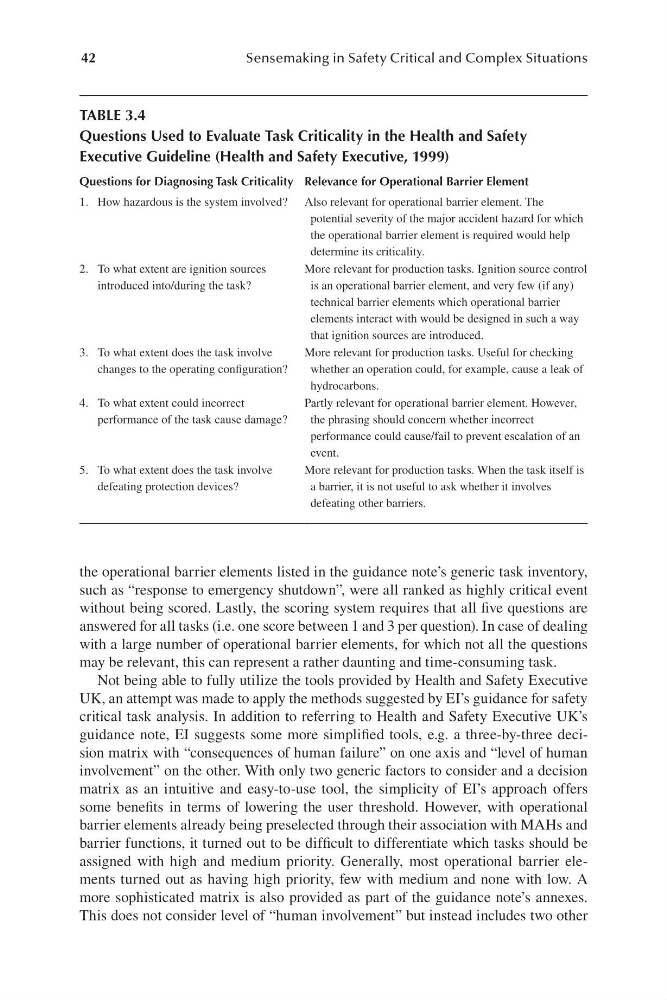
the operational barrier elements listed in the guidance note’s generic task inventory,
such as “ response to emergency shutdown”, were all ranked as highly critical event
without being scored. Lastly, the scoring system requires that all five questions are
answered for all tasks ( i.e. one score between 1 and 3 per question). In case of dealing
with a large number of operational barrier elements, for which not all the questions
may be relevant, this can represent a rather daunting and time-consuming task.
Not being able to fully utilize the tools provided by Health and Safety Executive
UK, an attempt was made to apply the methods suggested by EI’s guidance for safety
critical task analysis. In addition to referring to Health and Safety Executive UK’s
guidance note, EI suggests some more simplified tools, e.g. a t hree- by-three decision matrix with “ consequences of human failure” on one axis and “ level of human
involvement” on the other. With only two generic factors to consider and a decision
matrix as an intuitive and e asy- to-use tool, the simplicity of EI’s approach offers
some benefits in terms of lowering the user threshold. However, with operational
barrier elements already being preselected through their association with MAHs and
barrier functions, it turned out to be difficult to differentiate which tasks should be
assigned with high and medium priority. Generally, most operational barrier elements turned out as having high priority, few with medium and none with low. A
more sophisticated matrix is also provided as part of the guidance note’s annexes.
This does not consider level of “ human involvement” but instead includes two other
TABLE 3.4
Questions Used to Evaluate Task Criticality in the Health and Safety
Executive Guideline ( Health and Safety Executive, 1999)
Questions for Diagnosing Task Criticality Relevance for Operational Barrier Element
1. How hazardous is the system involved? Also relevant for operational barrier element. The
potential severity of the major accident hazard for which
the operational barrier element is required would help
determine its criticality.
2. To what extent are ignition sources
More relevant for production tasks. Ignition source control
introduced into/ during the task?
is an operational barrier element, and very few ( if any)
technical barrier elements which operational barrier
elements interact with would be designed in such a way
that ignition sources are introduced.
3. To what extent does the task involve
More relevant for production tasks. Useful for checking
changes to the operating configuration?
whether an operation could, for example, cause a leak of
hydrocarbons.
4. To what extent could incorrect
Partly relevant for operational barrier element. However,
performance of the task cause damage?
the phrasing should concern whether incorrect
performance could cause/ fail to prevent escalation of an
event.
5. To what extent does the task involve
More relevant for production tasks. When the task itself is
defeating protection devices?
a barrier, it is not useful to ask whether it involves
defeating other barriers.
Sensemaking in Safety Critical and Complex Situations
the operational barrier elements listed in the guidance note’s generic task inventory,
such as “ response to emergency shutdown”, were all ranked as highly critical event
without being scored. Lastly, the scoring system requires that all five questions are
answered for all tasks ( i.e. one score between 1 and 3 per question). In case of dealing
with a large number of operational barrier elements, for which not all the questions
may be relevant, this can represent a rather daunting and time-consuming task.
Not being able to fully utilize the tools provided by Health and Safety Executive
UK, an attempt was made to apply the methods suggested by EI’s guidance for safety
critical task analysis. In addition to referring to Health and Safety Executive UK’s
guidance note, EI suggests some more simplified tools, e.g. a t hree- by-three decision matrix with “ consequences of human failure” on one axis and “ level of human
involvement” on the other. With only two generic factors to consider and a decision
matrix as an intuitive and e asy- to-use tool, the simplicity of EI’s approach offers
some benefits in terms of lowering the user threshold. However, with operational
barrier elements already being preselected through their association with MAHs and
barrier functions, it turned out to be difficult to differentiate which tasks should be
assigned with high and medium priority. Generally, most operational barrier elements turned out as having high priority, few with medium and none with low. A
more sophisticated matrix is also provided as part of the guidance note’s annexes.
This does not consider level of “ human involvement” but instead includes two other
TABLE 3.4
Questions Used to Evaluate Task Criticality in the Health and Safety
Executive Guideline ( Health and Safety Executive, 1999)
Questions for Diagnosing Task Criticality Relevance for Operational Barrier Element
1. How hazardous is the system involved? Also relevant for operational barrier element. The
potential severity of the major accident hazard for which
the operational barrier element is required would help
determine its criticality.
2. To what extent are ignition sources
More relevant for production tasks. Ignition source control
introduced into/ during the task?
is an operational barrier element, and very few ( if any)
technical barrier elements which operational barrier
elements interact with would be designed in such a way
that ignition sources are introduced.
3. To what extent does the task involve
More relevant for production tasks. Useful for checking
changes to the operating configuration?
whether an operation could, for example, cause a leak of
hydrocarbons.
4. To what extent could incorrect
Partly relevant for operational barrier element. However,
performance of the task cause damage?
the phrasing should concern whether incorrect
performance could cause/ fail to prevent escalation of an
event.
5. To what extent does the task involve
More relevant for production tasks. When the task itself is
defeating protection devices?
a barrier, it is not useful to ask whether it involves
defeating other barriers.