

40
Sensemaking in Safety Critical and Complex Situations
argued to represent a “ robust solution”, and not an operational barrier element part
of a barrier function, the distinction from the latter becomes more theoretical than
practical – they can both be potential safety critical tasks, they happen close in time
and are performed by the same personnel. In principle, if a single human failure has
the potential to trigger a MAH, preventing this from happening by performing such
tasks correctly could be claimed to represent an operational barrier element. When
identifying such tasks, a decision must therefore be made whether the task should
be considered an operational barrier element or not, based on the initially perceived
criticality. On the NCS or companies operating under similar regulatory regimes, the
practical implications from such a decision will be whether the safety critical task is
followed up as part of the systems implemented to manage safety barriers.
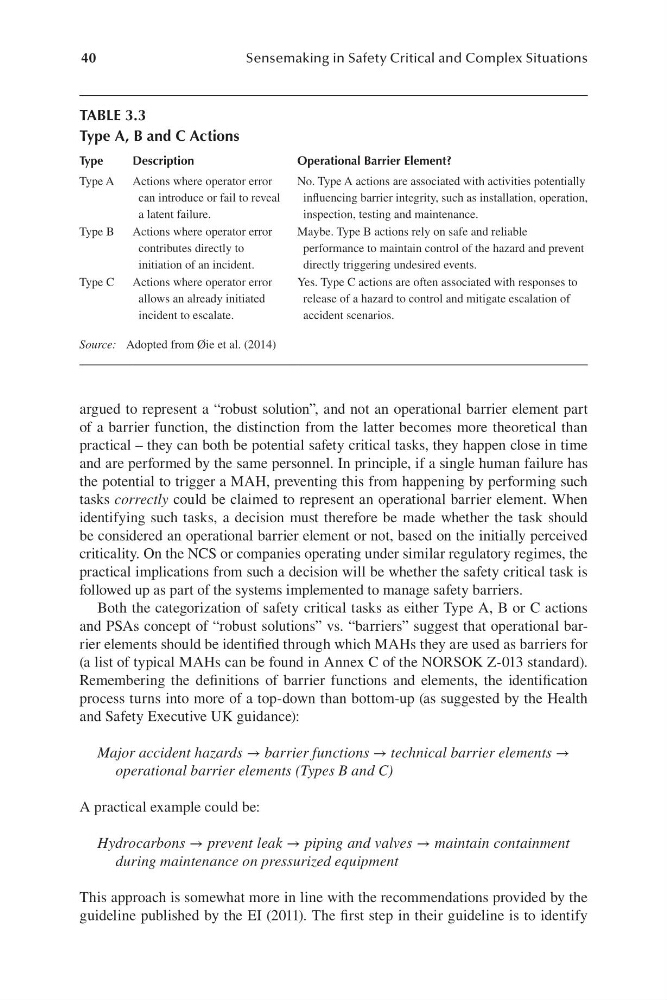
Both the categorization of safety critical tasks as either Type A, B or C actions
and PSAs concept of “ robust solutions” vs. “ barriers” suggest that operational barrier elements should be identified through which MAHs they are used as barriers for
( a list of typical MAHs can be found in Annex C of the NORSOK Z -013 standard).
Remembering the definitions of barrier functions and elements, the identification
process turns into more of a top-down than bottom-up ( as suggested by the Health
and Safety Executive UK guidance):
Major accident hazards → barrier functions → technical barrier elements →
operational barrier elements ( Types B and C)
A practical example could be:
Hydrocarbons → prevent leak → piping and valves → maintain containment
during maintenance on pressurized equipment
This approach is somewhat more in line with the recommendations provided by the
guideline published by the EI ( 2011). The first step in their guideline is to identify
TABLE 3.3
Type A, B and C Actions
Type
Description
Operational Barrier Element?
Type A
Actions where operator error
No. Type A actions are associated with activities potentially
can introduce or fail to reveal
influencing barrier integrity, such as installation, operation,
a latent failure.
inspection, testing and maintenance.
Type B
Actions where operator error
Maybe. Type B actions rely on safe and reliable
contributes directly to
performance to maintain control of the hazard and prevent
initiation of an incident.
directly triggering undesired events.
Type C
Actions where operator error
Yes. Type C actions are often associated with responses to
allows an already initiated
release of a hazard to control and mitigate escalation of
incident to escalate.
accident scenarios.
Source: Adopted from Øie et al. ( 2014)
Sensemaking in Safety Critical and Complex Situations
argued to represent a “ robust solution”, and not an operational barrier element part
of a barrier function, the distinction from the latter becomes more theoretical than
practical – they can both be potential safety critical tasks, they happen close in time
and are performed by the same personnel. In principle, if a single human failure has
the potential to trigger a MAH, preventing this from happening by performing such
tasks correctly could be claimed to represent an operational barrier element. When
identifying such tasks, a decision must therefore be made whether the task should
be considered an operational barrier element or not, based on the initially perceived
criticality. On the NCS or companies operating under similar regulatory regimes, the
practical implications from such a decision will be whether the safety critical task is
followed up as part of the systems implemented to manage safety barriers.
Both the categorization of safety critical tasks as either Type A, B or C actions
and PSAs concept of “ robust solutions” vs. “ barriers” suggest that operational barrier elements should be identified through which MAHs they are used as barriers for
( a list of typical MAHs can be found in Annex C of the NORSOK Z -013 standard).
Remembering the definitions of barrier functions and elements, the identification
process turns into more of a top-down than bottom-up ( as suggested by the Health
and Safety Executive UK guidance):
Major accident hazards → barrier functions → technical barrier elements →
operational barrier elements ( Types B and C)
A practical example could be:
Hydrocarbons → prevent leak → piping and valves → maintain containment
during maintenance on pressurized equipment
This approach is somewhat more in line with the recommendations provided by the
guideline published by the EI ( 2011). The first step in their guideline is to identify
TABLE 3.3
Type A, B and C Actions
Type
Description
Operational Barrier Element?
Type A
Actions where operator error
No. Type A actions are associated with activities potentially
can introduce or fail to reveal
influencing barrier integrity, such as installation, operation,
a latent failure.
inspection, testing and maintenance.
Type B
Actions where operator error
Maybe. Type B actions rely on safe and reliable
contributes directly to
performance to maintain control of the hazard and prevent
initiation of an incident.
directly triggering undesired events.
Type C
Actions where operator error
Yes. Type C actions are often associated with responses to
allows an already initiated
release of a hazard to control and mitigate escalation of
incident to escalate.
accident scenarios.
Source: Adopted from Øie et al. ( 2014)