

245
Constrained Autonomy
• DA4 – Full autonomy: The ship automation can handle all states in O without any intervention from a crew.
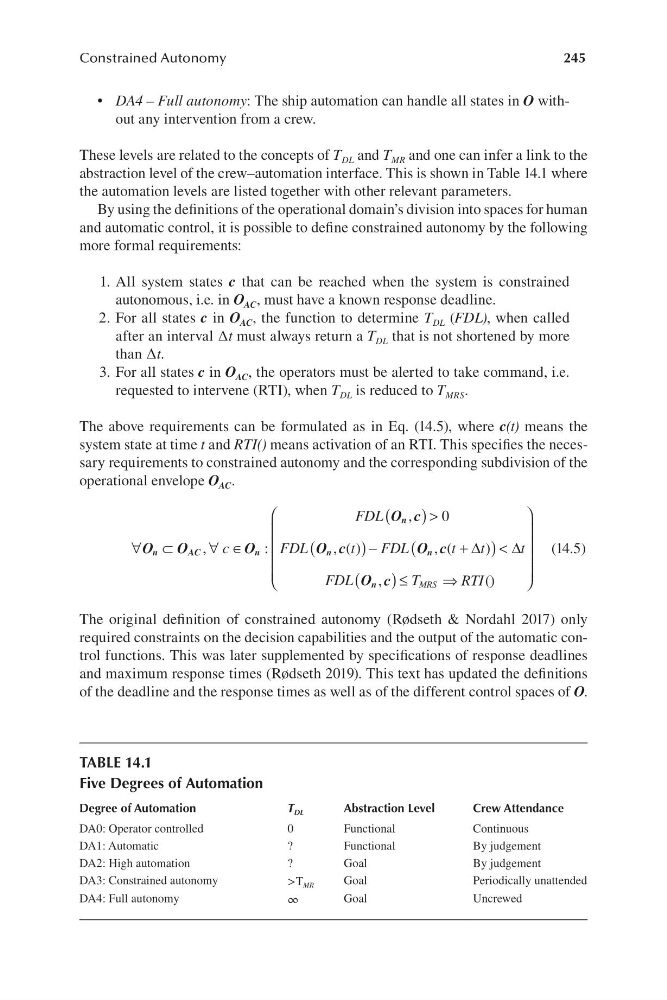
These levels are related to the concepts of T DL and T MR and one can infer a link to the
abstraction level of the crew–automation interface. This is shown in Table 14.1 where
the automation levels are listed together with other relevant parameters.
By using the definitions of the operational domain’s division into spaces for human
and automatic control, it is possible to define constrained autonomy by the following
more formal requirements:
1. All system states c that can be reached when the system is constrained
autonomous, i.e. in O AC , must have a known response deadline.
2. For all states c in O AC , the function to determine T DL (FDL), when called
after an interval ∆t must always return a T DL that is not shortened by more
than ∆t.
3. For all states c in O AC , the operators must be alerted to take command, i.e.
requested to intervene ( RTI), when T DL is reduced to T MRS .
The above requirements can be formulated as in Eq. ( 14.5), where c(t) means the
system state at time t and RTI() means activation of an RTI. This specifies the necessary requirements to constrained autonomy and the corresponding subdivision of the
operational envelope O AC .
FDL (
)
O n ,
0
c >
∀ ⊂
O
O
n
A C
n
,
:
∀ ∈
c O FDL
t
(
)
O
O
n
n
, (
c
c
)
,
−
+
FDL
t
(
)
(
)
∆ <
t
t
∆ (14.5)
FDL
T
(
)
O n ,
(
c ≤
⇒
MRS
RTI )
The original definition of constrained autonomy ( Rødseth & Nordahl 2017) only
required constraints on the decision capabilities and the output of the automatic control functions. This was later supplemented by specifications of response deadlines
and maximum response times ( Rødseth 2019). This text has updated the definitions
of the deadline and the response times as well as of the different control spaces of O.
TABLE 14.1
Five Degrees of Automation
Degree of Automation
T DL
Abstraction Level
Crew Attendance
DA0: Operator controlled
0
Functional
Continuous
DA1: Automatic
?
Functional
By judgement
DA2: High automation
?
Goal
By judgement
DA3: Constrained autonomy
>T MR
Goal
Periodically unattended
DA4: Full autonomy
∞
Goal
Uncrewed
Constrained Autonomy
• DA4 – Full autonomy: The ship automation can handle all states in O without any intervention from a crew.
These levels are related to the concepts of T DL and T MR and one can infer a link to the
abstraction level of the crew–automation interface. This is shown in Table 14.1 where
the automation levels are listed together with other relevant parameters.
By using the definitions of the operational domain’s division into spaces for human
and automatic control, it is possible to define constrained autonomy by the following
more formal requirements:
1. All system states c that can be reached when the system is constrained
autonomous, i.e. in O AC , must have a known response deadline.
2. For all states c in O AC , the function to determine T DL (FDL), when called
after an interval ∆t must always return a T DL that is not shortened by more
than ∆t.
3. For all states c in O AC , the operators must be alerted to take command, i.e.
requested to intervene ( RTI), when T DL is reduced to T MRS .
The above requirements can be formulated as in Eq. ( 14.5), where c(t) means the
system state at time t and RTI() means activation of an RTI. This specifies the necessary requirements to constrained autonomy and the corresponding subdivision of the
operational envelope O AC .
FDL (
)
O n ,
0
c >
∀ ⊂
O
O
n
A C
n
,
:
∀ ∈
c O FDL
t
(
)
O
O
n
n
, (
c
c
)
,
−
+
FDL
t
(
)
(
)
∆ <
t
t
∆ (14.5)
FDL
T
(
)
O n ,
(
c ≤
⇒
MRS
RTI )
The original definition of constrained autonomy ( Rødseth & Nordahl 2017) only
required constraints on the decision capabilities and the output of the automatic control functions. This was later supplemented by specifications of response deadlines
and maximum response times ( Rødseth 2019). This text has updated the definitions
of the deadline and the response times as well as of the different control spaces of O.
TABLE 14.1
Five Degrees of Automation
Degree of Automation
T DL
Abstraction Level
Crew Attendance
DA0: Operator controlled
0
Functional
Continuous
DA1: Automatic
?
Functional
By judgement
DA2: High automation
?
Goal
By judgement
DA3: Constrained autonomy
>T MR
Goal
Periodically unattended
DA4: Full autonomy
∞
Goal
Uncrewed