

237
Constrained Autonomy
under specified conditions, can function without human intervention”. Furthermore,
this can be used to define autonomy as “ in the context of ships, autonomy e.g. as in
‘ Autonomous Ship’, means that the ship uses automation to operate without human
intervention, related to one or more ship processes, for the full duration or in limited periods of the ship’s operations or voyage.” These are definitions that have been
proposed to the International Maritime Organization ( IMO) by ISO ( 2020a). These
definitions simply say that automation can be used to provide autonomy and that
autonomy emerges when the system is designed, approved and deployed to be operated without human intervention or supervision for certain periods. This could also
be used to describe levels of autonomy by how long the operator can stay away as
indicated below.
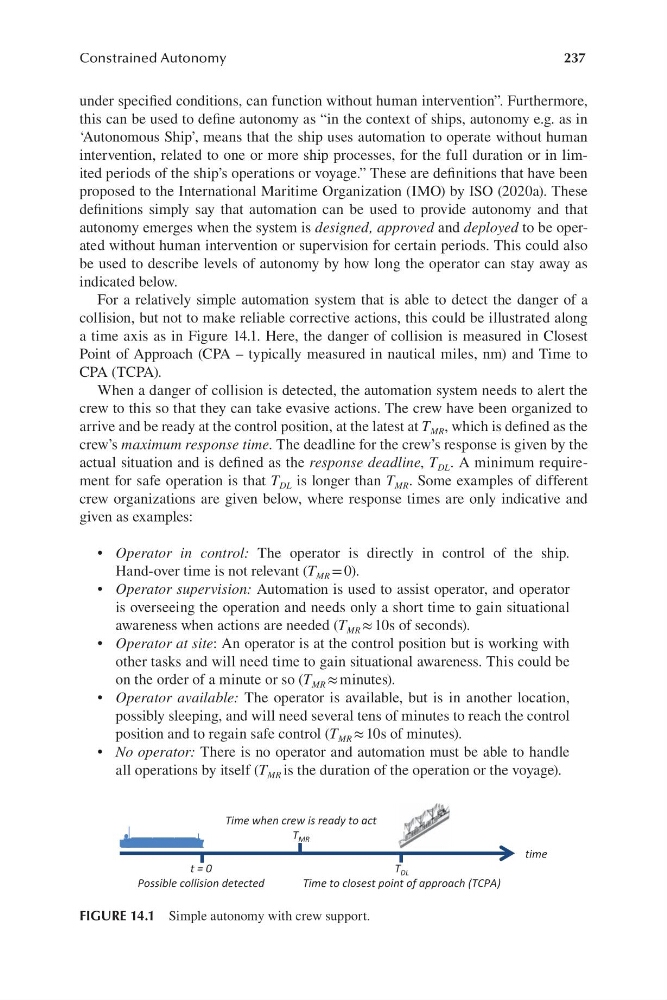
For a relatively simple automation system that is able to detect the danger of a
collision, but not to make reliable corrective actions, this could be illustrated along
a time axis as in Figure 14.1. Here, the danger of collision is measured in Closest
Point of Approach ( C PA – typically measured in nautical miles, nm) and Time to
CPA (TCPA).
When a danger of collision is detected, the automation system needs to alert the
crew to this so that they can take evasive actions. The crew have been organized to
arrive and be ready at the control position, at the latest at T MR , which is defined as the
crew’s maximum response time. The deadline for the crew’s response is given by the
actual situation and is defined as the response deadline, T DL . A minimum requirement for safe operation is that T DL is longer than T MR . Some examples of different
crew organizations are given below, where response times are only indicative and
given as examples:
• Operator in control: The operator is directly in control of the ship.
Hand-over time is not relevant (T MR = 0).
• Operator supervision: Automation is used to assist operator, and operator
is overseeing the operation and needs only a short time to gain situational
awareness when actions are needed (T MR ≈ 10s of seconds).
• Operator at site: An operator is at the control position but is working with
other tasks and will need time to gain situational awareness. This could be
on the order of a minute or so (T MR ≈ minutes).
• Operator available: The operator is available, but is in another location,
possibly sleeping, and will need several tens of minutes to reach the control
position and to regain safe control (T MR ≈ 10s of minutes).
• No operator: There is no operator and automation must be able to handle
all operations by itself (T MR is the duration of the operation or the voyage).
time
t = 0
Possible collision detected
T DL
Time to closest point of approach (TCPA)
Time when crew is ready to act
T MR
FIGURE 14.1 Simple autonomy with crew support.
Constrained Autonomy
under specified conditions, can function without human intervention”. Furthermore,
this can be used to define autonomy as “ in the context of ships, autonomy e.g. as in
‘ Autonomous Ship’, means that the ship uses automation to operate without human
intervention, related to one or more ship processes, for the full duration or in limited periods of the ship’s operations or voyage.” These are definitions that have been
proposed to the International Maritime Organization ( IMO) by ISO ( 2020a). These
definitions simply say that automation can be used to provide autonomy and that
autonomy emerges when the system is designed, approved and deployed to be operated without human intervention or supervision for certain periods. This could also
be used to describe levels of autonomy by how long the operator can stay away as
indicated below.
For a relatively simple automation system that is able to detect the danger of a
collision, but not to make reliable corrective actions, this could be illustrated along
a time axis as in Figure 14.1. Here, the danger of collision is measured in Closest
Point of Approach ( C PA – typically measured in nautical miles, nm) and Time to
CPA (TCPA).
When a danger of collision is detected, the automation system needs to alert the
crew to this so that they can take evasive actions. The crew have been organized to
arrive and be ready at the control position, at the latest at T MR , which is defined as the
crew’s maximum response time. The deadline for the crew’s response is given by the
actual situation and is defined as the response deadline, T DL . A minimum requirement for safe operation is that T DL is longer than T MR . Some examples of different
crew organizations are given below, where response times are only indicative and
given as examples:
• Operator in control: The operator is directly in control of the ship.
Hand-over time is not relevant (T MR = 0).
• Operator supervision: Automation is used to assist operator, and operator
is overseeing the operation and needs only a short time to gain situational
awareness when actions are needed (T MR ≈ 10s of seconds).
• Operator at site: An operator is at the control position but is working with
other tasks and will need time to gain situational awareness. This could be
on the order of a minute or so (T MR ≈ minutes).
• Operator available: The operator is available, but is in another location,
possibly sleeping, and will need several tens of minutes to reach the control
position and to regain safe control (T MR ≈ 10s of minutes).
• No operator: There is no operator and automation must be able to handle
all operations by itself (T MR is the duration of the operation or the voyage).
time
t = 0
Possible collision detected
T DL
Time to closest point of approach (TCPA)
Time when crew is ready to act
T MR
FIGURE 14.1 Simple autonomy with crew support.