

227
Application of Sensemaking
hinted at the significance of accurate input since the consequences of inputting
wrong information could result in a multimillion-dollar mishap.
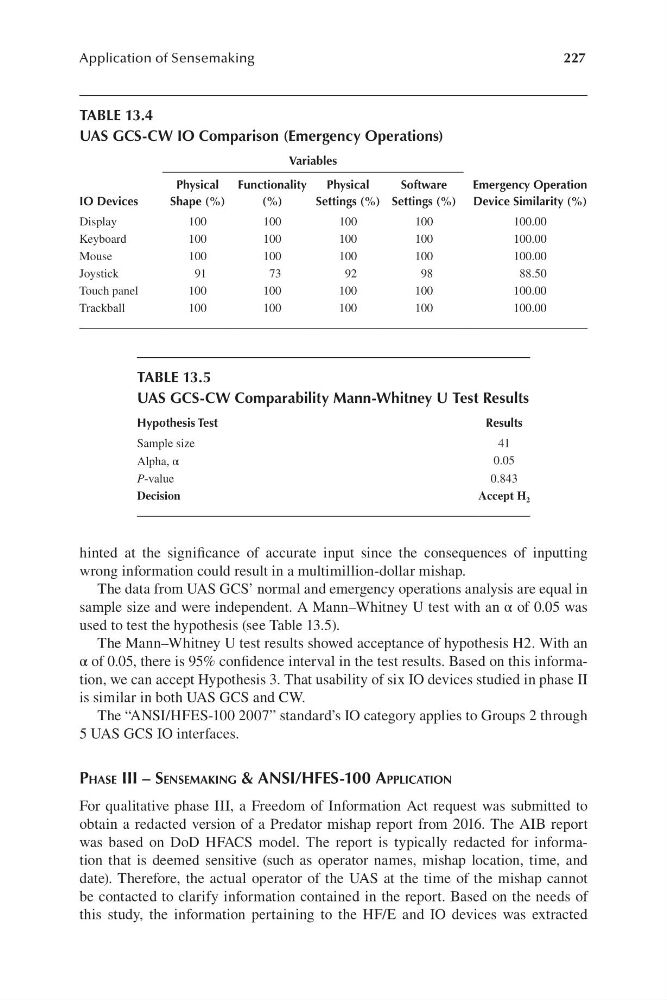
The data from UAS GCS’ normal and emergency operations analysis are equal in
sample size and were independent. A M ann–Whitney U test with an α of 0.05 was
used to test the hypothesis ( see Table 13.5).
The Mann–Whitney U test results showed acceptance of hypothesis H2. With an
α of 0.05, there is 95% confidence interval in the test results. Based on this information, we can accept Hypothesis 3. That usability of six IO devices studied in phase II
is similar in both UAS GCS and CW.
The “ ANSI/ HFES-100 2007” standard’s IO category applies to Groups 2 through
5 UAS GCS IO interfaces.
PhaSe iii – SenSemaking & anSi/ hfeS-100 aPPlication
For qualitative phase III, a Freedom of Information Act request was submitted to
obtain a redacted version of a Predator mishap report from 2016. The AIB report
was based on DoD HFACS model. The report is typically redacted for information that is deemed sensitive ( such as operator names, mishap location, time, and
date). Therefore, the actual operator of the UAS at the time of the mishap cannot
be contacted to clarify information contained in the report. Based on the needs of
this study, the information pertaining to the HF/ E and IO devices was extracted
TABLE 13.4
UAS GCS-CW IO Comparison (E mergency Operations)
Variables
Physical
Functionality
Physical
Software
Emergency Operation
IO Devices
Shape (%)
(%)
Settings (%) Settings (%) Device Similarity (%)
Display
100
100
100
100
100.00
Keyboard
100
100
100
100
100.00
Mouse
100
100
100
100
100.00
Joystick
91
73
92
98
88.50
Touch panel
100
100
100
100
100.00
Trackball
100
100
100
100
100.00
TABLE 13.5
UAS GCS-CW Comparability Mann-Whitney U Test Results
Hypothesis Test
Results
Sample size
41
Alpha, α
0.05
P-value
0.843
Decision
Accept H 2
Application of Sensemaking
hinted at the significance of accurate input since the consequences of inputting
wrong information could result in a multimillion-dollar mishap.
The data from UAS GCS’ normal and emergency operations analysis are equal in
sample size and were independent. A M ann–Whitney U test with an α of 0.05 was
used to test the hypothesis ( see Table 13.5).
The Mann–Whitney U test results showed acceptance of hypothesis H2. With an
α of 0.05, there is 95% confidence interval in the test results. Based on this information, we can accept Hypothesis 3. That usability of six IO devices studied in phase II
is similar in both UAS GCS and CW.
The “ ANSI/ HFES-100 2007” standard’s IO category applies to Groups 2 through
5 UAS GCS IO interfaces.
PhaSe iii – SenSemaking & anSi/ hfeS-100 aPPlication
For qualitative phase III, a Freedom of Information Act request was submitted to
obtain a redacted version of a Predator mishap report from 2016. The AIB report
was based on DoD HFACS model. The report is typically redacted for information that is deemed sensitive ( such as operator names, mishap location, time, and
date). Therefore, the actual operator of the UAS at the time of the mishap cannot
be contacted to clarify information contained in the report. Based on the needs of
this study, the information pertaining to the HF/ E and IO devices was extracted
TABLE 13.4
UAS GCS-CW IO Comparison (E mergency Operations)
Variables
Physical
Functionality
Physical
Software
Emergency Operation
IO Devices
Shape (%)
(%)
Settings (%) Settings (%) Device Similarity (%)
Display
100
100
100
100
100.00
Keyboard
100
100
100
100
100.00
Mouse
100
100
100
100
100.00
Joystick
91
73
92
98
88.50
Touch panel
100
100
100
100
100.00
Trackball
100
100
100
100
100.00
TABLE 13.5
UAS GCS-CW Comparability Mann-Whitney U Test Results
Hypothesis Test
Results
Sample size
41
Alpha, α
0.05
P-value
0.843
Decision
Accept H 2