

140
Sensemaking in Safety Critical and Complex Situations
of the sailors – and from a sensemaking perspective, i.e. how cues are shared and
the social collaboration helps to create a common mental model of what is going on.
Define
Asking the correct questions when assembling the information gathered in the previous phase, emphasizing, is important to get the correct angle to the “ problem” and
to define the problem and investigate how it might be possible to solve. During the
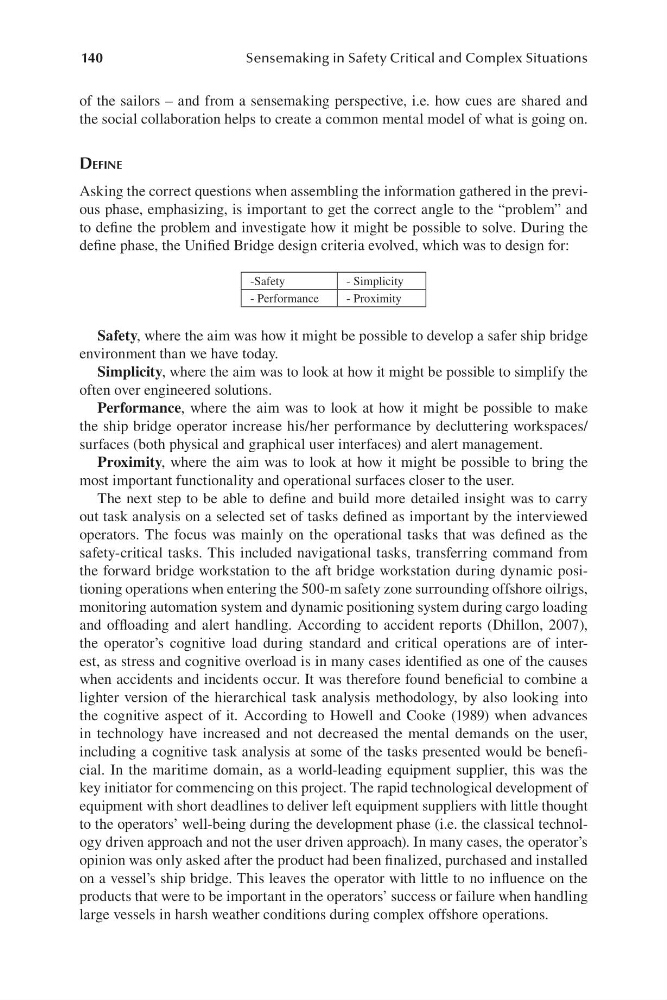
define phase, the Unified Bridge design criteria evolved, which was to design for:
Safety, where the aim was how it might be possible to develop a safer ship bridge
environment than we have today.
Simplicity, where the aim was to look at how it might be possible to simplify the
often over engineered solutions.
Performance, where the aim was to look at how it might be possible to make
the ship bridge operator increase his/ her performance by decluttering workspaces/
surfaces ( both physical and graphical user interfaces) and alert management.
Proximity, where the aim was to look at how it might be possible to bring the
most important functionality and operational surfaces closer to the user.
The next step to be able to define and build more detailed insight was to carry
out task analysis on a selected set of tasks defined as important by the interviewed
operators. The focus was mainly on the operational tasks that was defined as the
safety-critical tasks. This included navigational tasks, transferring command from
the forward bridge workstation to the aft bridge workstation during dynamic positioning operations when entering the 500-m safety zone surrounding offshore oilrigs,
monitoring automation system and dynamic positioning system during cargo loading
and offloading and alert handling. According to accident reports ( Dhillon, 2007),
the operator’s cognitive load during standard and critical operations are of interest, as stress and cognitive overload is in many cases identified as one of the causes
when accidents and incidents occur. It was therefore found beneficial to combine a
lighter version of the hierarchical task analysis methodology, by also looking into
the cognitive aspect of it. According to Howell and Cooke ( 1989) when advances
in technology have increased and not decreased the mental demands on the user,
including a cognitive task analysis at some of the tasks presented would be beneficial. In the maritime domain, as a world-leading equipment supplier, this was the
key initiator for commencing on this project. The rapid technological development of
equipment with short deadlines to deliver left equipment suppliers with little thought
to the operators’ well-being during the development phase ( i.e. the classical technology driven approach and not the user driven approach). In many cases, the operator’s
opinion was only asked after the product had been finalized, purchased and installed
on a vessel’s ship bridge. This leaves the operator with little to no influence on the
products that were to be important in the operators’ success or failure when handling
large vessels in harsh weather conditions during complex offshore operations.
-Safety
- Simplicity
- Performance
- Proximity
Sensemaking in Safety Critical and Complex Situations
of the sailors – and from a sensemaking perspective, i.e. how cues are shared and
the social collaboration helps to create a common mental model of what is going on.
Define
Asking the correct questions when assembling the information gathered in the previous phase, emphasizing, is important to get the correct angle to the “ problem” and
to define the problem and investigate how it might be possible to solve. During the
define phase, the Unified Bridge design criteria evolved, which was to design for:
Safety, where the aim was how it might be possible to develop a safer ship bridge
environment than we have today.
Simplicity, where the aim was to look at how it might be possible to simplify the
often over engineered solutions.
Performance, where the aim was to look at how it might be possible to make
the ship bridge operator increase his/ her performance by decluttering workspaces/
surfaces ( both physical and graphical user interfaces) and alert management.
Proximity, where the aim was to look at how it might be possible to bring the
most important functionality and operational surfaces closer to the user.
The next step to be able to define and build more detailed insight was to carry
out task analysis on a selected set of tasks defined as important by the interviewed
operators. The focus was mainly on the operational tasks that was defined as the
safety-critical tasks. This included navigational tasks, transferring command from
the forward bridge workstation to the aft bridge workstation during dynamic positioning operations when entering the 500-m safety zone surrounding offshore oilrigs,
monitoring automation system and dynamic positioning system during cargo loading
and offloading and alert handling. According to accident reports ( Dhillon, 2007),
the operator’s cognitive load during standard and critical operations are of interest, as stress and cognitive overload is in many cases identified as one of the causes
when accidents and incidents occur. It was therefore found beneficial to combine a
lighter version of the hierarchical task analysis methodology, by also looking into
the cognitive aspect of it. According to Howell and Cooke ( 1989) when advances
in technology have increased and not decreased the mental demands on the user,
including a cognitive task analysis at some of the tasks presented would be beneficial. In the maritime domain, as a world-leading equipment supplier, this was the
key initiator for commencing on this project. The rapid technological development of
equipment with short deadlines to deliver left equipment suppliers with little thought
to the operators’ well-being during the development phase ( i.e. the classical technology driven approach and not the user driven approach). In many cases, the operator’s
opinion was only asked after the product had been finalized, purchased and installed
on a vessel’s ship bridge. This leaves the operator with little to no influence on the
products that were to be important in the operators’ success or failure when handling
large vessels in harsh weather conditions during complex offshore operations.
-Safety
- Simplicity
- Performance
- Proximity