

120
Sensemaking in Safety Critical and Complex Situations
healthy teenagers and adults can concentrate to handle tasks without being distracted
is limited to 1 0–20 minutes ( Wilson & Korn 2017). Navigating in your own backyard
is a piece of cake and very easy. This is what my grandfather felt in the story above.
This might be what the driver of that water scooter and that fast leisure boat also felt
navigating in well-known areas. Accident investigations often talk about complacency, a feeling of calm satisfaction with your own abilities or situation especially
when accompanied by unawareness of actual dangers or deficiencies. Fifty years of
successfully sailing in and out of the port had made my grandfather complacent to
the danger posed by the shoal outside the pier.
The accidents described in the beginning of this paper could be examples of
“ human error”. According to Donald Norman ( 2013), one category of such errors is
slips. Slips occur when a user is on mental “ autopilot” and takes wrong actions pursuing a goal, typically when the user does not fully devote his or her attention to the
task at hand. The question a designer asks himself here is if there is any simple help
that can be provided to avoid these kinds of accidents in the future? The necessary
data are already available: the position of the boat and future position within a reasonable time frame and chart data showing water with enough depth to sail in. This
information could be available on a chart application ready to be used by a user. And
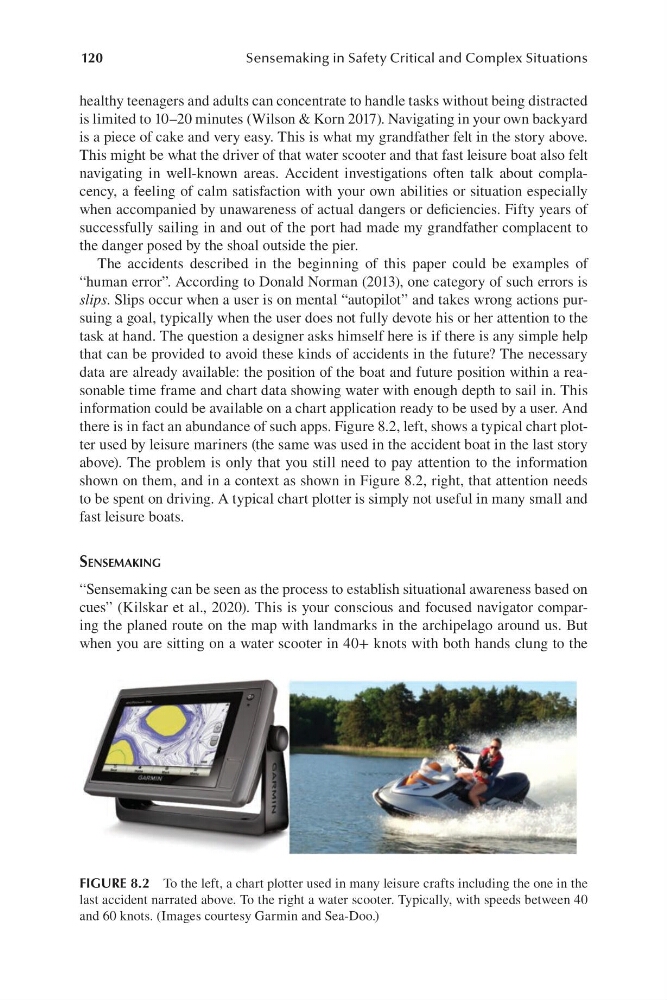
there is in fact an abundance of such apps. Figure 8.2, left, shows a typical chart plotter used by leisure mariners ( the same was used in the accident boat in the last story
above). The problem is only that you still need to pay attention to the information
shown on them, and in a context as shown in F igure 8.2, right, that attention needs
to be spent on driving. A typical chart plotter is simply not useful in many small and
fast leisure boats.
SenSemaking
“ Sensemaking can be seen as the process to establish situational awareness based on
cues” ( Kilskar et al., 2020). This is your conscious and focused navigator comparing the planed route on the map with landmarks in the archipelago around us. But
when you are sitting on a water scooter in 40+ knots with both hands clung to the
FIGURE 8.2 To the left, a chart plotter used in many leisure crafts including the one in the
last accident narrated above. To the right a water scooter. Typically, with speeds between 40
and 60 knots. ( Images courtesy Garmin and Sea-Doo.)
Sensemaking in Safety Critical and Complex Situations
healthy teenagers and adults can concentrate to handle tasks without being distracted
is limited to 1 0–20 minutes ( Wilson & Korn 2017). Navigating in your own backyard
is a piece of cake and very easy. This is what my grandfather felt in the story above.
This might be what the driver of that water scooter and that fast leisure boat also felt
navigating in well-known areas. Accident investigations often talk about complacency, a feeling of calm satisfaction with your own abilities or situation especially
when accompanied by unawareness of actual dangers or deficiencies. Fifty years of
successfully sailing in and out of the port had made my grandfather complacent to
the danger posed by the shoal outside the pier.
The accidents described in the beginning of this paper could be examples of
“ human error”. According to Donald Norman ( 2013), one category of such errors is
slips. Slips occur when a user is on mental “ autopilot” and takes wrong actions pursuing a goal, typically when the user does not fully devote his or her attention to the
task at hand. The question a designer asks himself here is if there is any simple help
that can be provided to avoid these kinds of accidents in the future? The necessary
data are already available: the position of the boat and future position within a reasonable time frame and chart data showing water with enough depth to sail in. This
information could be available on a chart application ready to be used by a user. And
there is in fact an abundance of such apps. Figure 8.2, left, shows a typical chart plotter used by leisure mariners ( the same was used in the accident boat in the last story
above). The problem is only that you still need to pay attention to the information
shown on them, and in a context as shown in F igure 8.2, right, that attention needs
to be spent on driving. A typical chart plotter is simply not useful in many small and
fast leisure boats.
SenSemaking
“ Sensemaking can be seen as the process to establish situational awareness based on
cues” ( Kilskar et al., 2020). This is your conscious and focused navigator comparing the planed route on the map with landmarks in the archipelago around us. But
when you are sitting on a water scooter in 40+ knots with both hands clung to the
FIGURE 8.2 To the left, a chart plotter used in many leisure crafts including the one in the
last accident narrated above. To the right a water scooter. Typically, with speeds between 40
and 60 knots. ( Images courtesy Garmin and Sea-Doo.)