

62
The Chemistry and Technology of Petroleum
excess of 200°C (390°F) would be required to bring about any significant amount of conversion for
such a process within a geologically acceptable period.
Current estimates of the increase in temperature with depth (0.015°C, 0.012°F/ft of depth) indicate the depths required to attain such a temperature, assuming, of course, that the temperature
gradient remained approximately the same during the oil-forming period. Indeed, current concepts
of the principal phase of oil formation favor a low-temperature process, whether the process is bacterial or chemical.
However, much of the laboratory work has been carried out at temperatures on the order of
300°C (570°F). The geothermal gradient varies from place to place, but is generally in the range
25°C–30°C/km (15°F/1000 ft or 120°C/1000 ft, i.e., 0.015°C/ft of depth or 0.012°C/ft of depth).
A temperature on the order of 240°C (465°F) represents a source rock at about 20,000 ft. Then it
is assumed that laboratory simulations of petroleum formation using temperatures on the order of
300°C (570°F) provide a quicker response than geologic time at lower temperatures; after all who
can plan laboratory experiments that may have to last several million years!
This may be interpreted that all petroleum generation involving thermal alteration of the sedimentary matter starts at extreme depths; decarboxylation of acidic functions will commence at
lower temperatures and, therefore, closer to the surface. Even if the petroleum-forming reactions
can proceed at 200°C (390°F), using the current thermal gradient, depths in excess of 25,000 ft are
required to attain such a temperature.
The thermal alteration of kerogen (Chapter 5) has also been the subject of much experimentation
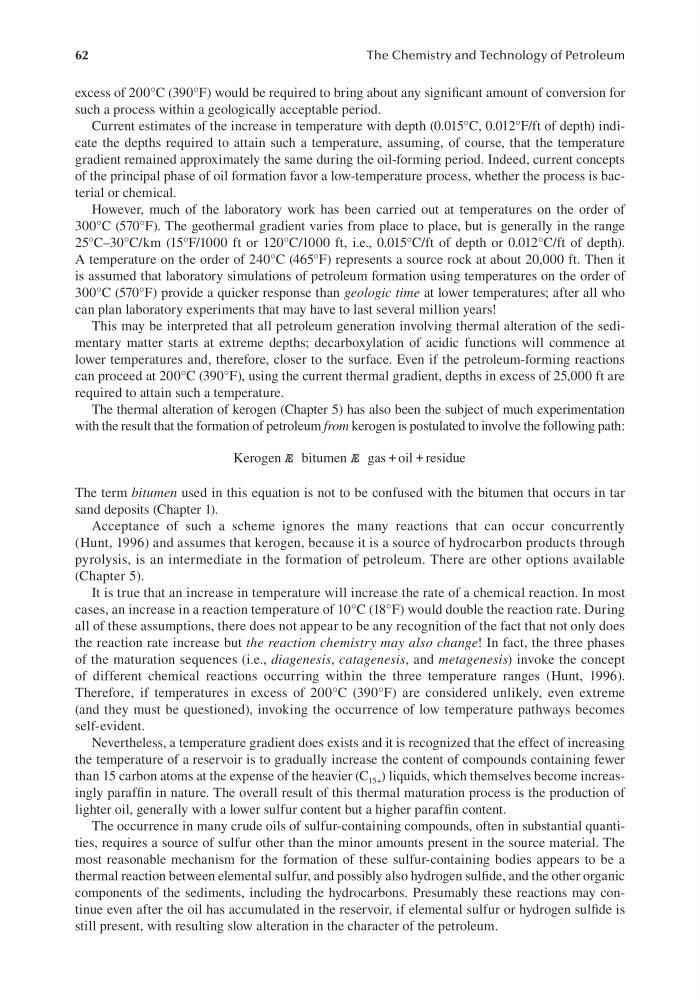
with the result that the formation of petroleum from kerogen is postulated to involve the following path:
Kerogen bitumen gas oil residue
Æ
Æ
+ +
The term bitumen used in this equation is not to be confused with the bitumen that occurs in tar
sand deposits (Chapter 1).
Acceptance of such a scheme ignores the many reactions that can occur concurrently
(Hunt, 1996) and assumes that kerogen, because it is a source of hydrocarbon products through
pyrolysis, is an intermediate in the formation of petroleum. There are other options available
(Chapter 5).
It is true that an increase in temperature will increase the rate of a chemical reaction. In most
cases, an increase in a reaction temperature of 10°C (18°F) would double the reaction rate. During
all of these assumptions, there does not appear to be any recognition of the fact that not only does
the reaction rate increase but the reaction chemistry may also change! In fact, the three phases
of the maturation sequences (i.e., diagenesis, catagenesis, and metagenesis) invoke the concept
of different chemical reactions occurring within the three temperature ranges (Hunt, 1996).
Therefore, if temperatures in excess of 200°C (390°F) are considered unlikely, even extreme
(and they must be questioned), invoking the occurrence of low temperature pathways becomes
self-evident.
Nevertheless, a temperature gradient does exists and it is recognized that the effect of increasing
the temperature of a reservoir is to gradually increase the content of compounds containing fewer
than 15 carbon atoms at the expense of the heavier (C 15+ ) liquids, which themselves become increasingly paraffin in nature. The overall result of this thermal maturation process is the production of
lighter oil, generally with a lower sulfur content but a higher paraffin content.
The occurrence in many crude oils of sulfur-containing compounds, often in substantial quantities, requires a source of sulfur other than the minor amounts present in the source material. The
most reasonable mechanism for the formation of these sulfur-containing bodies appears to be a
thermal reaction between elemental sulfur, and possibly also hydrogen sulfide, and the other organic
components of the sediments, including the hydrocarbons. Presumably these reactions may continue even after the oil has accumulated in the reservoir, if elemental sulfur or hydrogen sulfide is
still present, with resulting slow alteration in the character of the petroleum.
The Chemistry and Technology of Petroleum
excess of 200°C (390°F) would be required to bring about any significant amount of conversion for
such a process within a geologically acceptable period.
Current estimates of the increase in temperature with depth (0.015°C, 0.012°F/ft of depth) indicate the depths required to attain such a temperature, assuming, of course, that the temperature
gradient remained approximately the same during the oil-forming period. Indeed, current concepts
of the principal phase of oil formation favor a low-temperature process, whether the process is bacterial or chemical.
However, much of the laboratory work has been carried out at temperatures on the order of
300°C (570°F). The geothermal gradient varies from place to place, but is generally in the range
25°C–30°C/km (15°F/1000 ft or 120°C/1000 ft, i.e., 0.015°C/ft of depth or 0.012°C/ft of depth).
A temperature on the order of 240°C (465°F) represents a source rock at about 20,000 ft. Then it
is assumed that laboratory simulations of petroleum formation using temperatures on the order of
300°C (570°F) provide a quicker response than geologic time at lower temperatures; after all who
can plan laboratory experiments that may have to last several million years!
This may be interpreted that all petroleum generation involving thermal alteration of the sedimentary matter starts at extreme depths; decarboxylation of acidic functions will commence at
lower temperatures and, therefore, closer to the surface. Even if the petroleum-forming reactions
can proceed at 200°C (390°F), using the current thermal gradient, depths in excess of 25,000 ft are
required to attain such a temperature.
The thermal alteration of kerogen (Chapter 5) has also been the subject of much experimentation
with the result that the formation of petroleum from kerogen is postulated to involve the following path:
Kerogen bitumen gas oil residue
Æ
Æ
+ +
The term bitumen used in this equation is not to be confused with the bitumen that occurs in tar
sand deposits (Chapter 1).
Acceptance of such a scheme ignores the many reactions that can occur concurrently
(Hunt, 1996) and assumes that kerogen, because it is a source of hydrocarbon products through
pyrolysis, is an intermediate in the formation of petroleum. There are other options available
(Chapter 5).
It is true that an increase in temperature will increase the rate of a chemical reaction. In most
cases, an increase in a reaction temperature of 10°C (18°F) would double the reaction rate. During
all of these assumptions, there does not appear to be any recognition of the fact that not only does
the reaction rate increase but the reaction chemistry may also change! In fact, the three phases
of the maturation sequences (i.e., diagenesis, catagenesis, and metagenesis) invoke the concept
of different chemical reactions occurring within the three temperature ranges (Hunt, 1996).
Therefore, if temperatures in excess of 200°C (390°F) are considered unlikely, even extreme
(and they must be questioned), invoking the occurrence of low temperature pathways becomes
self-evident.
Nevertheless, a temperature gradient does exists and it is recognized that the effect of increasing
the temperature of a reservoir is to gradually increase the content of compounds containing fewer
than 15 carbon atoms at the expense of the heavier (C 15+ ) liquids, which themselves become increasingly paraffin in nature. The overall result of this thermal maturation process is the production of
lighter oil, generally with a lower sulfur content but a higher paraffin content.
The occurrence in many crude oils of sulfur-containing compounds, often in substantial quantities, requires a source of sulfur other than the minor amounts present in the source material. The
most reasonable mechanism for the formation of these sulfur-containing bodies appears to be a
thermal reaction between elemental sulfur, and possibly also hydrogen sulfide, and the other organic
components of the sediments, including the hydrocarbons. Presumably these reactions may continue even after the oil has accumulated in the reservoir, if elemental sulfur or hydrogen sulfide is
still present, with resulting slow alteration in the character of the petroleum.