

58
The Chemistry and Technology of Petroleum
the network of capillaries and pores must take place in the presence of the aqueous pore fluid. Such
movement may be due to active water flow or may occur independently of the aqueous phase, either
by displacement or by diffusion. There may be a single phase (oil and gas dissolved in water) or a
multiphase (separate water and hydrocarbon phases) fluid system. The loss of hydrocarbons from a
trap is referred to as dismigration.
The specific gravity of gas and petroleum, the latter generally between specific gravity
(at 60°F, 15.6°C) that varies from about 0.75 to 1.00 (57 to 10°API), with the specific gravity of
most crude oils falling in the range 0.80–0.95 (45–17°API), are considerably lower than those of
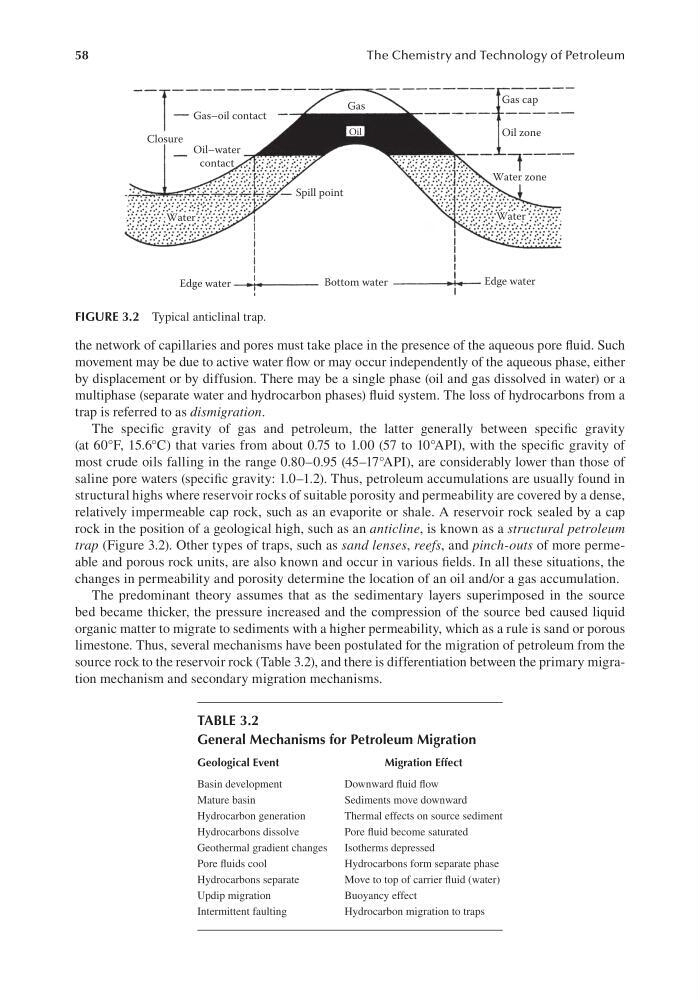
saline pore waters (specific gravity: 1.0–1.2). Thus, petroleum accumulations are usually found in
structural highs where reservoir rocks of suitable porosity and permeability are covered by a dense,
relatively impermeable cap rock, such as an evaporite or shale. A reservoir rock sealed by a cap
rock in the position of a geological high, such as an anticline, is known as a structural petroleum
trap (Figure 3.2). Other types of traps, such as sand lenses, reefs, and pinch-outs of more permeable and porous rock units, are also known and occur in various fields. In all these situations, the
changes in permeability and porosity determine the location of an oil and/or a gas accumulation.
The predominant theory assumes that as the sedimentary layers superimposed in the source
bed became thicker, the pressure increased and the compression of the source bed caused liquid
organic matter to migrate to sediments with a higher permeability, which as a rule is sand or porous
limestone. Thus, several mechanisms have been postulated for the migration of petroleum from the
source rock to the reservoir rock (Table 3.2), and there is differentiation between the primary migration mechanism and secondary migration mechanisms.
Bottom water
Spill point
Gas cap
Closure
Oil
Oil zone
Gas
Gas–oil contact
Oil–water
contact
Water
Water
Water zone
Edge water
Edge water
FIGURE 3.2 Typical anticlinal trap.
TABLE 3.2
General Mechanisms for Petroleum Migration
Geological Event
Migration Effect
Basin development
Downward fluid flow
Mature basin
Sediments move downward
Hydrocarbon generation
Thermal effects on source sediment
Hydrocarbons dissolve
Pore fluid become saturated
Geothermal gradient changes
Isotherms depressed
Pore fluids cool
Hydrocarbons form separate phase
Hydrocarbons separate
Move to top of carrier fluid (water)
Updip migration
Buoyancy effect
Intermittent faulting
Hydrocarbon migration to traps
The Chemistry and Technology of Petroleum
the network of capillaries and pores must take place in the presence of the aqueous pore fluid. Such
movement may be due to active water flow or may occur independently of the aqueous phase, either
by displacement or by diffusion. There may be a single phase (oil and gas dissolved in water) or a
multiphase (separate water and hydrocarbon phases) fluid system. The loss of hydrocarbons from a
trap is referred to as dismigration.
The specific gravity of gas and petroleum, the latter generally between specific gravity
(at 60°F, 15.6°C) that varies from about 0.75 to 1.00 (57 to 10°API), with the specific gravity of
most crude oils falling in the range 0.80–0.95 (45–17°API), are considerably lower than those of
saline pore waters (specific gravity: 1.0–1.2). Thus, petroleum accumulations are usually found in
structural highs where reservoir rocks of suitable porosity and permeability are covered by a dense,
relatively impermeable cap rock, such as an evaporite or shale. A reservoir rock sealed by a cap
rock in the position of a geological high, such as an anticline, is known as a structural petroleum
trap (Figure 3.2). Other types of traps, such as sand lenses, reefs, and pinch-outs of more permeable and porous rock units, are also known and occur in various fields. In all these situations, the
changes in permeability and porosity determine the location of an oil and/or a gas accumulation.
The predominant theory assumes that as the sedimentary layers superimposed in the source
bed became thicker, the pressure increased and the compression of the source bed caused liquid
organic matter to migrate to sediments with a higher permeability, which as a rule is sand or porous
limestone. Thus, several mechanisms have been postulated for the migration of petroleum from the
source rock to the reservoir rock (Table 3.2), and there is differentiation between the primary migration mechanism and secondary migration mechanisms.
Bottom water
Spill point
Gas cap
Closure
Oil
Oil zone
Gas
Gas–oil contact
Oil–water
contact
Water
Water
Water zone
Edge water
Edge water
FIGURE 3.2 Typical anticlinal trap.
TABLE 3.2
General Mechanisms for Petroleum Migration
Geological Event
Migration Effect
Basin development
Downward fluid flow
Mature basin
Sediments move downward
Hydrocarbon generation
Thermal effects on source sediment
Hydrocarbons dissolve
Pore fluid become saturated
Geothermal gradient changes
Isotherms depressed
Pore fluids cool
Hydrocarbons form separate phase
Hydrocarbons separate
Move to top of carrier fluid (water)
Updip migration
Buoyancy effect
Intermittent faulting
Hydrocarbon migration to traps