

55
Origin and Occurrence
low pH values. This structure allows the humic materials to function as surfactants, with the ability
to bind both hydrophobic and hydrophilic materials. This function, in combination with their colloidal properties, makes humic and fulvic materials effective agents in transporting both organic
and inorganic contaminants in the environment.
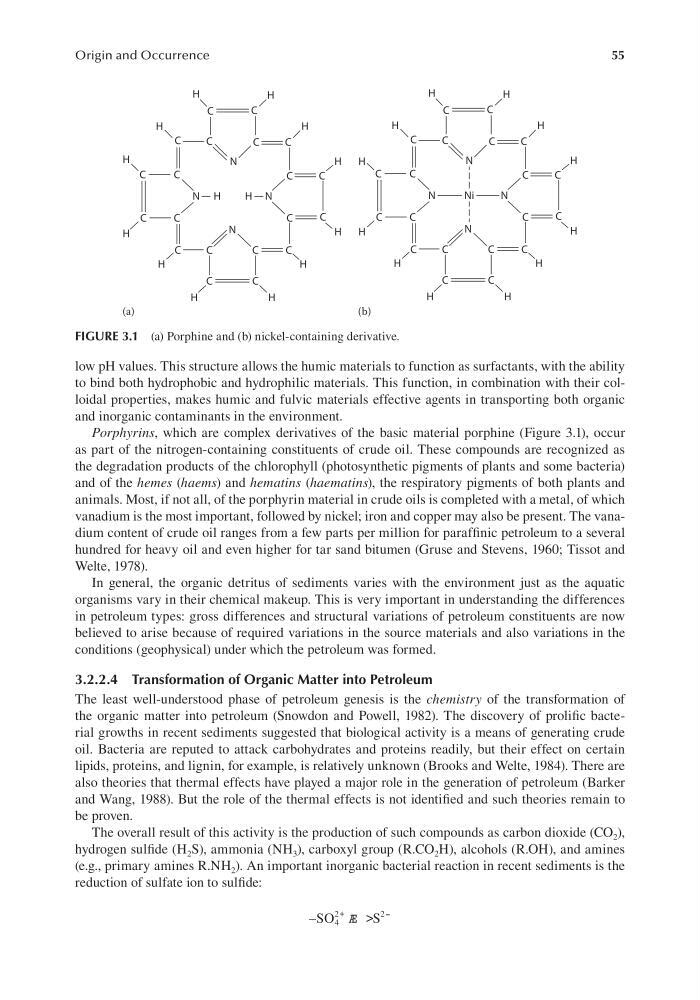
Porphyrins, which are complex derivatives of the basic material porphine (Figure 3.1), occur
as part of the nitrogen-containing constituents of crude oil. These compounds are recognized as
the degradation products of the chlorophyll (photosynthetic pigments of plants and some bacteria)
and of the hemes (haems) and hematins (haematins), the respiratory pigments of both plants and
animals. Most, if not all, of the porphyrin material in crude oils is completed with a metal, of which
vanadium is the most important, followed by nickel; iron and copper may also be present. The vanadium content of crude oil ranges from a few parts per million for paraffinic petroleum to a several
hundred for heavy oil and even higher for tar sand bitumen (Gruse and Stevens, 1960; Tissot and
Welte, 1978).
In general, the organic detritus of sediments varies with the environment just as the aquatic
organisms vary in their chemical makeup. This is very important in understanding the differences
in petroleum types: gross differences and structural variations of petroleum constituents are now
believed to arise because of required variations in the source materials and also variations in the
conditions (geophysical) under which the petroleum was formed.
3.2.2.4 Transformation of Organic Matter into Petroleum
The least well-understood phase of petroleum genesis is the chemistry of the transformation of
the organic matter into petroleum (Snowdon and Powell, 1982). The discovery of prolific bacterial growths in recent sediments suggested that biological activity is a means of generating crude
oil. Bacteria are reputed to attack carbohydrates and proteins readily, but their effect on certain
lipids, proteins, and lignin, for example, is relatively unknown (Brooks and Welte, 1984). There are
also theories that thermal effects have played a major role in the generation of petroleum (Barker
and Wang, 1988). But the role of the thermal effects is not identified and such theories remain to
be proven.
The overall result of this activity is the production of such compounds as carbon dioxide (CO 2 ),
hydrogen sulfide (H 2 S), ammonia (NH 3 ), carboxyl group (R.CO 2 H), alcohols (R.OH), and amines
(e.g., primary amines R.NH 2 ). An important inorganic bacterial reaction in recent sediments is the
reduction of sulfate ion to sulfide:
–SO
S
4
2
2
+
-
Æ >
(a)
(b)
N
N
N
N
C
C
C
C
C
H
H
H
H
H
H
H
H
H
H
H
H
H
H
C
C
C
C
C
C
C
C
C
C
C
C
C
C
C
N
N i
N
N
N
C
C
C
C
C
H
H
H
H
H
H
H
H
H
H
H
H
C
C
C
C
C
C
C
C
C
C
C
C
C
C
C
FIGURE 3.1 (a) Porphine and (b) nickel-containing derivative.
Origin and Occurrence
low pH values. This structure allows the humic materials to function as surfactants, with the ability
to bind both hydrophobic and hydrophilic materials. This function, in combination with their colloidal properties, makes humic and fulvic materials effective agents in transporting both organic
and inorganic contaminants in the environment.
Porphyrins, which are complex derivatives of the basic material porphine (Figure 3.1), occur
as part of the nitrogen-containing constituents of crude oil. These compounds are recognized as
the degradation products of the chlorophyll (photosynthetic pigments of plants and some bacteria)
and of the hemes (haems) and hematins (haematins), the respiratory pigments of both plants and
animals. Most, if not all, of the porphyrin material in crude oils is completed with a metal, of which
vanadium is the most important, followed by nickel; iron and copper may also be present. The vanadium content of crude oil ranges from a few parts per million for paraffinic petroleum to a several
hundred for heavy oil and even higher for tar sand bitumen (Gruse and Stevens, 1960; Tissot and
Welte, 1978).
In general, the organic detritus of sediments varies with the environment just as the aquatic
organisms vary in their chemical makeup. This is very important in understanding the differences
in petroleum types: gross differences and structural variations of petroleum constituents are now
believed to arise because of required variations in the source materials and also variations in the
conditions (geophysical) under which the petroleum was formed.
3.2.2.4 Transformation of Organic Matter into Petroleum
The least well-understood phase of petroleum genesis is the chemistry of the transformation of
the organic matter into petroleum (Snowdon and Powell, 1982). The discovery of prolific bacterial growths in recent sediments suggested that biological activity is a means of generating crude
oil. Bacteria are reputed to attack carbohydrates and proteins readily, but their effect on certain
lipids, proteins, and lignin, for example, is relatively unknown (Brooks and Welte, 1984). There are
also theories that thermal effects have played a major role in the generation of petroleum (Barker
and Wang, 1988). But the role of the thermal effects is not identified and such theories remain to
be proven.
The overall result of this activity is the production of such compounds as carbon dioxide (CO 2 ),
hydrogen sulfide (H 2 S), ammonia (NH 3 ), carboxyl group (R.CO 2 H), alcohols (R.OH), and amines
(e.g., primary amines R.NH 2 ). An important inorganic bacterial reaction in recent sediments is the
reduction of sulfate ion to sulfide:
–SO
S
4
2
2
+
-
Æ >
(a)
(b)
N
N
N
N
C
C
C
C
C
H
H
H
H
H
H
H
H
H
H
H
H
H
H
C
C
C
C
C
C
C
C
C
C
C
C
C
C
C
N
N i
N
N
N
C
C
C
C
C
H
H
H
H
H
H
H
H
H
H
H
H
C
C
C
C
C
C
C
C
C
C
C
C
C
C
C
FIGURE 3.1 (a) Porphine and (b) nickel-containing derivative.