

48
The Chemistry and Technology of Petroleum
3.2.1 ABIogenIC orIgIn
There have been several attempts at formulating theories that describe the detail of the origin of
petroleum, of which the early postulates started with inorganic substances as source material. For
example, in 1866, Berthelot considered acetylene the basic material and crude oil constituents were
produced from acetylene. Initially, inorganic carbides were formed by the action of alkali metals on
carbonates after which acetylene was produced by the reaction of the carbides with water:
CaCO alkali metal CaC calcium carbide
3
2
+
Æ
(
)
CaC H O HC CH acetylene
petroleum
2
2
+
Æ
∫
Æ
(
)
Mendelejeff, who proposed that the action of dilute acids or hot water on mixed iron and manganese carbides produces a mixture of hydrocarbons from which petroleum evolved, described
another theory in which acetylene is considered to be the basic material:
Fe C H O H
hydrocarbons petroleum
3
2
+
+
Æ
Æ
+
Mn C H O H
hydrocarbons petroleum
3
2
+
+
Æ
Æ
+
There are also several recent theories related to the formation of petroleum from nonbiogenic
sources in the Earth (Gold and Soter, 1980, 1982; Szatmari, 1989).
Thus, the idea of abiogenic petroleum origin proposes that large amounts of carbon exist naturally
in the planet, some in the form of hydrocarbons. Hydrocarbons are less dense than aqueous pore
fluids and migrate upward through deep fracture networks. Thermophilic, rock-dwelling microbial
life-forms are in part responsible for the biomarkers found in petroleum. However, their role in the
formation, alteration, or contamination of the various hydrocarbon deposits is not yet understood.
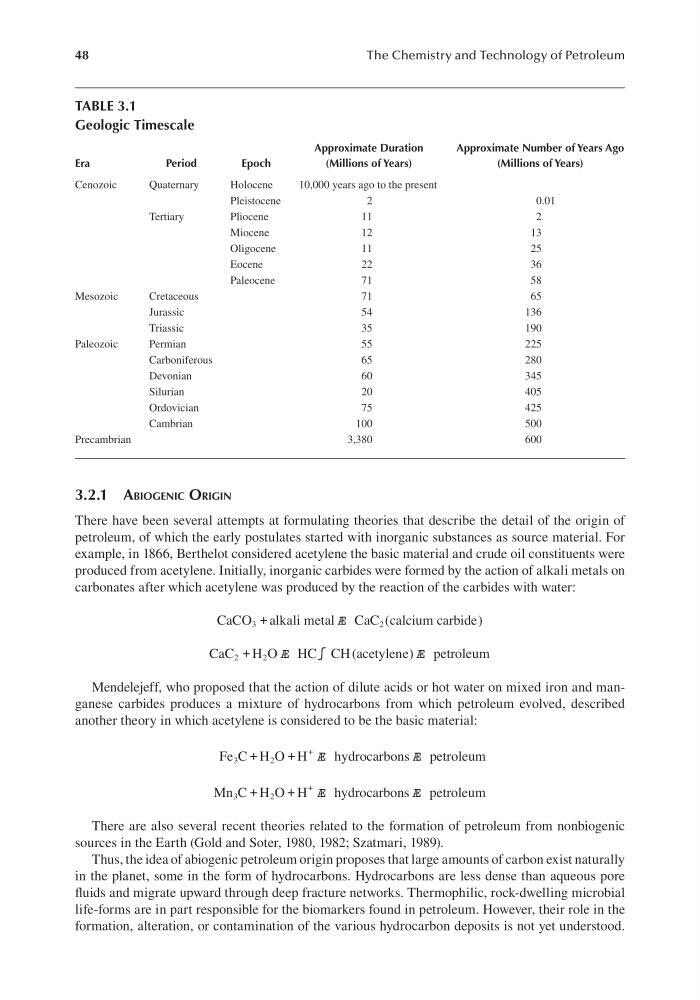
TABLE 3.1
Geologic Timescale
Era
Period
Epoch
Approximate Duration
(Millions of Years)
Approximate Number of Years Ago
(Millions of Years)
Cenozoic
Quaternary
Holocene
10,000 years ago to the present
Pleistocene
2
0.01
Tertiary
Pliocene
11
2
Miocene
12
13
Oligocene
11
25
Eocene
22
36
Paleocene
71
58
Mesozoic
Cretaceous
71
65
Jurassic
54
136
Triassic
35
190
Paleozoic
Permian
55
225
Carboniferous
65
280
Devonian
60
345
Silurian
20
405
Ordovician
75
425
Cambrian
100
500
Precambrian
3,380
600
The Chemistry and Technology of Petroleum
3.2.1 ABIogenIC orIgIn
There have been several attempts at formulating theories that describe the detail of the origin of
petroleum, of which the early postulates started with inorganic substances as source material. For
example, in 1866, Berthelot considered acetylene the basic material and crude oil constituents were
produced from acetylene. Initially, inorganic carbides were formed by the action of alkali metals on
carbonates after which acetylene was produced by the reaction of the carbides with water:
CaCO alkali metal CaC calcium carbide
3
2
+
Æ
(
)
CaC H O HC CH acetylene
petroleum
2
2
+
Æ
∫
Æ
(
)
Mendelejeff, who proposed that the action of dilute acids or hot water on mixed iron and manganese carbides produces a mixture of hydrocarbons from which petroleum evolved, described
another theory in which acetylene is considered to be the basic material:
Fe C H O H
hydrocarbons petroleum
3
2
+
+
Æ
Æ
+
Mn C H O H
hydrocarbons petroleum
3
2
+
+
Æ
Æ
+
There are also several recent theories related to the formation of petroleum from nonbiogenic
sources in the Earth (Gold and Soter, 1980, 1982; Szatmari, 1989).
Thus, the idea of abiogenic petroleum origin proposes that large amounts of carbon exist naturally
in the planet, some in the form of hydrocarbons. Hydrocarbons are less dense than aqueous pore
fluids and migrate upward through deep fracture networks. Thermophilic, rock-dwelling microbial
life-forms are in part responsible for the biomarkers found in petroleum. However, their role in the
formation, alteration, or contamination of the various hydrocarbon deposits is not yet understood.
TABLE 3.1
Geologic Timescale
Era
Period
Epoch
Approximate Duration
(Millions of Years)
Approximate Number of Years Ago
(Millions of Years)
Cenozoic
Quaternary
Holocene
10,000 years ago to the present
Pleistocene
2
0.01
Tertiary
Pliocene
11
2
Miocene
12
13
Oligocene
11
25
Eocene
22
36
Paleocene
71
58
Mesozoic
Cretaceous
71
65
Jurassic
54
136
Triassic
35
190
Paleozoic
Permian
55
225
Carboniferous
65
280
Devonian
60
345
Silurian
20
405
Ordovician
75
425
Cambrian
100
500
Precambrian
3,380
600