

41
Classification
been recorded for the bitumen in Utah with formation temperatures on the order of 10°C (50°F).
This indicates that the bitumen is solid within the deposit and therefore immobile. The injection
of steam to raise and maintain the reservoir temperature above the pour point of the bitumen and
to enhance bitumen mobility is difficult, in some cases almost impossible. Conversely, when the
reservoir temperature exceeds the pour point, the oil is fluid in the reservoir and therefore mobile.
The injection of steam to raise and maintain the reservoir temperature above the pour point of the
bitumen and to enhance bitumen mobility is possible and oil recovery can be achieved.
A method that uses the pour point of the oil and the reservoir temperature adds a specific qualification to the term extremely viscous as it occurs in the definition of tar sand. In fact, when used in
conjunction with the recovery method, pour point offers more general applicability to the conditions
of the oil in the reservoir or the bitumen in the deposit and comparison of the two temperatures
(pour point and reservoir temperatures) shows promise and warrants further consideration.
2.3 MISCELLANEOUS SYSTEMS
Predicting the behavior of crude oil during production and refining operations requires a detailed
knowledge of the structure of crude oil and the interrelationships of the various constituents
(Chapter 13). The classical approach of correlating properties with structural types has proved to be
of some value. However, determining the structural types that will dominate the properties of crude
oil is often difficult. Thus, other classification systems have evolved.
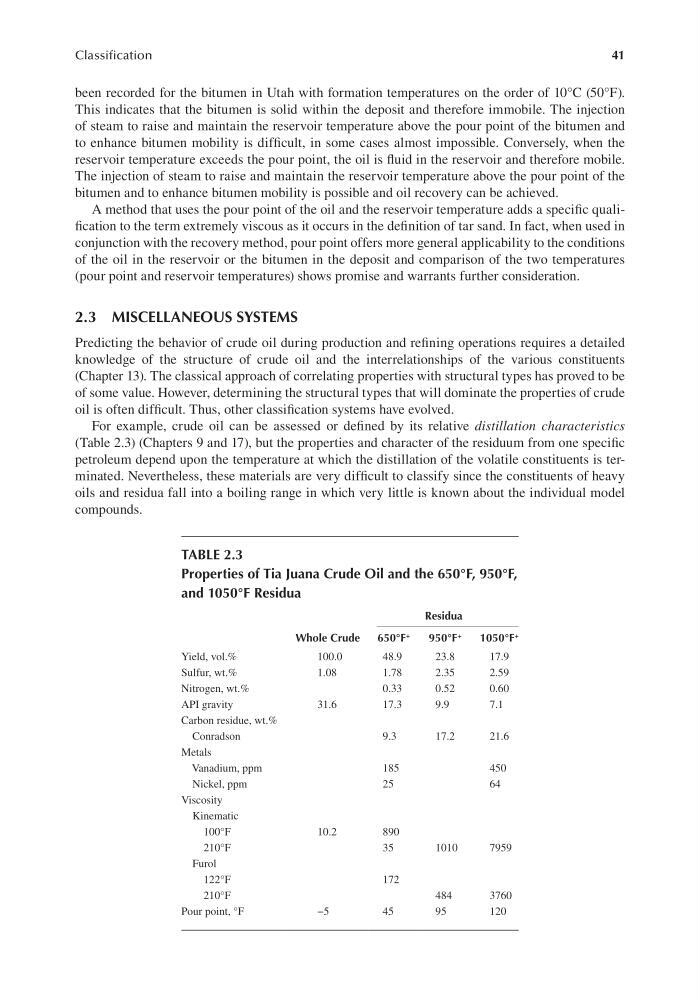
For example, crude oil can be assessed or defined by its relative distillation characteristics
(Table 2.3) (Chapters 9 and 17), but the properties and character of the residuum from one specific
petroleum depend upon the temperature at which the distillation of the volatile constituents is terminated. Nevertheless, these materials are very difficult to classify since the constituents of heavy
oils and residua fall into a boiling range in which very little is known about the individual model
compounds.
TABLE 2.3
Properties of Tia Juana Crude Oil and the 650°F, 950°F,
and 1050°F Residua
Whole Crude
Residua
650°F +
950°F +
1050°F +
Yield, vol.%
100.0
48.9
23.8
17.9
Sulfur, wt.%
1.08
1.78
2.35
2.59
Nitrogen, wt.%
0.33
0.52
0.60
API gravity
31.6
17.3
9.9
7.1
Carbon residue, wt.%
Conradson
9.3
17.2
21.6
Metals
Vanadium, ppm
185
450
Nickel, ppm
25
64
Viscosity
Kinematic
100°F
10.2
890
210°F
35
1010
7959
Furol
122°F
172
210°F
484
3760
Pour point, °F
−5
45
95
120
Classification
been recorded for the bitumen in Utah with formation temperatures on the order of 10°C (50°F).
This indicates that the bitumen is solid within the deposit and therefore immobile. The injection
of steam to raise and maintain the reservoir temperature above the pour point of the bitumen and
to enhance bitumen mobility is difficult, in some cases almost impossible. Conversely, when the
reservoir temperature exceeds the pour point, the oil is fluid in the reservoir and therefore mobile.
The injection of steam to raise and maintain the reservoir temperature above the pour point of the
bitumen and to enhance bitumen mobility is possible and oil recovery can be achieved.
A method that uses the pour point of the oil and the reservoir temperature adds a specific qualification to the term extremely viscous as it occurs in the definition of tar sand. In fact, when used in
conjunction with the recovery method, pour point offers more general applicability to the conditions
of the oil in the reservoir or the bitumen in the deposit and comparison of the two temperatures
(pour point and reservoir temperatures) shows promise and warrants further consideration.
2.3 MISCELLANEOUS SYSTEMS
Predicting the behavior of crude oil during production and refining operations requires a detailed
knowledge of the structure of crude oil and the interrelationships of the various constituents
(Chapter 13). The classical approach of correlating properties with structural types has proved to be
of some value. However, determining the structural types that will dominate the properties of crude
oil is often difficult. Thus, other classification systems have evolved.
For example, crude oil can be assessed or defined by its relative distillation characteristics
(Table 2.3) (Chapters 9 and 17), but the properties and character of the residuum from one specific
petroleum depend upon the temperature at which the distillation of the volatile constituents is terminated. Nevertheless, these materials are very difficult to classify since the constituents of heavy
oils and residua fall into a boiling range in which very little is known about the individual model
compounds.
TABLE 2.3
Properties of Tia Juana Crude Oil and the 650°F, 950°F,
and 1050°F Residua
Whole Crude
Residua
650°F +
950°F +
1050°F +
Yield, vol.%
100.0
48.9
23.8
17.9
Sulfur, wt.%
1.08
1.78
2.35
2.59
Nitrogen, wt.%
0.33
0.52
0.60
API gravity
31.6
17.3
9.9
7.1
Carbon residue, wt.%
Conradson
9.3
17.2
21.6
Metals
Vanadium, ppm
185
450
Nickel, ppm
25
64
Viscosity
Kinematic
100°F
10.2
890
210°F
35
1010
7959
Furol
122°F
172
210°F
484
3760
Pour point, °F
−5
45
95
120