

645
Hydrogen Production
The reactor temperatures vary from 1095°C to 1490°C (2000°F to 2700°F), while pressures
can vary from approximately atmospheric pressure to approximately 2000 psi. The process has
the capability of producing high-purity hydrogen, although the extent of the purification procedure depends upon the use to which the hydrogen is to be put. For example, carbon dioxide can
be removed by scrubbing with various alkaline reagents, while carbon monoxide can be removed
by washing with liquid nitrogen or, if nitrogen is undesirable in the product, the carbon monoxide
should be removed by washing with copper-amine solutions.
This particular partial oxidation technique has also been applied to a whole range of liquid
feedstocks for hydrogen production. There is now serious consideration being given to hydrogen
production by the partial oxidation of solid feedstocks such as petroleum coke (from both delayed
and fluid-bed reactors), lignite, and coal, as well as petroleum residua.
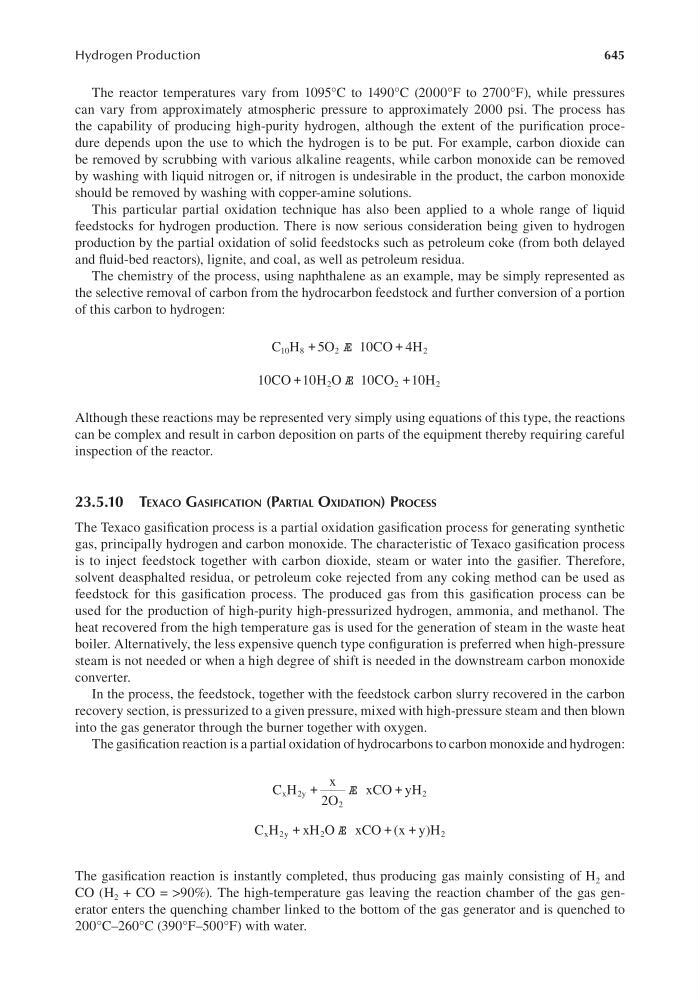
The chemistry of the process, using naphthalene as an example, may be simply represented as
the selective removal of carbon from the hydrocarbon feedstock and further conversion of a portion
of this carbon to hydrogen:
C H
O
CO H
10 8
2
2
5
10
4
+
Æ
+
10
10
10
10
2
2
2
CO
H O
CO
H
+
Æ
+
Although these reactions may be represented very simply using equations of this type, the reactions
can be complex and result in carbon deposition on parts of the equipment thereby requiring careful
inspection of the reactor.
23.5.10 texACo gAsIFICAtIon (PArtIAl oxIdAtIon) ProCess
The Texaco gasification process is a partial oxidation gasification process for generating synthetic
gas, principally hydrogen and carbon monoxide. The characteristic of Texaco gasification process
is to inject feedstock together with carbon dioxide, steam or water into the gasifier. Therefore,
solvent deasphalted residua, or petroleum coke rejected from any coking method can be used as
feedstock for this gasification process. The produced gas from this gasification process can be
used for the production of high-purity high-pressurized hydrogen, ammonia, and methanol. The
heat recovered from the high temperature gas is used for the generation of steam in the waste heat
boiler. Alternatively, the less expensive quench type configuration is preferred when high-pressure
steam is not needed or when a high degree of shift is needed in the downstream carbon monoxide
converter.
In the process, the feedstock, together with the feedstock carbon slurry recovered in the carbon
recovery section, is pressurized to a given pressure, mixed with high-pressure steam and then blown
into the gas generator through the burner together with oxygen.
The gasification reaction is a partial oxidation of hydrocarbons to carbon monoxide and hydrogen:
C H
x
2O
xCO yH
x 2y
2
2
+
Æ
+
C H
xH O xCO x y H
x
y
2
2
2
+
Æ
+ +
(
)
The gasification reaction is instantly completed, thus producing gas mainly consisting of H 2 and
CO (H 2 + CO = >90%). The high-temperature gas leaving the reaction chamber of the gas generator enters the quenching chamber linked to the bottom of the gas generator and is quenched to
200°C–260°C (390°F–500°F) with water.