

639
Hydrogen Production
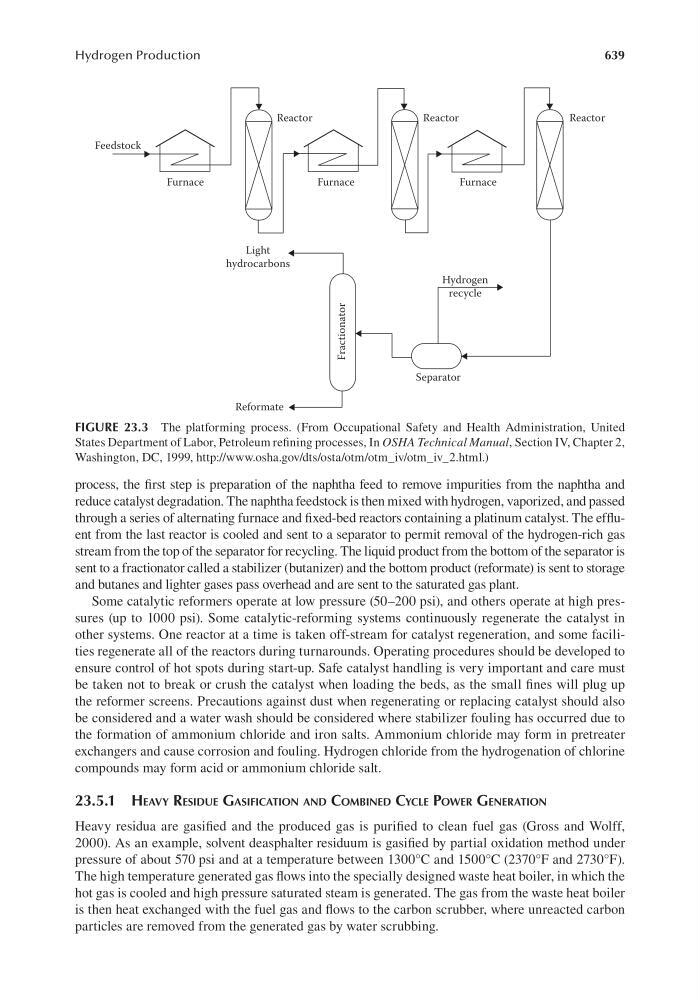
process, the first step is preparation of the naphtha feed to remove impurities from the naphtha and
reduce catalyst degradation. The naphtha feedstock is then mixed with hydrogen, vaporized, and passed
through a series of alternating furnace and fixed-bed reactors containing a platinum catalyst. The effluent from the last reactor is cooled and sent to a separator to permit removal of the hydrogen-rich gas
stream from the top of the separator for recycling. The liquid product from the bottom of the separator is
sent to a fractionator called a stabilizer (butanizer) and the bottom product (reformate) is sent to storage
and butanes and lighter gases pass overhead and are sent to the saturated gas plant.
Some catalytic reformers operate at low pressure (50–200 psi), and others operate at high pressures (up to 1000 psi). Some catalytic-reforming systems continuously regenerate the catalyst in
other systems. One reactor at a time is taken off-stream for catalyst regeneration, and some facilities regenerate all of the reactors during turnarounds. Operating procedures should be developed to
ensure control of hot spots during start-up. Safe catalyst handling is very important and care must
be taken not to break or crush the catalyst when loading the beds, as the small fines will plug up
the reformer screens. Precautions against dust when regenerating or replacing catalyst should also
be considered and a water wash should be considered where stabilizer fouling has occurred due to
the formation of ammonium chloride and iron salts. Ammonium chloride may form in pretreater
exchangers and cause corrosion and fouling. Hydrogen chloride from the hydrogenation of chlorine
compounds may form acid or ammonium chloride salt.
23.5.1 HeAvy resIdue gAsIFICAtIon And ComBIned CyCle PoWer generAtIon
Heavy residua are gasified and the produced gas is purified to clean fuel gas (Gross and Wolff,
2000). As an example, solvent deasphalter residuum is gasified by partial oxidation method under
pressure of about 570 psi and at a temperature between 1300°C and 1500°C (2370°F and 2730°F).
The high temperature generated gas flows into the specially designed waste heat boiler, in which the
hot gas is cooled and high pressure saturated steam is generated. The gas from the waste heat boiler
is then heat exchanged with the fuel gas and flows to the carbon scrubber, where unreacted carbon
particles are removed from the generated gas by water scrubbing.
Reactor
R eactor
Reactor
Furnace
Furnace
Light
hydrocarbons
Separator
Hydrogen
recycle
Fractionator
Furnace
Feedstock
Reformate
FIGURE 23.3 The platforming process. (From Occupational Safety and Health Administration, United
States Department of Labor, Petroleum refining processes, In OSHA Technical Manual, Section IV, Chapter 2,
Washington, DC, 1999, http://www.osha.gov/dts/osta/otm/otm_iv/otm_iv_2.html.)