

637
Hydrogen Production
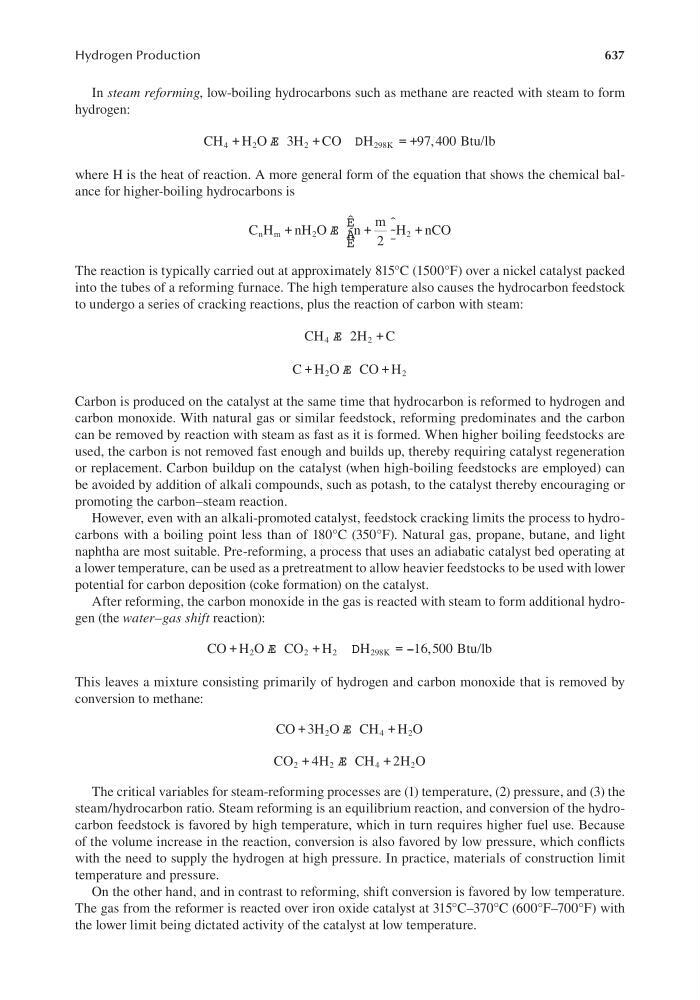
In steam reforming, low-boiling hydrocarbons such as methane are reacted with steam to form
hydrogen:
CH H O
H CO
H
Btu/lb
K
4
2
2
298
3
9 7 400
+
Æ
+
= +
D
,
where H is the heat of reaction. A more general form of the equation that shows the chemical balance for higher-boiling hydrocarbons is
C H
nH O
n
m
H nCO
n m
2
2
+
Æ
+
Ê
Ë
Á
ˆ
¯
˜ +
2
The reaction is typically carried out at approximately 815°C (1500°F) over a nickel catalyst packed
into the tubes of a reforming furnace. The high temperature also causes the hydrocarbon feedstock
to undergo a series of cracking reactions, plus the reaction of carbon with steam:
CH
H C
4
2
2
Æ
+
C H O CO H
+
Æ
+
2
2
Carbon is produced on the catalyst at the same time that hydrocarbon is reformed to hydrogen and
carbon monoxide. With natural gas or similar feedstock, reforming predominates and the carbon
can be removed by reaction with steam as fast as it is formed. When higher boiling feedstocks are
used, the carbon is not removed fast enough and builds up, thereby requiring catalyst regeneration
or replacement. Carbon buildup on the catalyst (when high-boiling feedstocks are employed) can
be avoided by addition of alkali compounds, such as potash, to the catalyst thereby encouraging or
promoting the carbon–steam reaction.
However, even with an alkali-promoted catalyst, feedstock cracking limits the process to hydrocarbons with a boiling point less than of 180°C (350°F). Natural gas, propane, butane, and light
naphtha are most suitable. Pre-reforming, a process that uses an adiabatic catalyst bed operating at
a lower temperature, can be used as a pretreatment to allow heavier feedstocks to be used with lower
potential for carbon deposition (coke formation) on the catalyst.
After reforming, the carbon monoxide in the gas is reacted with steam to form additional hydrogen (the water–gas shift reaction):
CO H O CO H
H
Btu/lb
K
+
Æ
+
= -
2
2
2
298
16 500
D
,
This leaves a mixture consisting primarily of hydrogen and carbon monoxide that is removed by
conversion to methane:
CO H O CH H O
+
Æ
+
3 2
4
2
CO
H
CH
H O
2
2
4
2
4
2
+
Æ
+
The critical variables for steam-reforming processes are (1) temperature, (2) pressure, and (3) the
steam/hydrocarbon ratio. Steam reforming is an equilibrium reaction, and conversion of the hydrocarbon feedstock is favored by high temperature, which in turn requires higher fuel use. Because
of the volume increase in the reaction, conversion is also favored by low pressure, which conflicts
with the need to supply the hydrogen at high pressure. In practice, materials of construction limit
temperature and pressure.
On the other hand, and in contrast to reforming, shift conversion is favored by low temperature.
The gas from the reformer is reacted over iron oxide catalyst at 315°C–370°C (600°F–700°F) with
the lower limit being dictated activity of the catalyst at low temperature.