

39
Classification
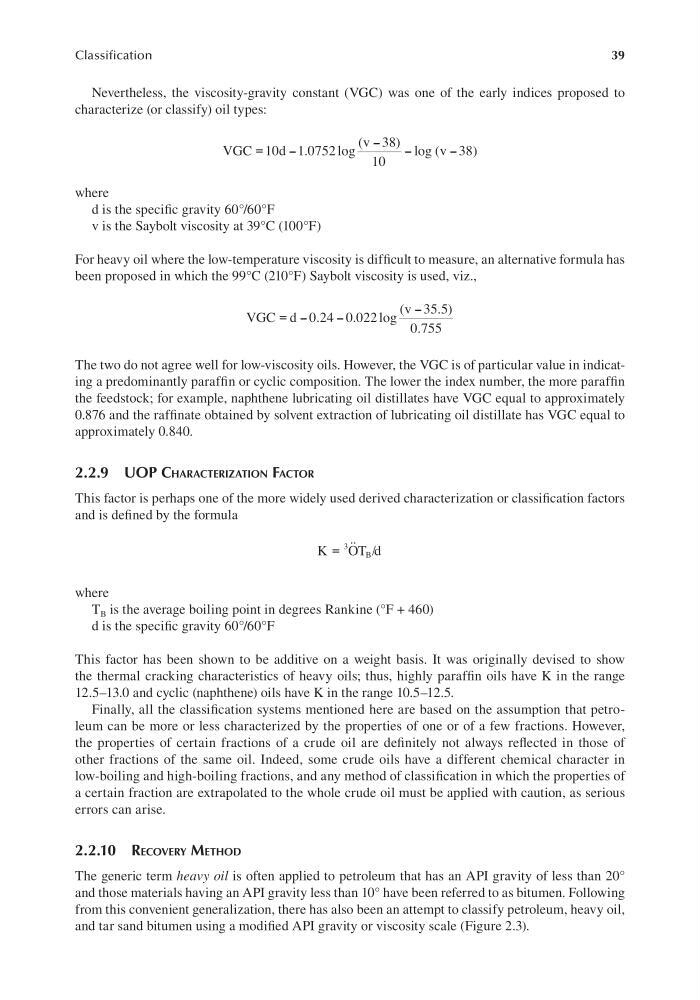
Nevertheless, the viscosity-gravity constant (VGC) was one of the early indices proposed to
characterize (or classify) oil types:
VGC 10d 1.0752 log
v
log v
=
-
-
-
-
(
)
(
)
38
10
38
where
d is the specific gravity 60°/60°F
v is the Saybolt viscosity at 39°C (100°F)
For heavy oil where the low-temperature viscosity is difficult to measure, an alternative formula has
been proposed in which the 99°C (210°F) Saybolt viscosity is used, viz.,
VGC d
v
= -
-
-
0 24 0 022
35 5
0 755
.
.
log
(
. )
.
The two do not agree well for low-viscosity oils. However, the VGC is of particular value in indicating a predominantly paraffin or cyclic composition. The lower the index number, the more paraffin
the feedstock; for example, naphthene lubricating oil distillates have VGC equal to approximately
0.876 and the raffinate obtained by solvent extraction of lubricating oil distillate has VGC equal to
approximately 0.840.
2.2.9 uoP CHArACterIzAtIon FACtor
This factor is perhaps one of the more widely used derived characterization or classification factors
and is defined by the formula
K
T d
O B
=
3 /
where
T B is the average boiling point in degrees Rankine (°F + 460)
d is the specific gravity 60°/60°F
This factor has been shown to be additive on a weight basis. It was originally devised to show
the thermal cracking characteristics of heavy oils; thus, highly paraffin oils have K in the range
12.5–13.0 and cyclic (naphthene) oils have K in the range 10.5–12.5.
Finally, all the classification systems mentioned here are based on the assumption that petroleum can be more or less characterized by the properties of one or of a few fractions. However,
the properties of certain fractions of a crude oil are definitely not always reflected in those of
other fractions of the same oil. Indeed, some crude oils have a different chemical character in
low-boiling and high-boiling fractions, and any method of classification in which the properties of
a certain fraction are extrapolated to the whole crude oil must be applied with caution, as serious
errors can arise.
2.2.10 reCovery metHod
The generic term heavy oil is often applied to petroleum that has an API gravity of less than 20°
and those materials having an API gravity less than 10° have been referred to as bitumen. Following
from this convenient generalization, there has also been an attempt to classify petroleum, heavy oil,
and tar sand bitumen using a modified API gravity or viscosity scale (Figure 2.3).
Classification
Nevertheless, the viscosity-gravity constant (VGC) was one of the early indices proposed to
characterize (or classify) oil types:
VGC 10d 1.0752 log
v
log v
=
-
-
-
-
(
)
(
)
38
10
38
where
d is the specific gravity 60°/60°F
v is the Saybolt viscosity at 39°C (100°F)
For heavy oil where the low-temperature viscosity is difficult to measure, an alternative formula has
been proposed in which the 99°C (210°F) Saybolt viscosity is used, viz.,
VGC d
v
= -
-
-
0 24 0 022
35 5
0 755
.
.
log
(
. )
.
The two do not agree well for low-viscosity oils. However, the VGC is of particular value in indicating a predominantly paraffin or cyclic composition. The lower the index number, the more paraffin
the feedstock; for example, naphthene lubricating oil distillates have VGC equal to approximately
0.876 and the raffinate obtained by solvent extraction of lubricating oil distillate has VGC equal to
approximately 0.840.
2.2.9 uoP CHArACterIzAtIon FACtor
This factor is perhaps one of the more widely used derived characterization or classification factors
and is defined by the formula
K
T d
O B
=
3 /
where
T B is the average boiling point in degrees Rankine (°F + 460)
d is the specific gravity 60°/60°F
This factor has been shown to be additive on a weight basis. It was originally devised to show
the thermal cracking characteristics of heavy oils; thus, highly paraffin oils have K in the range
12.5–13.0 and cyclic (naphthene) oils have K in the range 10.5–12.5.
Finally, all the classification systems mentioned here are based on the assumption that petroleum can be more or less characterized by the properties of one or of a few fractions. However,
the properties of certain fractions of a crude oil are definitely not always reflected in those of
other fractions of the same oil. Indeed, some crude oils have a different chemical character in
low-boiling and high-boiling fractions, and any method of classification in which the properties of
a certain fraction are extrapolated to the whole crude oil must be applied with caution, as serious
errors can arise.
2.2.10 reCovery metHod
The generic term heavy oil is often applied to petroleum that has an API gravity of less than 20°
and those materials having an API gravity less than 10° have been referred to as bitumen. Following
from this convenient generalization, there has also been an attempt to classify petroleum, heavy oil,
and tar sand bitumen using a modified API gravity or viscosity scale (Figure 2.3).