

625
Hydrocracking
As an example, the zeolite faujasite crystallizes with the composition SiO 2 (NaAlO 2 ) x (H 2 O) y .
The ratio of silicon to aluminum, expressed here by the subscript x, can be varied in the crystallization from 1 to >10. What does not vary is the total number of silicon and aluminum atoms per unit
cell, 192. For legal purposes, to define certain composition of matter patents, zeolites with a ratio of
1–1.5 are called type X; those with ratio greater than 1.5 are type Y.
Both silicon and aluminum in zeolites are found in tetrahedral oxide sites. The four oxides are
shared with another silicon or aluminum (except that two aluminum ions are never found in adjacent, linked tetrahedral). Silicon with a plus four charge balances exactly half of the charge of the
oxide ions it is linked to; since all of the oxygen atoms are shared, silicon balances all of the charge
around it and is electrically neutral. Aluminum, with three positive charges, leaves one charge
unsatisfied. Sodium neutralizes this charge.
The sodium, as expected from its chemistry, is not linked to the oxides by covalent bonds as
the silicon and aluminum are. The attraction is simply ionic, and sodium can be replaced by other
cations by ion-exchange processes. In extensive but rarely published experiments, virtually every
metallic and organic cation has been exchanged into zeolites in studies by catalyst designers.
The most important ion exchanged for sodium is the proton. In the hydrogen ion form, faujasite zeolites are very strong acids, with strengths approaching that of oleum. Unfortunately, direct
exchange using mineral acids such as hydrochloric acid is not practical. The acid tends to attack the
silica alumina network, in the same way that strong acids attack clays in the activation processes
developed by Houdry. The technique adopted to avoid this problem is indirect exchange, beginning
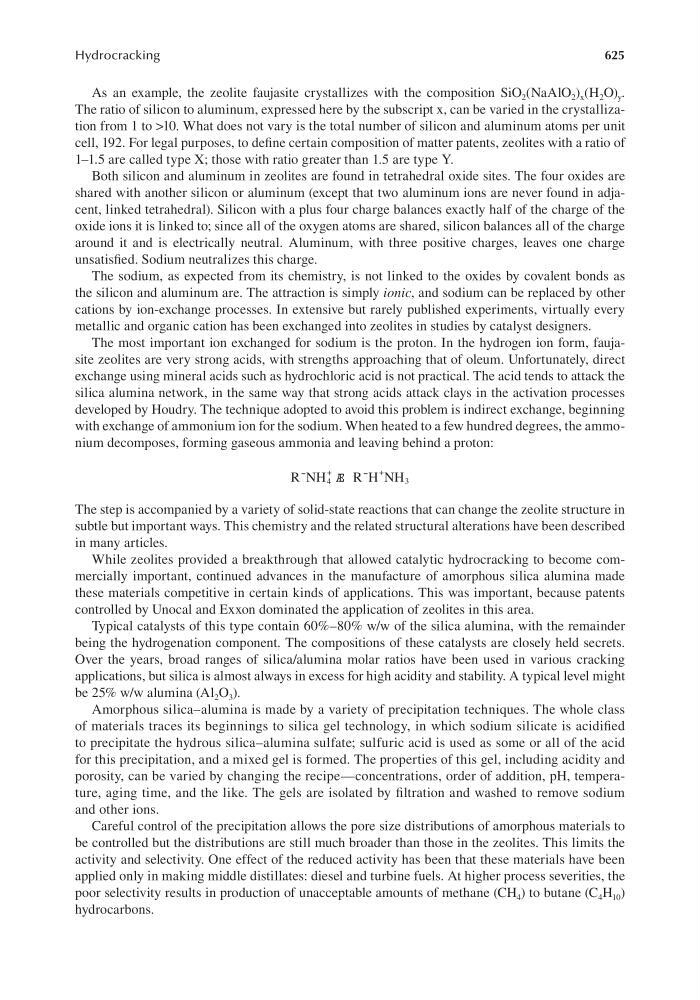
with exchange of ammonium ion for the sodium. When heated to a few hundred degrees, the ammonium decomposes, forming gaseous ammonia and leaving behind a proton:
R NH
R H NH
-
+
- +
Æ
4
3
The step is accompanied by a variety of solid-state reactions that can change the zeolite structure in
subtle but important ways. This chemistry and the related structural alterations have been described
in many articles.
While zeolites provided a breakthrough that allowed catalytic hydrocracking to become commercially important, continued advances in the manufacture of amorphous silica alumina made
these materials competitive in certain kinds of applications. This was important, because patents
controlled by Unocal and Exxon dominated the application of zeolites in this area.
Typical catalysts of this type contain 60%–80% w/w of the silica alumina, with the remainder
being the hydrogenation component. The compositions of these catalysts are closely held secrets.
Over the years, broad ranges of silica/alumina molar ratios have been used in various cracking
applications, but silica is almost always in excess for high acidity and stability. A typical level might
be 25% w/w alumina (Al 2 O 3 ).
Amorphous silica–alumina is made by a variety of precipitation techniques. The whole class
of materials traces its beginnings to silica gel technology, in which sodium silicate is acidified
to precipitate the hydrous silica–alumina sulfate; sulfuric acid is used as some or all of the acid
for this precipitation, and a mixed gel is formed. The properties of this gel, including acidity and
porosity, can be varied by changing the recipe—concentrations, order of addition, pH, temperature, aging time, and the like. The gels are isolated by filtration and washed to remove sodium
and other ions.
Careful control of the precipitation allows the pore size distributions of amorphous materials to
be controlled but the distributions are still much broader than those in the zeolites. This limits the
activity and selectivity. One effect of the reduced activity has been that these materials have been
applied only in making middle distillates: diesel and turbine fuels. At higher process severities, the
poor selectivity results in production of unacceptable amounts of methane (CH 4 ) to butane (C 4 H 10 )
hydrocarbons.