

620
The Chemistry and Technology of Petroleum
requirements depend on feedstock quality and the required severity of operation. The primary function of the catalysts is to effect mild hydrogenation activity for the stabilization of cracked products
while also limiting the saturation of aromatic rings. Because of the hydrogenation function, the
catalyst also decouples the relationship between conversion and the propensity for carbon residue
formation of the feedstock.
22.3.22 veBA ComBI CrACkIng ProCess
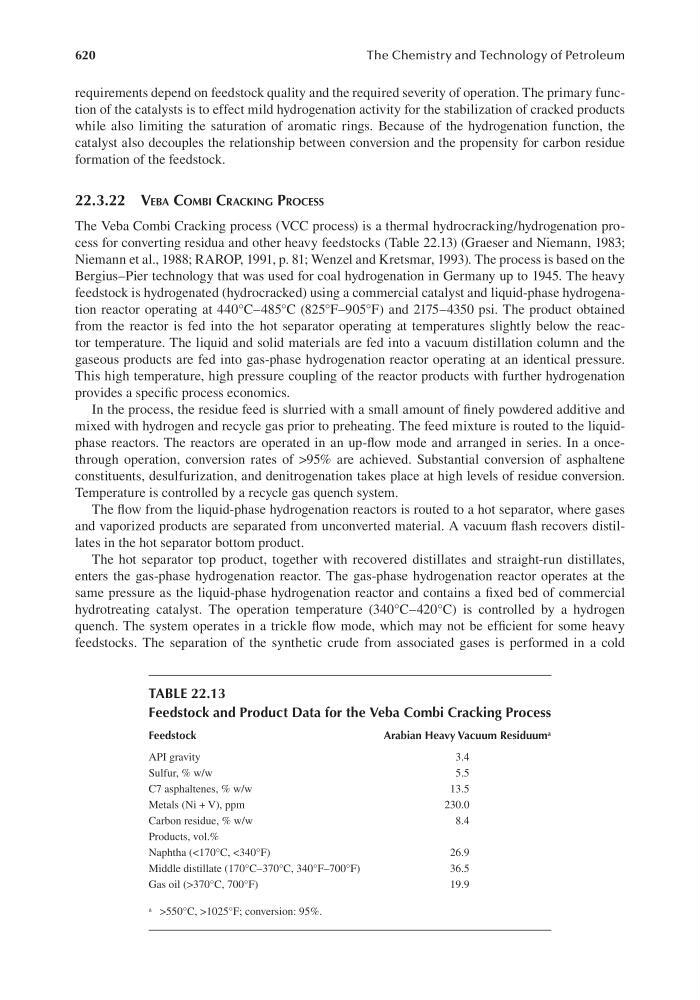
The Veba Combi Cracking process (VCC process) is a thermal hydrocracking/hydrogenation process for converting residua and other heavy feedstocks (Table 22.13) (Graeser and Niemann, 1983;
Niemann et al., 1988; RAROP, 1991, p. 81; Wenzel and Kretsmar, 1993). The process is based on the
Bergius–Pier technology that was used for coal hydrogenation in Germany up to 1945. The heavy
feedstock is hydrogenated (hydrocracked) using a commercial catalyst and liquid-phase hydrogenation reactor operating at 440°C–485°C (825°F–905°F) and 2175–4350 psi. The product obtained
from the reactor is fed into the hot separator operating at temperatures slightly below the reactor temperature. The liquid and solid materials are fed into a vacuum distillation column and the
gaseous products are fed into gas-phase hydrogenation reactor operating at an identical pressure.
This high temperature, high pressure coupling of the reactor products with further hydrogenation
provides a specific process economics.
In the process, the residue feed is slurried with a small amount of finely powdered additive and
mixed with hydrogen and recycle gas prior to preheating. The feed mixture is routed to the liquidphase reactors. The reactors are operated in an up-flow mode and arranged in series. In a oncethrough operation, conversion rates of >95% are achieved. Substantial conversion of asphaltene
constituents, desulfurization, and denitrogenation takes place at high levels of residue conversion.
Temperature is controlled by a recycle gas quench system.
The flow from the liquid-phase hydrogenation reactors is routed to a hot separator, where gases
and vaporized products are separated from unconverted material. A vacuum flash recovers distillates in the hot separator bottom product.
The hot separator top product, together with recovered distillates and straight-run distillates,
enters the gas-phase hydrogenation reactor. The gas-phase hydrogenation reactor operates at the
same pressure as the liquid-phase hydrogenation reactor and contains a fixed bed of commercial
hydrotreating catalyst. The operation temperature (340°C–420°C) is controlled by a hydrogen
quench. The system operates in a trickle flow mode, which may not be efficient for some heavy
feedstocks. The separation of the synthetic crude from associated gases is performed in a cold
TABLE 22.13
Feedstock and Product Data for the Veba Combi Cracking Process
Feedstock
Arabian Heavy Vacuum Residuum a
API gravity
3.4
Sulfur, % w/w
5.5
C7 asphaltenes, % w/w
13.5
Metals (Ni + V), ppm
230.0
Carbon residue, % w/w
8.4
Products, vol.%
Naphtha (<170°C, <340°F)
26.9
Middle distillate (170°C–370°C, 340°F–700°F)
36.5
Gas oil (>370°C, 700°F)
19.9
a >550°C, >1025°F; conversion: 95%.