

618
The Chemistry and Technology of Petroleum
cobalt–molybdena–alumina catalyst with a controlled pore structure that permits a high degree of
desulfurization and, at the same time, minimizes any coking tendencies.
The process uses base-metal or noble-metal hydrogenation-activity promoters impregnated on
combinations of zeolites and amorphous aluminosilicates for cracking activity (Reno, 1997). The
specific metals chosen and the proportions of the metals, zeolite, and nonzeolite aluminosilicates
are optimized for the feedstock and desired product balance. This is effective in the production of
clean fuels, especially for cases where a partial conversion Unicracking unit and a fluid catalytic
cracking unit are integrated.
The Unicracking process converts feedstocks into lower molecular weight products that are more
saturated than the feed. Feedstocks include atmospheric gas oil, vacuum gas oil, fluid catalytic cracking/resid catalytic cracking cycle oil, coker gas oil, deasphalted oil, and naphtha. Hydrocracking
catalysts promote sulfur and nitrogen removal, aromatic saturation, and molecular weight reduction.
All of these reactions consume hydrogen and as a result, the volume of recovered liquid product
normally exceeds the feedstock. Many units are operated to make naphtha (for petrochemical or
motor-fuel use) as a primary product.
Unicracking catalysts are designed to function in the presence of hydrogen sulfide (H 2 S) and
ammonia (NH 3 ). This gives rise to an important difference between Unicracking and other hydrocracking processes: the availability of a single-stage design. In a single stage unit, the absence
of a stripper between treating and cracking reactors reduces investment costs by making use of
a common recycle gas system. Process objectives determine catalyst selection for a specific unit.
Product from the reactor section is condensed, separated from hydrogen-rich gas, and fractionated
into desired products. Unconverted oil is recycled or used as lube stock, fluid catalytic cracking
feedstock, or ethylene plant feedstock.
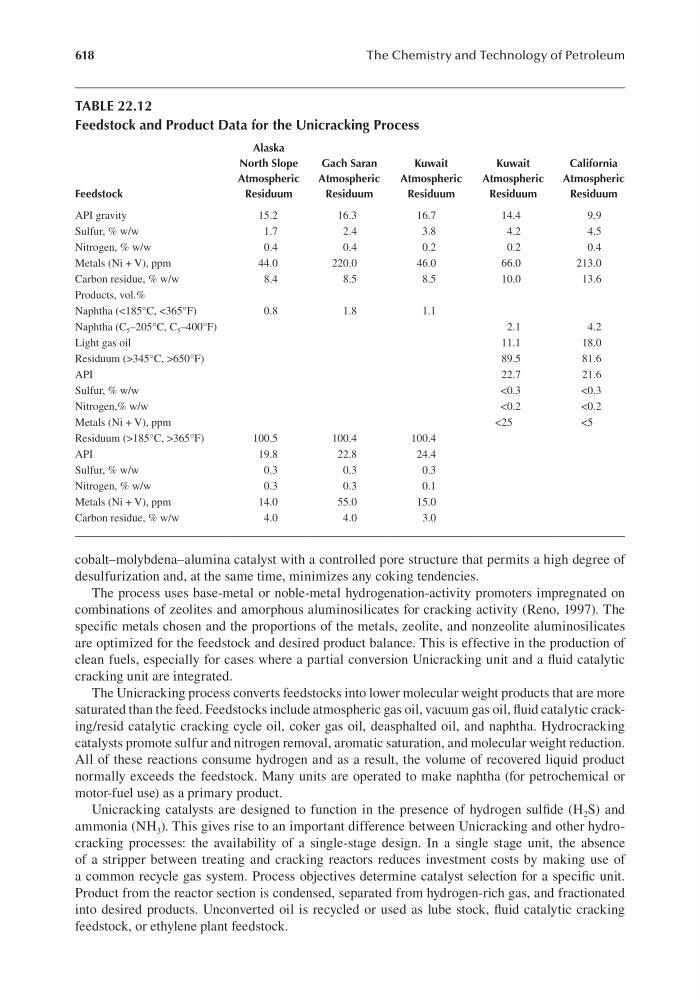
TABLE 22.12
Feedstock and Product Data for the Unicracking Process
Feedstock
Alaska
North Slope
Atmospheric
Residuum
Gach Saran
Atmospheric
Residuum
Kuwait
Atmospheric
Residuum
Kuwait
Atmospheric
Residuum
California
Atmospheric
Residuum
API gravity
15.2
16.3
16.7
14.4
9.9
Sulfur, % w/w
1.7
2.4
3.8
4.2
4.5
Nitrogen, % w/w
0.4
0.4
0.2
0.2
0.4
Metals (Ni + V), ppm
44.0
220.0
46.0
66.0
213.0
Carbon residue, % w/w
8.4
8.5
8.5
10.0
13.6
Products, vol.%
Naphtha (<185°C, <365°F)
0.8
1.8
1.1
Naphtha (C 5 –205°C, C 5 –400°F)
2.1
4.2
Light gas oil
11.1
18.0
Residuum (>345°C, >650°F)
89.5
81.6
API
22.7
21.6
Sulfur, % w/w
<0.3
<0.3
Nitrogen,% w/w
<0.2
<0.2
Metals (Ni + V), ppm
<25
<5
Residuum (>185°C, >365°F)
100.5
100.4
100.4
API
19.8
22.8
24.4
Sulfur, % w/w
0.3
0.3
0.3
Nitrogen, % w/w
0.3
0.3
0.1
Metals (Ni + V), ppm
14.0
55.0
15.0
Carbon residue, % w/w
4.0
4.0
3.0