

605
Hydrocracking
The operating conditions of the hydrocracking unit call for a temperature on the order of 450°C
(840°F) and a pressure of approximately 2000–2100 psi. Also for this process, conversion levels
(of the fraction that boils above 500°C, 930°F) into gas, light distillates, and heavy distillates can
be obtained up to 95%.
22.3.5 H-oIl ProCess
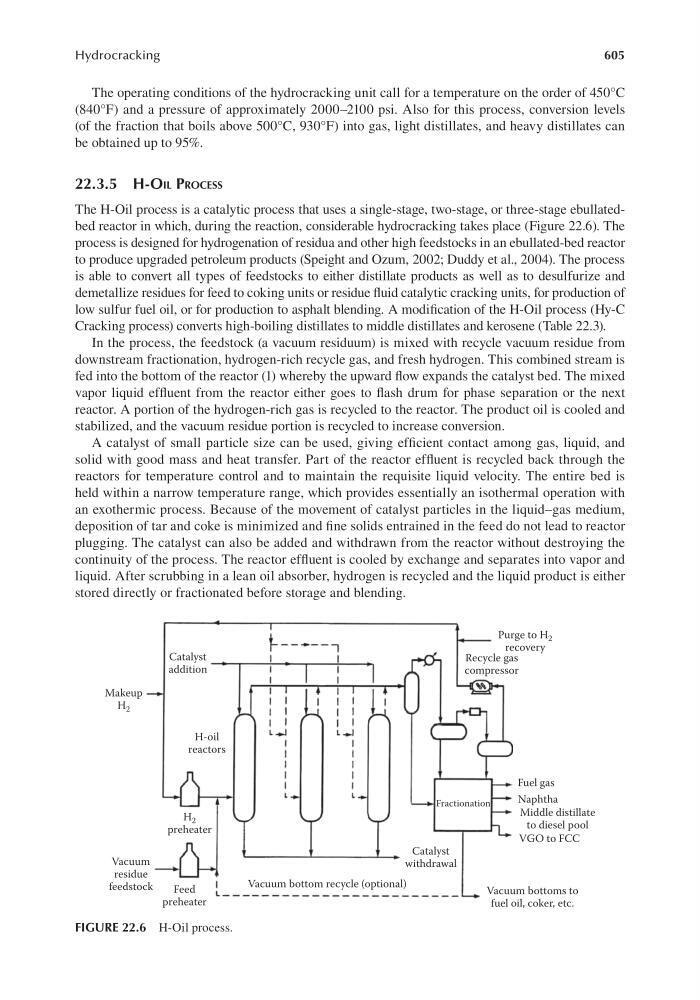
The H-Oil process is a catalytic process that uses a single-stage, two-stage, or three-stage ebullatedbed reactor in which, during the reaction, considerable hydrocracking takes place (Figure 22.6). The
process is designed for hydrogenation of residua and other high feedstocks in an ebullated-bed reactor
to produce upgraded petroleum products (Speight and Ozum, 2002; Duddy et al., 2004). The process
is able to convert all types of feedstocks to either distillate products as well as to desulfurize and
demetallize residues for feed to coking units or residue fluid catalytic cracking units, for production of
low sulfur fuel oil, or for production to asphalt blending. A modification of the H-Oil process (Hy-C
Cracking process) converts high-boiling distillates to middle distillates and kerosene (Table 22.3).
In the process, the feedstock (a vacuum residuum) is mixed with recycle vacuum residue from
downstream fractionation, hydrogen-rich recycle gas, and fresh hydrogen. This combined stream is
fed into the bottom of the reactor (1) whereby the upward flow expands the catalyst bed. The mixed
vapor liquid effluent from the reactor either goes to flash drum for phase separation or the next
reactor. A portion of the hydrogen-rich gas is recycled to the reactor. The product oil is cooled and
stabilized, and the vacuum residue portion is recycled to increase conversion.
A catalyst of small particle size can be used, giving efficient contact among gas, liquid, and
solid with good mass and heat transfer. Part of the reactor effluent is recycled back through the
reactors for temperature control and to maintain the requisite liquid velocity. The entire bed is
held within a narrow temperature range, which provides essentially an isothermal operation with
an exothermic process. Because of the movement of catalyst particles in the liquid–gas medium,
deposition of tar and coke is minimized and fine solids entrained in the feed do not lead to reactor
plugging. The catalyst can also be added and withdrawn from the reactor without destroying the
continuity of the process. The reactor effluent is cooled by exchange and separates into vapor and
liquid. After scrubbing in a lean oil absorber, hydrogen is recycled and the liquid product is either
stored directly or fractionated before storage and blending.
Recycle gas
compressor
Purge to H 2
recovery
Fractionation
Fuel gas
Naphtha
VGO to FCC
Catalyst
withdrawal
Vacuum bottom recycle (optional)
Feed
preheater
Vacuum
residue
feedstock
Makeup
H 2
Catalyst
addition
H-oil
reactors
H 2
preheater
Middle distillate
to diesel pool
Vacuum bottoms to
fuel oil, coker, etc.
FIGURE 22.6 H-Oil process.