

36
The Chemistry and Technology of Petroleum
paraffin series is given a value of CI = 0 and a parallel line passing through the point for the values of benzene is given as CI = 100. Thus,
CI
d
K
=
-
+
473 7 456 8 48 640
.
.
,
/
where
K for a petroleum fraction is the average boiling point determined by the standard Bureau of
Mines distillation method
d is the specific gravity (Gruse and Stevens, 1960)
Values for the index between 0 and 15 indicate a predominance of paraffin hydrocarbons in the
fraction. A value from 15 to 50 indicates predominance of either naphthenes or of mixtures of paraffins, naphthenes, and aromatics. An index value above 50 indicates a predominance of aromatic
species.
It is also possible to describe a crude oil by an expression of its chemical composition on the basis
of the CI figures for its middle portions. A diagram has been constructed using this principle. The
horizontal axis represents a progression from paraffin oils to aromatic oils, with 0 and 100 representing the extremes from n-paraffins to benzene. The position of a crude on this scale is determined by
the average CI for its fractions boiling between 200°C (390°F) at atmospheric pressure and 275°C
(525°F) at 40 mm, and the paraffin, or cyclic, nature of the fractions, and thereby the nature of the
bulk of the crude, are expressed directly. The height of the vertical bar above the horizontal indicates
the wax content of the heavy gas oil and light lubricating fractions of that crude, and hence the crystalline wax content of the crude can be assessed. The length of each bar below the horizontal is a
measure of the carbon residue (Conradson) of the nonvolatile residuum and thus serves to indicate the
asphalt content of each residuum and, thus, the content of each crude. By combining these chemical
indications with a qualitative expression of the results achieved by conventional refining, reasonable
assessment can be obtained of petroleum in relation to both composition and application.
2.2.4 densIty
Density (specific gravity) has been, since the early years of the industry, the principal, and often
the only specification of crude oil products and was taken as an index of the proportion of gasoline
and, particularly, kerosene present. As long as only one kind of petroleum was in use the relations
were approximately true, but as crude oils having other properties were discovered and came into
use, the significance of density measurements disappeared. Nevertheless, crude oils of particular
types are still rated by gravity, as are gasoline and naphtha within certain limits of other properties. The use of density values has been advocated for quantitative application using a scheme
based on the American Petroleum Institute (API) gravity of the 250°C–275°C (480°F–525°F,
1760 mm) and the 275°C–300°C (525°F–570°F, 40 mm) distillation fractions (Table 2.2).
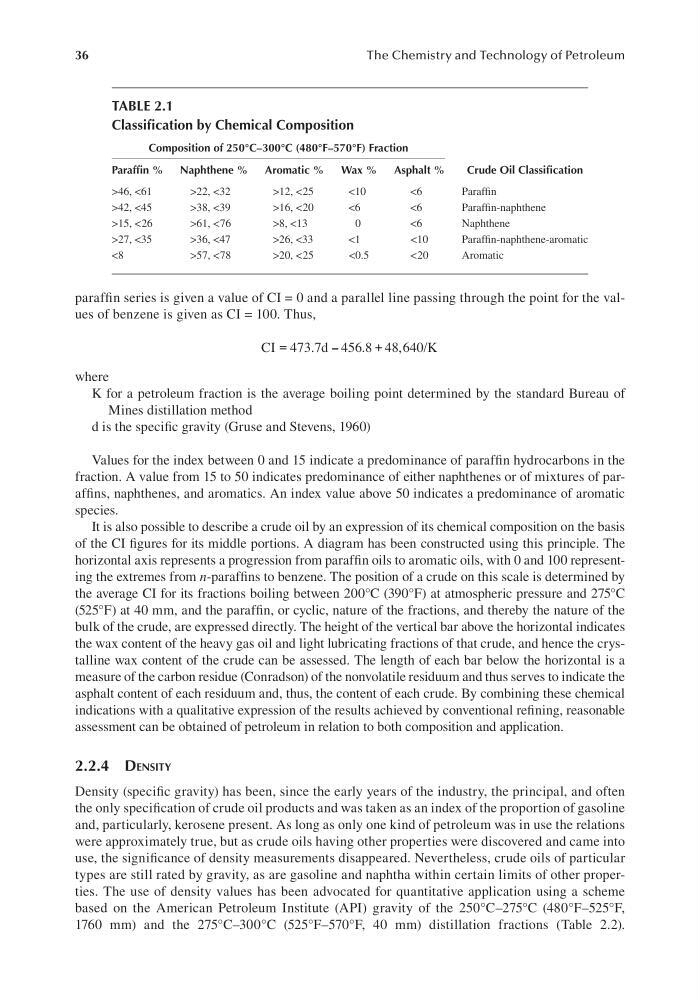
TABLE 2.1
Classification by Chemical Composition
Composition of 250°C–300°C (480°F–570°F) Fraction
Crude Oil Classification
Paraffin %
Naphthene %
Aromatic %
Wax %
Asphalt %
>46, <61
>22, <32
>12, < 25
<10
<6
Paraffin
>42, <45
>38, <39
>16, < 20
<6
<6
Paraffin-naphthene
>15, < 26
>61, < 76
>8, <13
0
<6
Naphthene
>27, <35
>36, <47
>26, <33
<1
<10
Paraffin-naphthene-aromatic
<8
>57, < 78
>20, < 25
<0.5
< 20
Aromatic
The Chemistry and Technology of Petroleum
paraffin series is given a value of CI = 0 and a parallel line passing through the point for the values of benzene is given as CI = 100. Thus,
CI
d
K
=
-
+
473 7 456 8 48 640
.
.
,
/
where
K for a petroleum fraction is the average boiling point determined by the standard Bureau of
Mines distillation method
d is the specific gravity (Gruse and Stevens, 1960)
Values for the index between 0 and 15 indicate a predominance of paraffin hydrocarbons in the
fraction. A value from 15 to 50 indicates predominance of either naphthenes or of mixtures of paraffins, naphthenes, and aromatics. An index value above 50 indicates a predominance of aromatic
species.
It is also possible to describe a crude oil by an expression of its chemical composition on the basis
of the CI figures for its middle portions. A diagram has been constructed using this principle. The
horizontal axis represents a progression from paraffin oils to aromatic oils, with 0 and 100 representing the extremes from n-paraffins to benzene. The position of a crude on this scale is determined by
the average CI for its fractions boiling between 200°C (390°F) at atmospheric pressure and 275°C
(525°F) at 40 mm, and the paraffin, or cyclic, nature of the fractions, and thereby the nature of the
bulk of the crude, are expressed directly. The height of the vertical bar above the horizontal indicates
the wax content of the heavy gas oil and light lubricating fractions of that crude, and hence the crystalline wax content of the crude can be assessed. The length of each bar below the horizontal is a
measure of the carbon residue (Conradson) of the nonvolatile residuum and thus serves to indicate the
asphalt content of each residuum and, thus, the content of each crude. By combining these chemical
indications with a qualitative expression of the results achieved by conventional refining, reasonable
assessment can be obtained of petroleum in relation to both composition and application.
2.2.4 densIty
Density (specific gravity) has been, since the early years of the industry, the principal, and often
the only specification of crude oil products and was taken as an index of the proportion of gasoline
and, particularly, kerosene present. As long as only one kind of petroleum was in use the relations
were approximately true, but as crude oils having other properties were discovered and came into
use, the significance of density measurements disappeared. Nevertheless, crude oils of particular
types are still rated by gravity, as are gasoline and naphtha within certain limits of other properties. The use of density values has been advocated for quantitative application using a scheme
based on the American Petroleum Institute (API) gravity of the 250°C–275°C (480°F–525°F,
1760 mm) and the 275°C–300°C (525°F–570°F, 40 mm) distillation fractions (Table 2.2).
TABLE 2.1
Classification by Chemical Composition
Composition of 250°C–300°C (480°F–570°F) Fraction
Crude Oil Classification
Paraffin %
Naphthene %
Aromatic %
Wax %
Asphalt %
>46, <61
>22, <32
>12, < 25
<10
<6
Paraffin
>42, <45
>38, <39
>16, < 20
<6
<6
Paraffin-naphthene
>15, < 26
>61, < 76
>8, <13
0
<6
Naphthene
>27, <35
>36, <47
>26, <33
<1
<10
Paraffin-naphthene-aromatic
<8
>57, < 78
>20, < 25
<0.5
< 20
Aromatic