

579
Hydrotreating and Desulfurization
21.3.8 unIonFInIng ProCess
Unionfining process is a catalytic hydrotreating technology applied to produce low-sulfur, color
stable diesel fuel. The process is also used to reduce aromatics in diesel and to improve the diesel
cetane number. In addition, the process can be used to prepare naphtha for catalytic reformers and
to refine coker-naphtha.
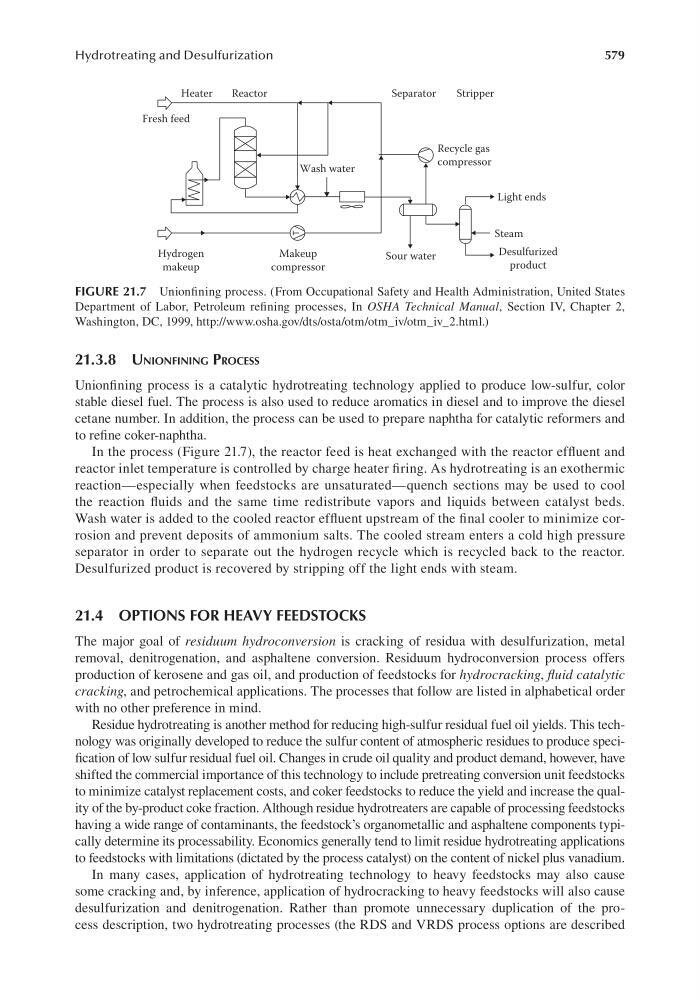
In the process (Figure 21.7), the reactor feed is heat exchanged with the reactor effluent and
reactor inlet temperature is controlled by charge heater firing. As hydrotreating is an exothermic
reaction—especially when feedstocks are unsaturated—quench sections may be used to cool
the reaction fluids and the same time redistribute vapors and liquids between catalyst beds.
Wash water is added to the cooled reactor effluent upstream of the final cooler to minimize corrosion and prevent deposits of ammonium salts. The cooled stream enters a cold high pressure
separator in order to separate out the hydrogen recycle which is recycled back to the reactor.
Desulfurized product is recovered by stripping off the light ends with steam.
21.4 OPTIONS FOR HEAVY FEEDSTOCKS
The major goal of residuum hydroconversion is cracking of residua with desulfurization, metal
removal, denitrogenation, and asphaltene conversion. Residuum hydroconversion process offers
production of kerosene and gas oil, and production of feedstocks for hydrocracking, fluid catalytic
cracking, and petrochemical applications. The processes that follow are listed in alphabetical order
with no other preference in mind.
Residue hydrotreating is another method for reducing high-sulfur residual fuel oil yields. This technology was originally developed to reduce the sulfur content of atmospheric residues to produce specification of low sulfur residual fuel oil. Changes in crude oil quality and product demand, however, have
shifted the commercial importance of this technology to include pretreating conversion unit feedstocks
to minimize catalyst replacement costs, and coker feedstocks to reduce the yield and increase the quality of the by-product coke fraction. Although residue hydrotreaters are capable of processing feedstocks
having a wide range of contaminants, the feedstock’s organometallic and asphaltene components typically determine its processability. Economics generally tend to limit residue hydrotreating applications
to feedstocks with limitations (dictated by the process catalyst) on the content of nickel plus vanadium.
In many cases, application of hydrotreating technology to heavy feedstocks may also cause
some cracking and, by inference, application of hydrocracking to heavy feedstocks will also cause
desulfurization and denitrogenation. Rather than promote unnecessary duplication of the process description, two hydrotreating processes (the RDS and VRDS process options are described
Sour water
Reactor
Fresh feed
Heater
Steam
Light ends
Stripper
Wash water
Recycle gas
compressor
Separator
Desulfurized
product
Makeup
compressor
Hydrogen
makeup
FIGURE 21.7 Unionfining process. (From Occupational Safety and Health Administration, United States
Department of Labor, Petroleum refining processes, In OSHA Technical Manual, Section IV, Chapter 2,
Washington, DC, 1999, http://www.osha.gov/dts/osta/otm/otm_iv/otm_iv_2.html.)