

33
Classification
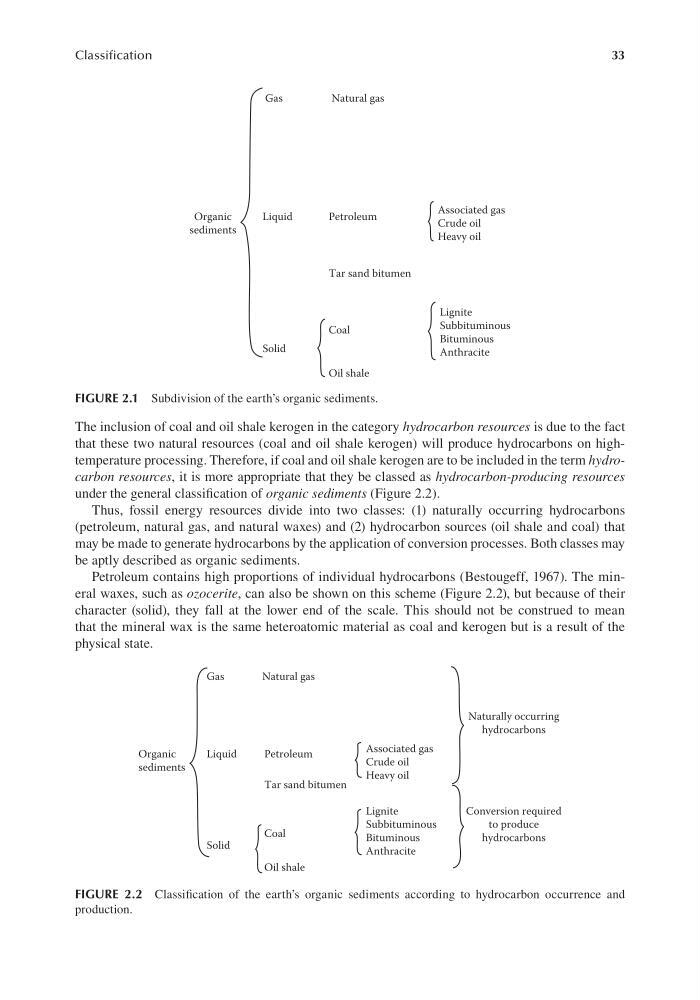
The inclusion of coal and oil shale kerogen in the category hydrocarbon resources is due to the fact
that these two natural resources (coal and oil shale kerogen) will produce hydrocarbons on hightemperature processing. Therefore, if coal and oil shale kerogen are to be included in the term hydrocarbon resources, it is more appropriate that they be classed as hydrocarbon-producing resources
under the general classification of organic sediments (Figure 2.2).
Thus, fossil energy resources divide into two classes: (1) naturally occurring hydrocarbons
(petroleum, natural gas, and natural waxes) and (2) hydrocarbon sources (oil shale and coal) that
may be made to generate hydrocarbons by the application of conversion processes. Both classes may
be aptly described as organic sediments.
Petroleum contains high proportions of individual hydrocarbons (Bestougeff, 1967). The mineral waxes, such as ozocerite, can also be shown on this scheme (Figure 2.2), but because of their
character (solid), they fall at the lower end of the scale. This should not be construed to mean
that the mineral wax is the same heteroatomic material as coal and kerogen but is a result of the
physical state.
Liquid
Petroleum
Natural gas
Naturally occurring
hydrocarbons
Conversion required
to produce
hydrocarbons
Gas
Associated gas
Crude oil
Heavy oil
Lignite
Subbituminous
Bituminous
Anthracite
Tar sand bitumen
Coal
Solid
Organic
sediments
Oil shale
FIGURE 2.2 Classification of the earth’s organic sediments according to hydrocarbon occurrence and
production.
Tar sand bitumen
Associated gas
Crude oil
Heavy oil
Lignite
Subbituminous
Bituminous
Anthracite
Petroleum
Natural gas
Gas
Liquid
Organic
sediments
Solid
Coal
Oil shale
FIGURE 2.1 Subdivision of the earth’s organic sediments.
Classification
The inclusion of coal and oil shale kerogen in the category hydrocarbon resources is due to the fact
that these two natural resources (coal and oil shale kerogen) will produce hydrocarbons on hightemperature processing. Therefore, if coal and oil shale kerogen are to be included in the term hydrocarbon resources, it is more appropriate that they be classed as hydrocarbon-producing resources
under the general classification of organic sediments (Figure 2.2).
Thus, fossil energy resources divide into two classes: (1) naturally occurring hydrocarbons
(petroleum, natural gas, and natural waxes) and (2) hydrocarbon sources (oil shale and coal) that
may be made to generate hydrocarbons by the application of conversion processes. Both classes may
be aptly described as organic sediments.
Petroleum contains high proportions of individual hydrocarbons (Bestougeff, 1967). The mineral waxes, such as ozocerite, can also be shown on this scheme (Figure 2.2), but because of their
character (solid), they fall at the lower end of the scale. This should not be construed to mean
that the mineral wax is the same heteroatomic material as coal and kerogen but is a result of the
physical state.
Liquid
Petroleum
Natural gas
Naturally occurring
hydrocarbons
Conversion required
to produce
hydrocarbons
Gas
Associated gas
Crude oil
Heavy oil
Lignite
Subbituminous
Bituminous
Anthracite
Tar sand bitumen
Coal
Solid
Organic
sediments
Oil shale
FIGURE 2.2 Classification of the earth’s organic sediments according to hydrocarbon occurrence and
production.
Tar sand bitumen
Associated gas
Crude oil
Heavy oil
Lignite
Subbituminous
Bituminous
Anthracite
Petroleum
Natural gas
Gas
Liquid
Organic
sediments
Solid
Coal
Oil shale
FIGURE 2.1 Subdivision of the earth’s organic sediments.