

571
Hydrotreating and Desulfurization
cracking operation, hydrodesulfurization will be accompanied by some degree of saturation
resulting in increased hydrogen consumption.
The hydrodesulfurization of low boiling (naphtha) feedstocks is usually a gas-phase reaction and
may employ the catalyst in fixed beds and (with all of the reactants in the gaseous phase) only minimal diffusion problems are encountered within the catalyst pore system. It is, however, important
that the feedstock be completely volatile before entering the reactor as there may be the possibility
of pressure variations (leading to less satisfactory results) if some of the feedstock enters the reactor
in the liquid phase and is vaporized within the reactor.
In applications of this type, the sulfur content of the feedstock may vary from 100 ppm to 1% and
the necessary degree of desulfurization to be effected by the treatment may vary from as little as
50% to more than 99%. If the sulfur content of the feedstock is particularly low, it will be necessary
to presulfide the catalyst. For example, if the feedstock only has 100–200 ppm sulfur, several days
may be required to sulfide the catalyst as an integral part of the desulfurization process even with
complete reaction of all of the feedstock sulfur to, say, cobalt and molybdenum (catalyst) sulfides.
In such a case, presulfiding can be conveniently achieved by addition of sulfur compounds to the
feedstock or by addition of hydrogen sulfide to the hydrogen.
Generally, hydrodesulfurization of naphtha feedstocks to produce catalytic reforming feedstocks
is carried to the point where the desulfurized feedstock contains <20 ppm sulfur. The net hydrogen
produced by the reforming operation may actually be sufficient to provide the hydrogen consumed
in the desulfurization process.
The hydrodesulfurization of middle distillates is also an efficient process and applications include
predominantly the desulfurization of kerosene, diesel fuel, jet fuel, and heating oils that boil over
the general range 250°C–400°C (480°F–750°F). However, with this type of feedstock, hydrogenation of the higher-boiling catalytic cracking feedstocks has become increasingly important where
hydrodesulfurization is accomplished alongside the saturation of condensed-ring aromatic compounds as an aid to subsequent processing.
Under the relatively mild processing conditions used for the hydrodesulfurization of these particular feedstocks, it is difficult to achieve complete vaporization of the feed. Process conditions
may dictate that only part of the feedstock is actually in the vapor phase and that sufficient liquid
phase is maintained in the catalyst bed to carry the larger molecular constituents of the feedstock
through the bed. If the amount of liquid phase is insufficient for this purpose, molecular stagnation
(leading to carbon deposition on the catalyst) will occur.
Hydrodesulfurization of middle distillates causes a more marked change in the specific gravity
of the feedstock, and the amount of low-boiling material is much more significant when compared
with the naphtha-type feedstock. In addition, the somewhat more severe reaction conditions (leading
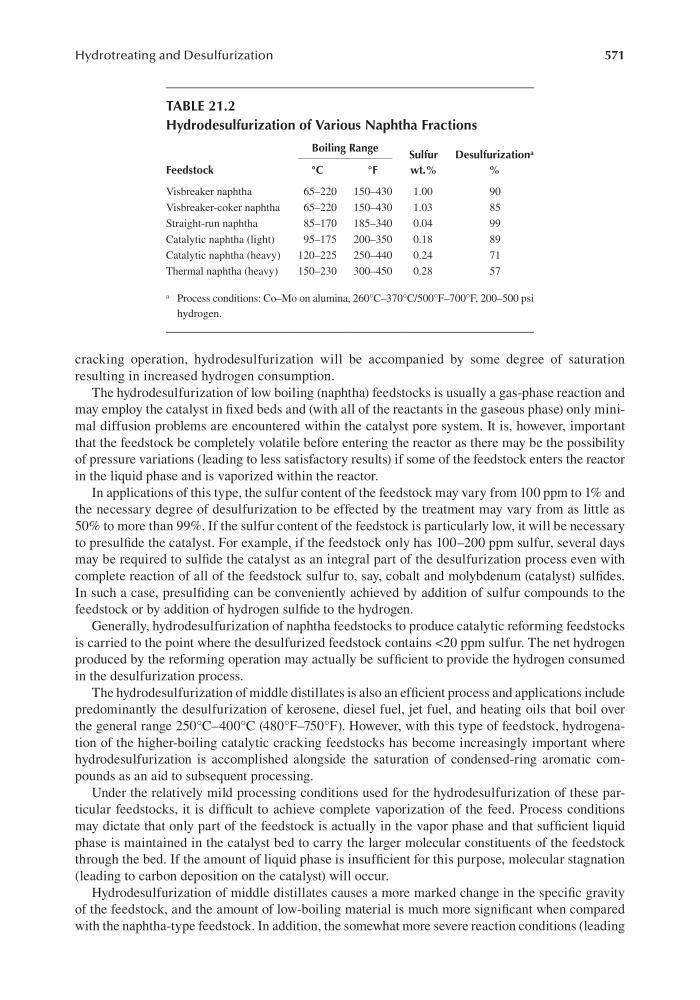
TABLE 21.2
Hydrodesulfurization of Various Naphtha Fractions
Feedstock
Boiling Range
Sulfur
wt.%
Desulfurization a
%
°C
°F
Visbreaker naphtha
65–220 150–430
1.00
90
Visbreaker-coker naphtha
65–220 150–430
1.03
85
Straight-run naphtha
85–170 185–340
0.04
99
Catalytic naphtha (light)
95–175 200–350
0.18
89
Catalytic naphtha (heavy)
120–225 250–440
0.24
71
Thermal naphtha (heavy)
150–230 300–450
0.28
57
a Process conditions: Co–Mo on alumina, 260°C–370°C/500°F–700°F, 200–500 psi
hydrogen.