

569
Hydrotreating and Desulfurization
section at temperatures between 290°C and 445°C (550°F and 850°F) and pressures between 150
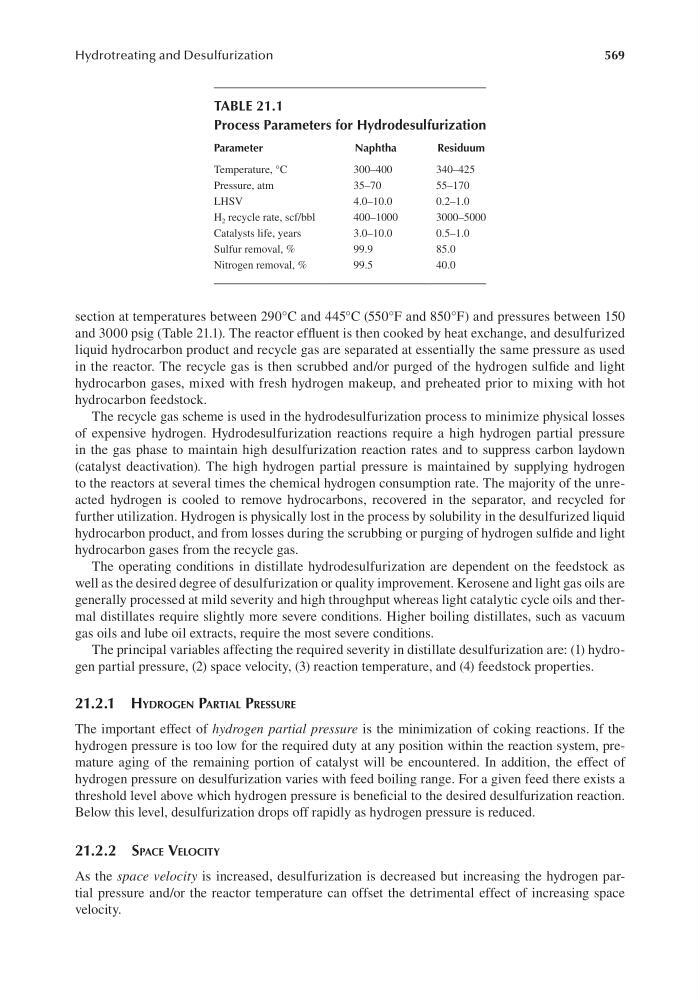
and 3000 psig (Table 21.1). The reactor effluent is then cooked by heat exchange, and desulfurized
liquid hydrocarbon product and recycle gas are separated at essentially the same pressure as used
in the reactor. The recycle gas is then scrubbed and/or purged of the hydrogen sulfide and light
hydrocarbon gases, mixed with fresh hydrogen makeup, and preheated prior to mixing with hot
hydrocarbon feedstock.
The recycle gas scheme is used in the hydrodesulfurization process to minimize physical losses
of expensive hydrogen. Hydrodesulfurization reactions require a high hydrogen partial pressure
in the gas phase to maintain high desulfurization reaction rates and to suppress carbon laydown
(catalyst deactivation). The high hydrogen partial pressure is maintained by supplying hydrogen
to the reactors at several times the chemical hydrogen consumption rate. The majority of the unreacted hydrogen is cooled to remove hydrocarbons, recovered in the separator, and recycled for
further utilization. Hydrogen is physically lost in the process by solubility in the desulfurized liquid
hydrocarbon product, and from losses during the scrubbing or purging of hydrogen sulfide and light
hydrocarbon gases from the recycle gas.
The operating conditions in distillate hydrodesulfurization are dependent on the feedstock as
well as the desired degree of desulfurization or quality improvement. Kerosene and light gas oils are
generally processed at mild severity and high throughput whereas light catalytic cycle oils and thermal distillates require slightly more severe conditions. Higher boiling distillates, such as vacuum
gas oils and lube oil extracts, require the most severe conditions.
The principal variables affecting the required severity in distillate desulfurization are: (1) hydrogen partial pressure, (2) space velocity, (3) reaction temperature, and (4) feedstock properties.
21.2.1 Hydrogen PArtIAl Pressure
The important effect of hydrogen partial pressure is the minimization of coking reactions. If the
hydrogen pressure is too low for the required duty at any position within the reaction system, premature aging of the remaining portion of catalyst will be encountered. In addition, the effect of
hydrogen pressure on desulfurization varies with feed boiling range. For a given feed there exists a
threshold level above which hydrogen pressure is beneficial to the desired desulfurization reaction.
Below this level, desulfurization drops off rapidly as hydrogen pressure is reduced.
21.2.2 sPACe veloCIty
As the space velocity is increased, desulfurization is decreased but increasing the hydrogen partial pressure and/or the reactor temperature can offset the detrimental effect of increasing space
velocity.
TABLE 21.1
Process Parameters for Hydrodesulfurization
Parameter
Naphtha
Residuum
Temperature, °C
300–400
340–425
Pressure, atm
35–70
55–170
LHSV
4.0–10.0
0.2–1.0
H 2 recycle rate, scf/bbl
400–1000
3000–5000
Catalysts life, years
3.0–10.0
0.5–1.0
Sulfur removal, %
99.9
85.0
Nitrogen removal, %
99.5
40.0