

548
The Chemistry and Technology of Petroleum
flows upward, extracting the paraffinic hydrocarbons from the vacuum residuum, which is flowing
downward through the RDC.
Steam coils at the top of the tower maintain the specified temperature gradient across the RDC.
The higher temperature in the top section of the RDC results in separation of the less soluble heavier
material from the DAO mix and provides internal reflux, which improves the separation. The DAO
mix leaves the top of the RDC tower. It flows to an evaporator where it is heated to vaporize a
portion of the solvent. It then flows into the high-pressure flash tower where high-pressure solvent
vapors are taken overhead.
The DAO mix from the bottom of this tower flows to the pressure vapor heat exchanger where
additional solvent is vaporized from the DAO mix by condensing high-pressure flash. The highpressure solvent, totally condensed, flows to the high-pressure solvent receiver. Partially vaporized,
Feedstock
Extraction tower
Steam
Deasphalted
oil separator
Deasphalted
oil stripper
Deasphalted oil
Asphalt
flash drum
Asphalt
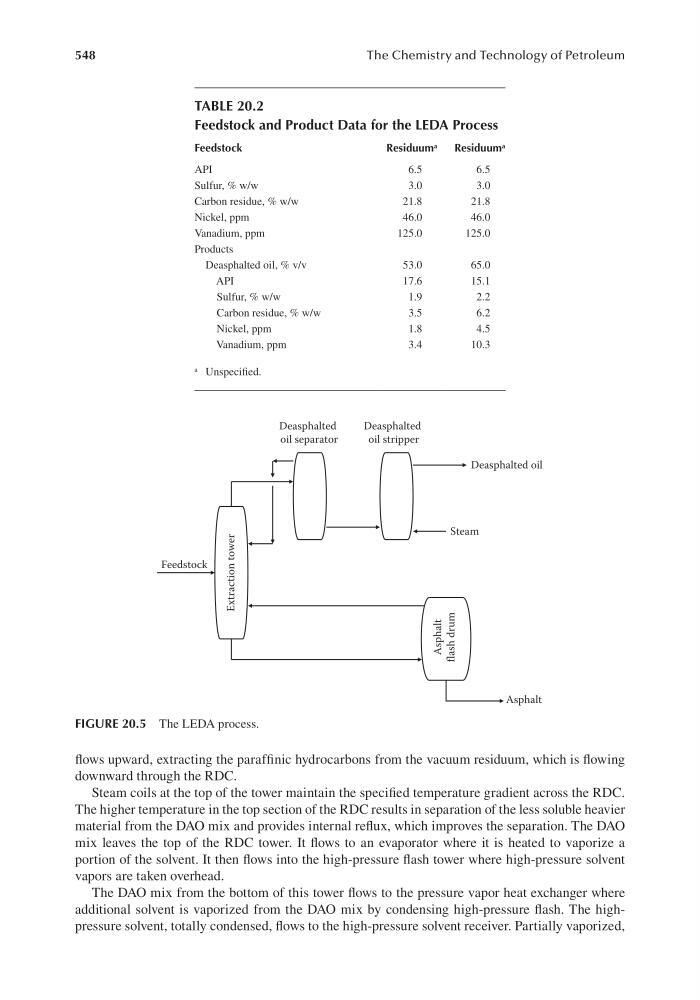
FIGURE 20.5 The LEDA process.
TABLE 20.2
Feedstock and Product Data for the LEDA Process
Feedstock
Residuum a
Residuum a
API
6.5
6.5
Sulfur, % w/w
3.0
3.0
Carbon residue, % w/w
21.8
21.8
Nickel, ppm
46.0
46.0
Vanadium, ppm
125.0
125.0
Products
Deasphalted oil, % v/v
53.0
65.0
API
17.6
15.1
Sulfur, % w/w
1.9
2.2
Carbon residue, % w/w
3.5
6.2
Nickel, ppm
1.8
4.5
Vanadium, ppm
3.4
10.3
a Unspecified.