

531
Catalytic Cracking
A low conversion operation for maximum production of light cycle oil is typically 40%–60%,
while a high conversion operation for maximum gasoline production is 70%–85%. Again, the range
is dependent on the character of the feedstock. Each fluid catalytic cracking unit that is operated for
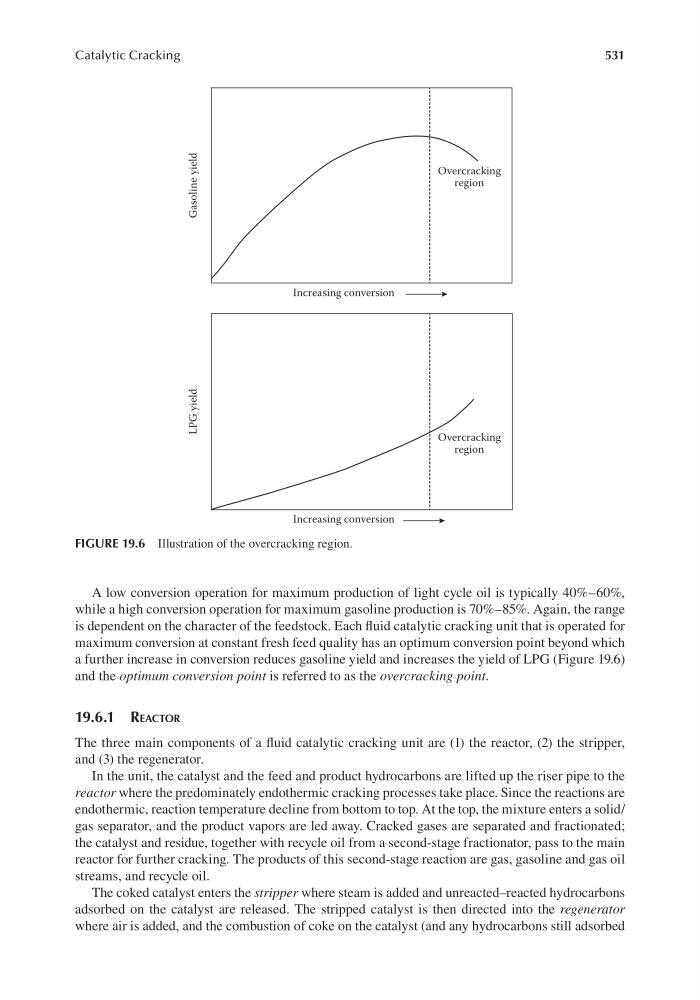
maximum conversion at constant fresh feed quality has an optimum conversion point beyond which
a further increase in conversion reduces gasoline yield and increases the yield of LPG (Figure 19.6)
and the optimum conversion point is referred to as the overcracking point.
19.6.1 reACtor
The three main components of a fluid catalytic cracking unit are (1) the reactor, (2) the stripper,
and (3) the regenerator.
In the unit, the catalyst and the feed and product hydrocarbons are lifted up the riser pipe to the
reactor where the predominately endothermic cracking processes take place. Since the reactions are
endothermic, reaction temperature decline from bottom to top. At the top, the mixture enters a solid/
gas separator, and the product vapors are led away. Cracked gases are separated and fractionated;
the catalyst and residue, together with recycle oil from a second-stage fractionator, pass to the main
reactor for further cracking. The products of this second-stage reaction are gas, gasoline and gas oil
streams, and recycle oil.
The coked catalyst enters the stripper where steam is added and unreacted–reacted hydrocarbons
adsorbed on the catalyst are released. The stripped catalyst is then directed into the regenerator
where air is added, and the combustion of coke on the catalyst (and any hydrocarbons still adsorbed
Increasing conversion
Overcracking
region
Overcracking
region
Gasoline yield
LPG yield
Increasing conversion
FIGURE 19.6 Illustration of the overcracking region.