

526
The Chemistry and Technology of Petroleum
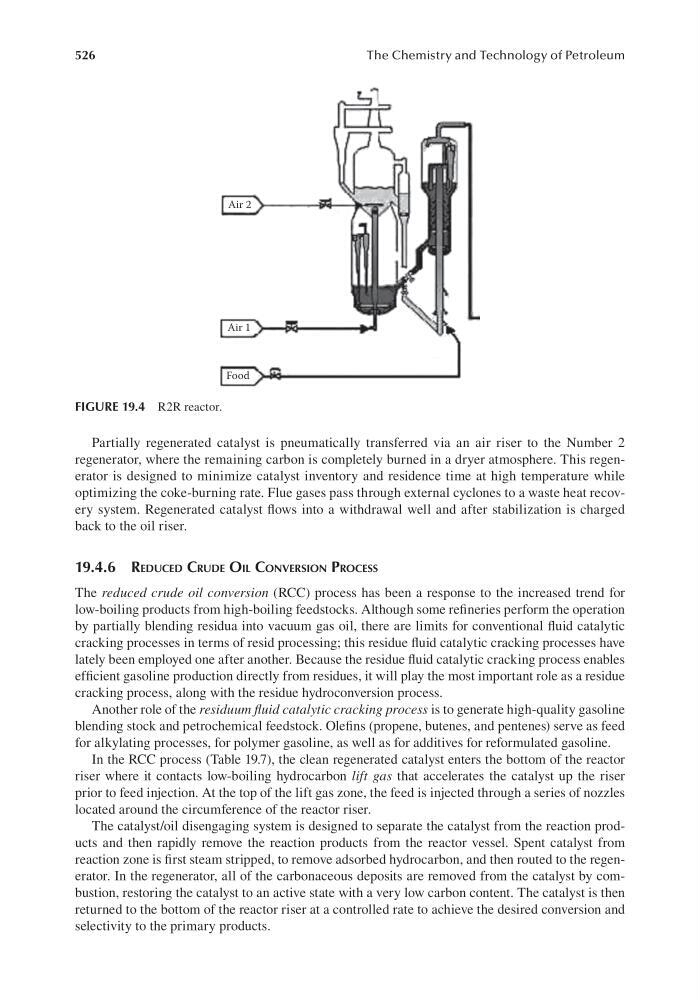
Partially regenerated catalyst is pneumatically transferred via an air riser to the Number 2
regenerator, where the remaining carbon is completely burned in a dryer atmosphere. This regenerator is designed to minimize catalyst inventory and residence time at high temperature while
optimizing the coke-burning rate. Flue gases pass through external cyclones to a waste heat recovery system. Regenerated catalyst flows into a withdrawal well and after stabilization is charged
back to the oil riser.
19.4.6 reduCed Crude oIl ConversIon ProCess
The reduced crude oil conversion (RCC) process has been a response to the increased trend for
low-boiling products from high-boiling feedstocks. Although some refineries perform the operation
by partially blending residua into vacuum gas oil, there are limits for conventional fluid catalytic
cracking processes in terms of resid processing; this residue fluid catalytic cracking processes have
lately been employed one after another. Because the residue fluid catalytic cracking process enables
efficient gasoline production directly from residues, it will play the most important role as a residue
cracking process, along with the residue hydroconversion process.
Another role of the residuum fluid catalytic cracking process is to generate high-quality gasoline
blending stock and petrochemical feedstock. Olefins (propene, butenes, and pentenes) serve as feed
for alkylating processes, for polymer gasoline, as well as for additives for reformulated gasoline.
In the RCC process (Table 19.7), the clean regenerated catalyst enters the bottom of the reactor
riser where it contacts low-boiling hydrocarbon lift gas that accelerates the catalyst up the riser
prior to feed injection. At the top of the lift gas zone, the feed is injected through a series of nozzles
located around the circumference of the reactor riser.
The catalyst/oil disengaging system is designed to separate the catalyst from the reaction products and then rapidly remove the reaction products from the reactor vessel. Spent catalyst from
reaction zone is first steam stripped, to remove adsorbed hydrocarbon, and then routed to the regenerator. In the regenerator, all of the carbonaceous deposits are removed from the catalyst by combustion, restoring the catalyst to an active state with a very low carbon content. The catalyst is then
returned to the bottom of the reactor riser at a controlled rate to achieve the desired conversion and
selectivity to the primary products.
Air 2
Air 1
Food
FIGURE 19.4 R2R reactor.