

506
The Chemistry and Technology of Petroleum
compressed and used as refinery fuel gas after sweetening. The cracked oil product after hydrotreating
is used as fluid catalytic cracking or hydrocracker feedstock. The residuum is suitable for being used
as boiler fuel, road asphalt, binder for the coking industry, and as a feedstock for partial oxidation.
18.4.8 mIxed-PHAse CrACkIng
Mixed-phase cracking (also called liquid-phase cracking) is a continuous thermal decomposition
process for the conversion of heavy feedstocks to products boiling in the gasoline range. The process generally employs rapid heating of the feedstock (kerosene, gas oil, reduced crude, or even
whole crude), after which it is passed to a reaction chamber and then to a separator where the vapors
are cooled. Overhead products from the flash chamber are fractionated to gasoline components and
recycle stock, and flash chamber bottoms are withdrawn as a heavy fuel oil. Coke formation, which
may be considerable at the process temperatures (400°C–480°C, 750°F–900°F), is minimized by
the use of pressures in excess of 350 psi.
18.4.9 orCrude ProCess
The OrCrude process was developed specifically for the upgrading of Canadian tar sand bitumen.
The process used exiting technology to convert tar sand bitumen to products.
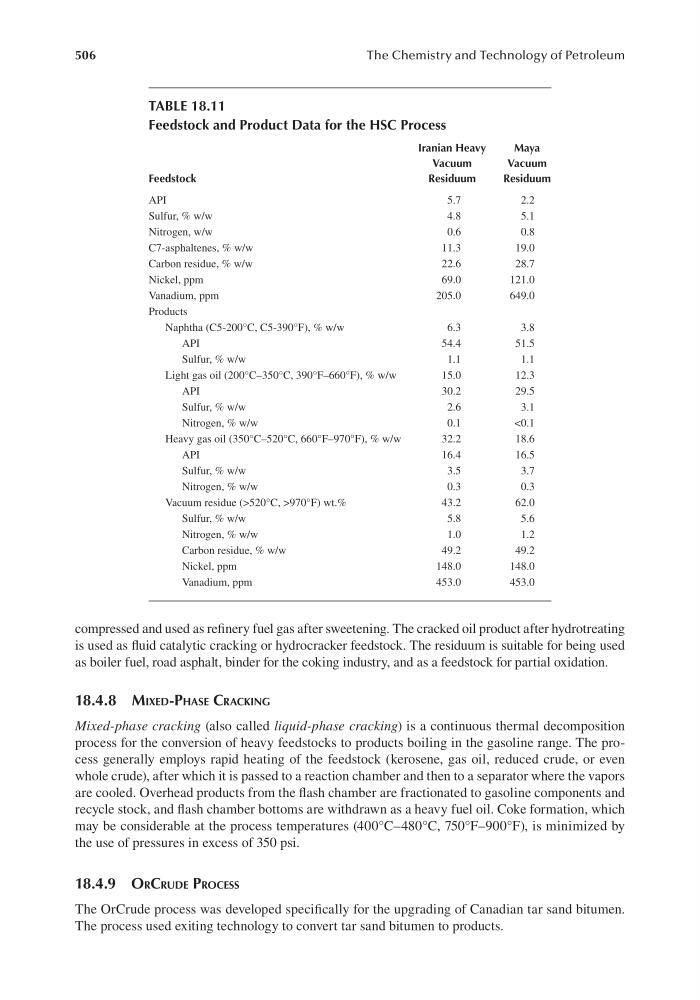
TABLE 18.11
Feedstock and Product Data for the HSC Process
Feedstock
Iranian Heavy
Vacuum
Residuum
Maya
Vacuum
Residuum
API
5.7
2.2
Sulfur, % w/w
4.8
5.1
Nitrogen, w/w
0.6
0.8
C7-asphaltenes, % w/w
11.3
19.0
Carbon residue, % w/w
22.6
28.7
Nickel, ppm
69.0
121.0
Vanadium, ppm
205.0
649.0
Products
Naphtha (C5-200°C, C5-390°F), % w/w
6.3
3.8
API
54.4
51.5
Sulfur, % w/w
1.1
1.1
Light gas oil (200°C–350°C, 390°F–660°F), % w/w
15.0
12.3
API
30.2
29.5
Sulfur, % w/w
2.6
3.1
Nitrogen, % w/w
0.1
<0.1
Heavy gas oil (350°C–520°C, 660°F–970°F), % w/w
32.2
18.6
API
16.4
16.5
Sulfur, % w/w
3.5
3.7
Nitrogen, % w/w
0.3
0.3
Vacuum residue (>520°C, >970°F) wt.%
43.2
62.0
Sulfur, % w/w
5.8
5.6
Nitrogen, % w/w
1.0
1.2
Carbon residue, % w/w
49.2
49.2
Nickel, ppm
148.0
148.0
Vanadium, ppm
453.0
453.0