

495
Thermal Cracking
In the process, the feedstock is introduced into the product fractionator where it is heated
and lighter fractions are removed as side-stream products. The fractionator bottoms, including a
recycle stream of heavy product, are then heated in a furnace whose outlet temperature varies
from 480°C to 515°C (895°F–960°F). The heated feedstock enters one of a pair of coking drums
where the cracking reactions continue. The cracked products leave as an overhead stream and coke
deposits form on the inner surface of the drum. To give continuous operation, two drums are used,
while one is on steam, the other is being cleaned. The temperature in the coke drum ranges from
415°C to 450°C (780°F–840°F) at pressures from 15 to 90 psi.
Delayed coking units fractionate the coke drum overhead products into fuel gas (low molecular
weight gases up to and including ethane), propane and propylene (CH 3 CH 2 CH 3 and CH 3 CH=CH 2 ),
butane and butene (CH 3 CH 2 CH 2 CH 3 and CH 3 CH 2 CH=CH 2 ), naphtha, light gas oil, and heavy gas
oil. Yields and product quality vary widely due to the broad range of feedstock types available for
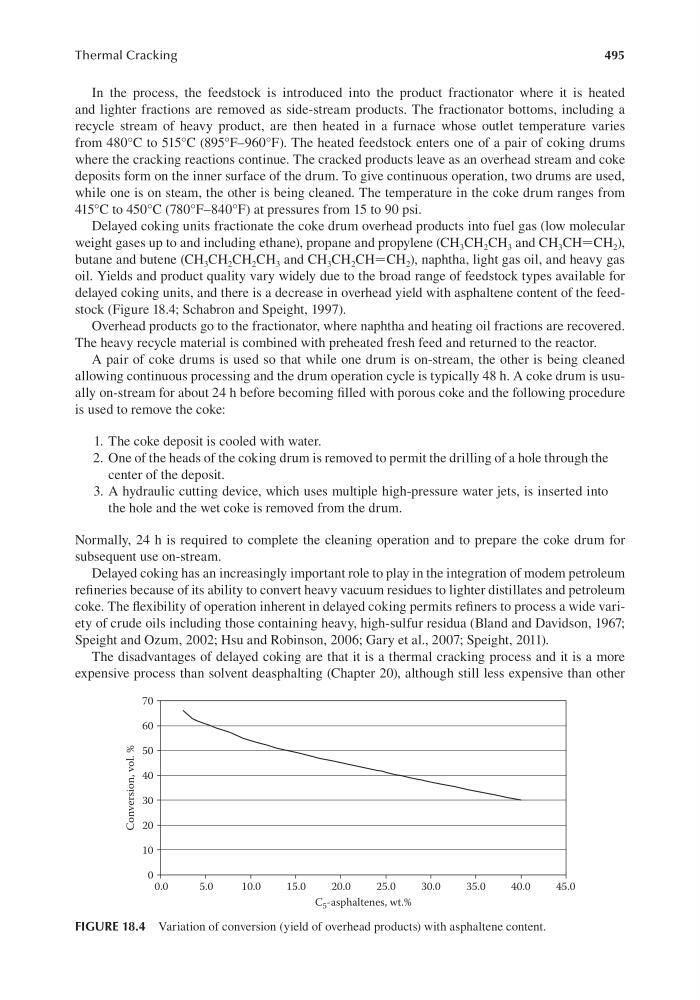
delayed coking units, and there is a decrease in overhead yield with asphaltene content of the feedstock (Figure 18.4; Schabron and Speight, 1997).
Overhead products go to the fractionator, where naphtha and heating oil fractions are recovered.
The heavy recycle material is combined with preheated fresh feed and returned to the reactor.
A pair of coke drums is used so that while one drum is on-stream, the other is being cleaned
allowing continuous processing and the drum operation cycle is typically 48 h. A coke drum is usually on-stream for about 24 h before becoming filled with porous coke and the following procedure
is used to remove the coke:
1. The coke deposit is cooled with water.
2. One of the heads of the coking drum is removed to permit the drilling of a hole through the
center of the deposit.
3. A hydraulic cutting device, which uses multiple high-pressure water jets, is inserted into
the hole and the wet coke is removed from the drum.
Normally, 24 h is required to complete the cleaning operation and to prepare the coke drum for
subsequent use on-stream.
Delayed coking has an increasingly important role to play in the integration of modem petroleum
refineries because of its ability to convert heavy vacuum residues to lighter distillates and petroleum
coke. The flexibility of operation inherent in delayed coking permits refiners to process a wide variety of crude oils including those containing heavy, high-sulfur residua (Bland and Davidson, 1967;
Speight and Ozum, 2002; Hsu and Robinson, 2006; Gary et al., 2007; Speight, 2011).
The disadvantages of delayed coking are that it is a thermal cracking process and it is a more
expensive process than solvent deasphalting (Chapter 20), although still less expensive than other
0
10
20
30
40
50
60
70
0.0
5.0
10.0
15.0
20.0
25.0
30.0
35.0
40.0
45.0
Conversion, vol. %
C 5 -asphaltenes, wt.%
FIGURE 18.4 Variation of conversion (yield of overhead products) with asphaltene content.