

493
Thermal Cracking
coil heater design now allow for the isolation of one or more passes through the heater for decoking,
thereby eliminating the need to shut the entire visbreaker down for furnace decoking.
The higher heater outlet temperature specified for a coil visbreaker is now viewed as an important advantage of coil visbreaking. The higher heater outlet temperature is used to recover significantly higher quantities of heavy visbroken gas oil through the use of the Wood’s technology. This
capability cannot be achieved with a soaker visbreaker without the addition of a vacuum flasher.
18.3.2.1 Delayed Coking
Delayed coking has been selected by many refiners as their preferred choice for bottom of the barrel
upgrading, because of the ability of the process to conveniently handle even the heaviest of residues
(Speight and Ozum, 2002; Elliott and Stewart, 2004).
The process provides essentially complete rejection of metals and precursors to term coke (precursors to Conradson carbon) while providing partial or complete conversion to naphtha and diesel. In
the past, many cokers were designed to provide complete conversion of atmospheric residue to diesel
and lighter, and today, several cokers still operate in this mode. However, most recent cokers have been
designed to minimize coke and produce heavy coker gas oil (HCGO) that is catalytically upgraded.
The economics of delayed coking are driven by the differential between transportation fuels and highsulfur residual fuel oil. The yield slate for a delayed coker can be varied to meet a refiner’s objectives
through the selection of operating parameters. Coke yield and the conversion of HCGO are reduced,
as the operating pressure and recycle are reduced and to a lesser extent as temperature is increased.
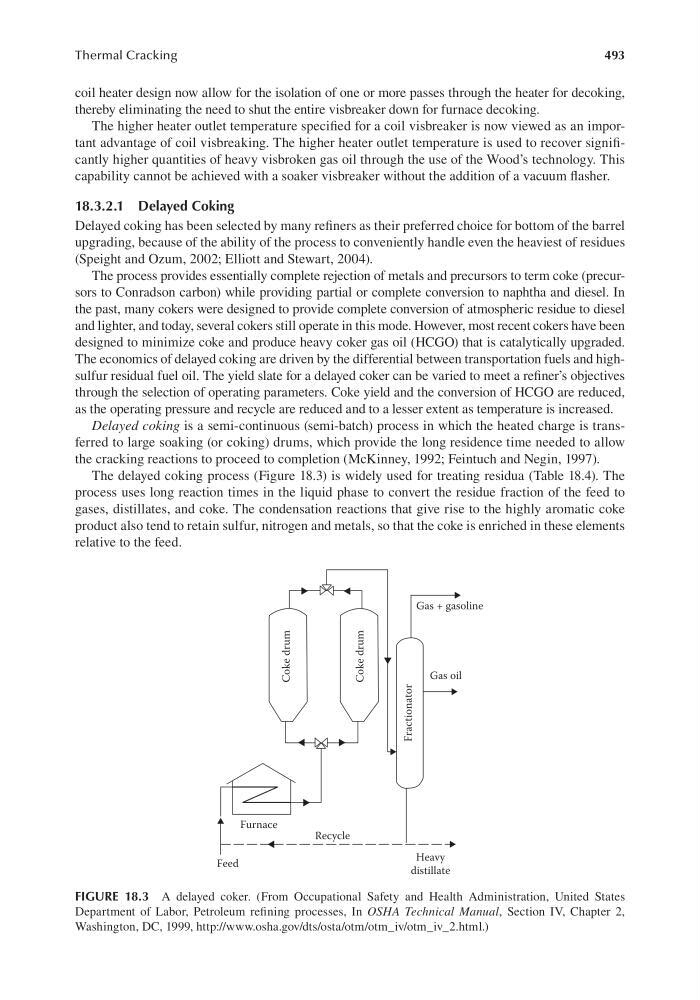
Delayed coking is a semi-continuous (semi-batch) process in which the heated charge is transferred to large soaking (or coking) drums, which provide the long residence time needed to allow
the cracking reactions to proceed to completion (McKinney, 1992; Feintuch and Negin, 1997).
The delayed coking process (Figure 18.3) is widely used for treating residua (Table 18.4). The
process uses long reaction times in the liquid phase to convert the residue fraction of the feed to
gases, distillates, and coke. The condensation reactions that give rise to the highly aromatic coke
product also tend to retain sulfur, nitrogen and metals, so that the coke is enriched in these elements
relative to the feed.
Gas oil
Fractionator
Coke drum
Coke drum
Gas + gasoline
Recycle
Furnace
Feed
Heavy
distillate
FIGURE 18.3 A delayed coker. (From Occupational Safety and Health Administration, United States
Department of Labor, Petroleum refining processes, In OSHA Technical Manual, Section IV, Chapter 2,
Washington, DC, 1999, http://www.osha.gov/dts/osta/otm/otm_iv/otm_iv_2.html.)