

25
History and Terminology
fraction has therefore been restricted to that of the n-pentane- or n-heptane-insoluble material
that dissolves in such solvents as benzene.
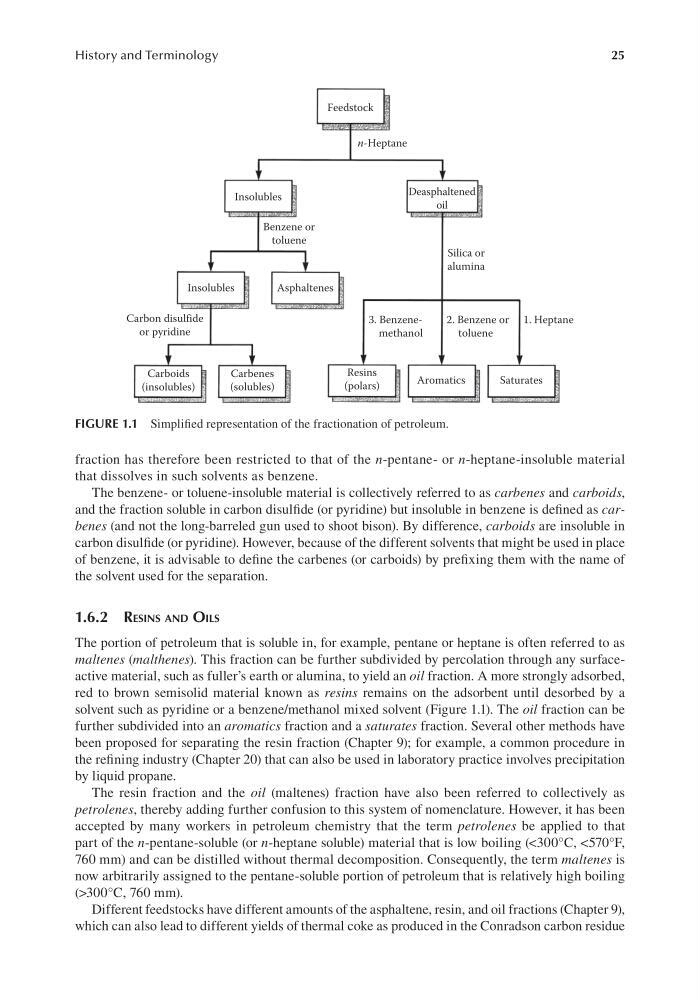
The benzene- or toluene-insoluble material is collectively referred to as carbenes and carboids,
and the fraction soluble in carbon disulfide (or pyridine) but insoluble in benzene is defined as carbenes (and not the long-barreled gun used to shoot bison). By difference, carboids are insoluble in
carbon disulfide (or pyridine). However, because of the different solvents that might be used in place
of benzene, it is advisable to define the carbenes (or carboids) by prefixing them with the name of
the solvent used for the separation.
1.6.2 resIns And oIls
The portion of petroleum that is soluble in, for example, pentane or heptane is often referred to as
maltenes (malthenes). This fraction can be further subdivided by percolation through any surfaceactive material, such as fuller’s earth or alumina, to yield an oil fraction. A more strongly adsorbed,
red to brown semisolid material known as resins remains on the adsorbent until desorbed by a
solvent such as pyridine or a benzene/methanol mixed solvent (Figure 1.1). The oil fraction can be
further subdivided into an aromatics fraction and a saturates fraction. Several other methods have
been proposed for separating the resin fraction (Chapter 9); for example, a common procedure in
the refining industry (Chapter 20) that can also be used in laboratory practice involves precipitation
by liquid propane.
The resin fraction and the oil (maltenes) fraction have also been referred to collectively as
petrolenes, thereby adding further confusion to this system of nomenclature. However, it has been
accepted by many workers in petroleum chemistry that the term petrolenes be applied to that
part of the n-pentane-soluble (or n-heptane soluble) material that is low boiling (<300°C, <570°F,
760 mm) and can be distilled without thermal decomposition. Consequently, the term maltenes is
now arbitrarily assigned to the pentane-soluble portion of petroleum that is relatively high boiling
(>300°C, 760 mm).
Different feedstocks have different amounts of the asphaltene, resin, and oil fractions (Chapter 9),
which can also lead to different yields of thermal coke as produced in the Conradson carbon residue
n-Heptane
Feedstock
Insolubles
Insolubles
Asphaltenes
Carbon disulfide
or pyridine
Deasphaltened
oil
Benzene or
toluene
Silica or
alumina
3. Benzenemethanol
2. Benzene or 1. Heptane
Saturates
Aromatics
Resins
(polars)
Carbenes
(solubles)
Carboids
(insolubles)
toluene
FIGURE 1.1 Simplified representation of the fractionation of petroleum.
History and Terminology
fraction has therefore been restricted to that of the n-pentane- or n-heptane-insoluble material
that dissolves in such solvents as benzene.
The benzene- or toluene-insoluble material is collectively referred to as carbenes and carboids,
and the fraction soluble in carbon disulfide (or pyridine) but insoluble in benzene is defined as carbenes (and not the long-barreled gun used to shoot bison). By difference, carboids are insoluble in
carbon disulfide (or pyridine). However, because of the different solvents that might be used in place
of benzene, it is advisable to define the carbenes (or carboids) by prefixing them with the name of
the solvent used for the separation.
1.6.2 resIns And oIls
The portion of petroleum that is soluble in, for example, pentane or heptane is often referred to as
maltenes (malthenes). This fraction can be further subdivided by percolation through any surfaceactive material, such as fuller’s earth or alumina, to yield an oil fraction. A more strongly adsorbed,
red to brown semisolid material known as resins remains on the adsorbent until desorbed by a
solvent such as pyridine or a benzene/methanol mixed solvent (Figure 1.1). The oil fraction can be
further subdivided into an aromatics fraction and a saturates fraction. Several other methods have
been proposed for separating the resin fraction (Chapter 9); for example, a common procedure in
the refining industry (Chapter 20) that can also be used in laboratory practice involves precipitation
by liquid propane.
The resin fraction and the oil (maltenes) fraction have also been referred to collectively as
petrolenes, thereby adding further confusion to this system of nomenclature. However, it has been
accepted by many workers in petroleum chemistry that the term petrolenes be applied to that
part of the n-pentane-soluble (or n-heptane soluble) material that is low boiling (<300°C, <570°F,
760 mm) and can be distilled without thermal decomposition. Consequently, the term maltenes is
now arbitrarily assigned to the pentane-soluble portion of petroleum that is relatively high boiling
(>300°C, 760 mm).
Different feedstocks have different amounts of the asphaltene, resin, and oil fractions (Chapter 9),
which can also lead to different yields of thermal coke as produced in the Conradson carbon residue
n-Heptane
Feedstock
Insolubles
Insolubles
Asphaltenes
Carbon disulfide
or pyridine
Deasphaltened
oil
Benzene or
toluene
Silica or
alumina
3. Benzenemethanol
2. Benzene or 1. Heptane
Saturates
Aromatics
Resins
(polars)
Carbenes
(solubles)
Carboids
(insolubles)
toluene
FIGURE 1.1 Simplified representation of the fractionation of petroleum.